
Finding the right slab flattening router bit is essential for achieving smooth spoilboard surfacing and accurate CNC plane work. The following selections cover a range of insert carbide designs, coatings, and shank sizes to suit different machines and workloads. Whether you’re resurfacing large slabs or fine-tuning joinery surfaces, these bits are designed to maximize tool life, reduce chatter, and deliver consistent cuts. Below is a quick overview of five top performers to help you choose the right fit for your workshop.
| Product | Shank | Diameter | Inserts | Coating |
|---|---|---|---|---|
| SpeTool 2+2 Flute Slab Flattening Bit | 1/4″ | 1-1/4″ | 2 edges per insert, replaceable | ATS Coating |
| SICWOOD Slab Flattening Bit | 1/2″ | 2″ | 6-Wing, 12+12 mm inserts | Unspecified |
| POWERTEC Slab Flattening Bit | 1/4″ | 2″ | 2 edges per insert; replaceable | Unspecified |
| BINSTAK Slab Flattening Bit | 1/2″ | 2″ | 3 or 4 edges per insert | Carbide inserts |
| MAILADA Slab Flattening Bit | 1/2″ | 1-3/8″ | 2+2 inserts | Titanium-coated |
SpeTool 2+2 Flute Slab Flattening Bit

The SpeTool slab flattening bit features a 1-1/4” cutting diameter with a 1/4” shank and a 2+2 inserts design. Its ATS-coated carbide inserts are optimized for long life, offering replaceable 4-edge carbide inserts to extend tool life by allowing edge rotation or swapping when dull. The 2+2 inserts layout helps balance cutting forces, reducing vibration on spoilboards and CNC sleds. This setup is well-suited for heavy-duty slab flattening on softwood, hardwood, and MDF. The ATS coating provides heat resistance, helping maintain sharpness during extended session runs. Aimed at shop floors that prioritize durability and cost-per-cut efficiency, this bit pairs well with upright planers and CNC spoilboard applications.
Key benefits include easier maintenance, because only the inserts are replaced rather than the entire bit, and improved longevity due to the ATS coating. For best results, monitor chip load and adjust feed rates to align with the 1-1/4” cutting diameter, ensuring clean surface finishing without scorch marks. In addition, having spare inserts on hand minimizes downtime when a edge becomes dull during longer projects.
SICWOOD Slab Flattening Bit, 2″ Diameter
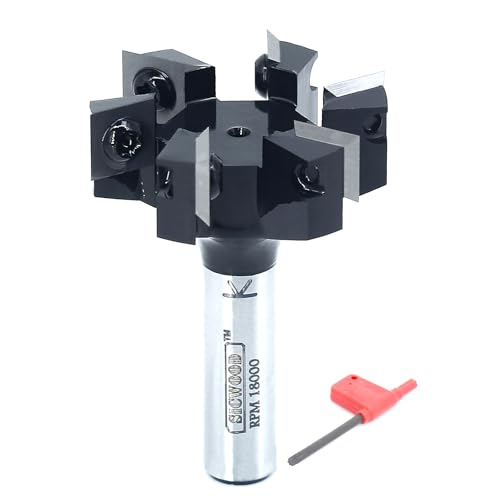
The SICWOOD insert-carbide router bit uses a 1/2″ shank and 2″ cutting diameter with a 6-wing design. It employs 12x12x1.5 mm carbide inserts and supports up to 18,000 RPM, making it suitable for CNC spoilboard surfacing and slab flattening tasks. The six-wing configuration contributes to smoother cuts and balanced removal, while the replaceable 4-sided carbide inserts offer cost efficiency and extended life. This bit is positioned as a versatile, high-precision choice for flattening large surfaces and achieving consistent plane finishes across softwood and hardwood projects. It integrates well with planers and wood shop CNC rigs requiring robust cutting action and straightforward maintenance.
Operating guidance emphasizes even feed rates and proper clamping to minimize deflection. The six-wing design helps reduce chatter when removing high spots, but users should ensure spindle speed aligns with insert geometry to preserve carbide edges. Replacement inserts are readily available or swappable, keeping downtime to a minimum on busy shop floors.
POWERTEC Slab Flattening Router Bit

The POWERTEC slab flattening bit uses a 2″ cutting diameter with a 1/4″ shank and a 1/2″ cutting depth. It features a solid hardened steel body with tungsten carbide-tipped cutting edges. The anti-kickback design provides smoother, controlled cuts, supporting precise spoilboard surfacing and planing. Its robust construction is meant for repeated use in professional woodworking scenarios and can handle large-area flattening tasks efficiently. The combination of carbide tips and hardened steel ensures sharpness retention and consistent performance, especially on CNC sleds and planer-like setups where flatness is critical.
When selecting this bit, practitioners should align feed rate and RPM with the blade geometry to maximize surface quality. The anti-kickback design helps maintain control in aggressive passes, while the 1/2″ cutting depth expands the bit’s versatility for varied spoilboard materials. This option is well-suited for users seeking durability without sacrificing precision on larger flattening operations.
BINSTAK CNC Spoilboard Surfacing Bit 1/4″ Shank

The BINSTAK 1/4″ shank model employs a 1-3/8″ cutting diameter with 2+2 carbide inserts. The bit is designed for efficient slab flattening with replaceable insert blades to prolong tool life. Its 4-sided carbide inserts yield extended edge life, and the 1/4″ shank makes it compatible with smaller machines and precision work. The insert blades provide cost-effective maintenance in comparison to full-bit replacements, matching professional shop needs for frequent use on spoilboards and large panels. The design emphasizes durability and consistent results for woodworkers requiring a dependable planing solution.
Users should consider the availability of spare inserts and edge rotation options to maximize uptime. The dual-edge setup supports smoother finishing across varying wood densities, while the light-to-moderate feed rates help prevent heat buildup on longer runs. Ideal for workshops that need a balance of longevity and performance in spoilboard surfacing and flattening tasks.
BINSTAK Slab Flattening Bit with 1-3/8″ Cut
This BINSTAK model features a 1/4″ shank and 1-3/8″ cutting diameter with 2+2 insert carbide design. The 12×12 mm inserts provide robust cutting edges, while the carbide insert design allows users to rotate or replace individual edges rather than the entire bit. This approach offers cost efficiency for frequent flattening tasks on spoilboards and wood surfaces. The combination of insert-based wear management and solid steel construction supports steady performance in demanding woodworking environments where large surfaces require even removal and minimal surface chatter.
When using this bit, plan for consistent chip load and maintain sharp inserts to ensure an even surface across the full width of the cut. The replaceable edges simplify maintenance cycles, making it a strong choice for shop floors that emphasize long-term tool economy and predictable results on slabs and spoilboard surfaces.
MAILADA Slab Flattening Bit, Titanium-Coated

The MAILADA slab flattening bit blends a 1/2″ shank with a 1-3/8″ cutting diameter and 2+2 titanium-coated inserts. The titanium coating enhances wear resistance and reduces friction for longer tool life in high-output settings. The 8-flute configuration, including four pre-installed inserts and four spare inserts, supports sustained cutting performance and easier maintenance. The included 1/2″ to 1/4″ router collet and screwdriver add convenience for setup and changes, making it a practical choice for shop floors running frequent spoilboard resurfacing and slab flattening tasks.
Considerations for this bit include the benefits of titanium coating for heat management and extended insert life, especially on aggressive passes. The 2+2 insert arrangement facilitates edge usage longevity, while the availability of spare inserts ensures downtime is minimized when maintaining a large workflow. It is suitable for users seeking a balanced combination of durability, cost efficiency, and versatile performance on various wood species.
Buying Guide: Key Considerations for Slab Flattening Router Bits
When selecting a slab flattening router bit, consider the following factors to match your setup and workflow:
- Shank size and machine compatibility: Most spoilboard and CNC setups accept 1/4″, 1/2″, or larger shanks. Confirm spindle and collet compatibility before purchasing.
- Cutting diameter and surface area: Larger diameters surface more quickly but require stable machines and proper workholding. Choose a diameter that balances finish quality with machine capability.
- Inserts vs. brazed blades: Insert carbide bits offer replaceable edges, reducing downtime and material waste. Brazed bits may be cheaper upfront but wear faster on heavy-duty tasks.
- Coating and wear resistance: ATS or titanium coatings improve heat resistance and tool life. Coatings are beneficial for long sessions and abrasive materials.
- Number of wings and cut geometry: More wings can yield smoother surfaces but may require different feed rates. 4-wing or 6-wing configurations are common; match to your material and machine.
- RPM and feed rate: Ensure your router or CNC can sustain the recommended RPM. Matching feed rate to tool geometry minimizes burn marks and ensures consistent flattening.
- Maintenance strategy: Availability of spare inserts and ease of replacement impact downtime. Bit designs that allow edge rotation extend tool life between changes.
- Material versatility: If you work with MDF, hardwood, softwood, and plywood, choose a bit designed for multi-material use with durable carbide inserts.
In summary, the best slab flattening bit depends on your machine’s capabilities, the required surface finish, and your preferred maintenance approach. Insert-based designs with durable coatings tend to offer the best balance of longevity and cost efficiency for most hobbyists and professional woodshops. Assess the above options against your typical projects to choose the most suitable bit for spoilboard surfacing and slab leveling.