
Answering the question “Which soil tester kit is best for my garden?” this guide identifies five solid options that cover different needs—from professional-style analysis to quick in-home checks. The ideal buyer ranges from casual home gardeners needing simple pH and basic nutrient checks to serious growers seeking detailed data for lawn, vegetables, and ornamentals. Read on to compare features, best-use cases, and potential limitations. A quick summary table follows to help you compare at a glance.
Product Comparison Summary
| Product | Best For | Key Benefit | Limitation |
|---|---|---|---|
| Rapitest Soil Test Kit (Luster Leaf) | Home gardeners who want quick pH and nutrient checks | Simple capsule system with color comparators; 40 tests total | Capsule-based may require careful handling for consistent results |
| MySoil Soil Test Kit | Lawn and garden owners seeking professional-level analysis | Lab-grade nutrient panel with 13 plant-available nutrients | Results in 6–8 days via mail-in analysis |
| Soil Test Kit 140 Tests (Dewilde) | Comprehensive home testing for accuracy and planning | All key nutrients plus ammonia in one kit | Liquid kit; may require setup and interpretation |
| NewTest 40 Tests Kit | Beginners and hands-on growers needing structured testing | 40 tests across four parameters with guided steps | Professional-grade promise; check for user-friendliness |
| SONKIR 3-in-1 Soil Tester | On-the-go testing for moisture, pH, and sunlight | No battery needed; quick three-parameter checks | Not suitable for precise chemical analysis |
Rapitest Soil Test Kit for Gardens, Vegetables, Flowers and Lawns
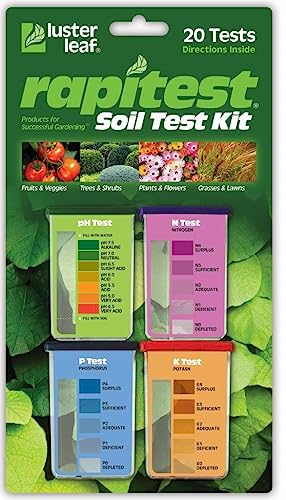
Best for: Home gardeners who want a quick, at-home read on soil pH and basic nutrients. This kit uses a capsule system and patented color comparators to provide 40 total tests—10 for each parameter: pH, Nitrogen, Phosphorus, and Potassium. It includes all components needed to test multiple spots in a single yard or garden. The approach is straightforward and inexpensive, making it a practical first step for beginners.
Why selected: Its simple, capsule-based design and clear color comparisons help users obtain reliable, repeatable results with minimal equipment. It works well for seasonal checks across lawns, flower beds, and vegetable plots. A potential limitation is the need for careful handling to avoid color interpretation errors and to ensure consistent sample placement.
MySoil Soil Test Kit

Best for: Lawn and garden owners who want a professional-grade, accurate soil analysis with actionable recommendations. The kit promises fast, precise data on 13 plant-available nutrient levels, including pH, which helps tailor soil amendments to specific crops or landscapes.
Why selected: It positions itself as a mail-in professional lab analysis, delivering deeper insight than typical home kits. Result turnaround is 6–8 days, which is reasonable for a detailed report. A limitation to note is the wait time for results, which may not suit quick planting deadlines or seasonal windows.
Soil Test Kit 140 Tests (Dewilde)

Best for: Gardeners who want a comprehensive, single-kit solution covering pH, ammonia, nitrogen, phosphorus, and potassium. This kit emphasizes a holistic view of soil health and supports diverse growing scenarios—from lawns to hydroponics.
Why selected: Consolidates significant nutrients and pH data into one kit, facilitating more informed fertilizer planning. A possible limitation is the reliance on liquid testing methods, which may require careful handling and interpretation, especially for beginners.
NewTest Soil Test Kit 4 Parameters

Best for: Beginners and hands-on growers who want a reliable, structured test across four key nutrients with straightforward use. The kit provides 40 tests—10 each for pH, Nitrogen, Phosphorus, and Potassium—designed to help gardeners become more confident in soil management.
Why selected: The emphasis on step-by-step instructions makes it approachable for new users while offering enough data density for practical fertilizer decisions. A limitation is that it claims professional-grade accuracy; users should follow the included guide carefully to maximize reliability.
SONKIR Soil pH Meter, MS02

Best for: Gardeners needing a compact, quick moisture and pH check along with light exposure evaluation. It is especially useful for in-ground or container setups where rapid adjustments are desired.
Why selected: A 3-in-1 tester that covers moisture, pH, and sunlight without batteries, offering immediate readings. A limitation is that it is not suitable for precise chemical analysis or lab-grade data; interpretation should be cautious for precise amendments.
YAMRON 4-in-1 Soil Moisture Meter

Best for: Gardeners who want a single device to monitor moisture, pH, temperature, and sunlight. This 4-in-1 tool is suited for ongoing plant care, seedling propagation, and general garden management.
Why selected: The combination of multiple measurements in one unit reduces gear clutter and provides a broader picture of plant needs. A potential drawback is reliance on an LCD with multiple readings; accuracy can vary with calibration and battery life if not used with included batteries.
Buying Guide: How to Choose The Right Soil Tester Kit
What type of test data do you need?
Choose a kit that matches your goals. For quick checks, a capsule-based or digital meter that covers pH and basic nutrients can be sufficient. For actionable fertilization plans, opt for kits offering a broad nutrient panel or mail-in lab analysis that reports plant-available nutrients.
How precise do you require the results?
Home kits vary from approximate readings to professional lab-grade analyses. If you grow high-value crops or manage a large lawn, professional-level tests or mail-in labs may provide the accuracy you need to optimize inputs and avoid waste.
How fast do you need the results?
In-house kits provide immediate results, ideal for on-the-spot watering and planting decisions. Lab-based analyses take days but yield deeper insights that can guide season-long strategies.
Ease of use and interpretation
Some products emphasize simplicity with color comparisons, while others require more steps to interpret results. Beginners should favor kits with clear instructions and guided recommendations, while experienced gardeners might prefer more detailed data outputs.
Maintenance and durability
Consider whether instruments require batteries, calibration, or special storage. Battery-free devices reduce maintenance concerns but may have fewer features. Digital meters may need occasional calibration but offer straightforward readouts.
What’s the best approach for your garden type?
Lawn and turf projects may benefit from broader nutrient panels and reputable lab analysis. Container gardens and small plots may be well-served by quick, easy-to-use in-home kits. Hydroponic setups often require precise electrolyte measurements and reliable pH control; check compatibility with your system before purchasing.
FAQ
- Q: Do I really need a soil tester? A: If you’re planning amendments or seedings, testing helps tailor inputs to your soil’s current needs, potentially saving time and resources.
- Q: What is plant-available nutrient value? A: It refers to nutrients that plants can uptake; some tests focus on total nutrients while others target plant-available levels for better accuracy in guidance.
- Q: Can I rely on home test kits for vegetable gardens? A: Yes, for general guidance and regular monitoring, but consider a lab test if you’re aiming for precise nutrient management for high-value crops.
- Q: How often should I test my soil? A: For established gardens, testing every 1–2 years is common; for new or changing crops, more frequent checks (seasonally) can be beneficial.
- Q: Are these kits suitable for hydroponics? A: Some kits measure soil parameters and may not apply to hydroponic media. Look for tests specifically designed for soil-less systems or hydroponics when applicable.
- Q: Do these kits replace lab testing? A: They provide actionable data for home gardening but may not replace the depth and precision of professional lab analyses in all scenarios.