
When water pressure runs too high, existing plumbing, appliances, and fixtures endure unnecessary wear and waste. A reliable water pressure reducing valve (PRV) helps protect systems, save water, and maintain consistent operation across residential, commercial, and industrial settings. This guide reviews five top PRVs, highlighting design features, installation considerations, and maintenance tips to help you choose the right model for your needs.
| Product | Brand | Size | Key Benefit |
|---|---|---|---|
| Watts LF25AUB-Z3 | Watts | 3/4″ | Corrosion-resistant, high-temp diaphragm |
| Zurn Wilkins 34-NR3XLDU | Zurn | 3/4″ | Compact with double union, easy repairs |
| Watts Backflow Preventer 3/4″ | Watts | 3/4″ | Thermal expansion protection, easy in-line service |
| Watts LFN45B Series | Watts | 1″ | Lead-free, inline serviceability |
| Cash Acme EB45 | Cash Acme | 3/4″ | Tamper-resistant, direct-access adjust screw |
The following selections are among the most compatible with American plumbing standards, featuring lead-free materials, adjustable output, and straightforward maintenance. Each entry below includes a concise look at its design and what kind of installation it suits best.
Watts LF25AUB-Z3 Water Pressure Reducing Valve

The LF25AUB-Z3 model from Watts reduces incoming pressure to protect plumbing systems and conserve water across commercial, industrial, and residential settings. It supports a broad incoming range of 25 to 75 psi (172 to 517 kPa) with a standard setting around 50 psi (345 kPa). Made from lead-free copper silicon alloy with a stainless steel strainer and corrosion-resistant adjusting and cage screws, the unit includes a high-temperature diaphragm and a replaceable seat module for long-term reliability. This valve is well-suited for utility rooms, basements, or outdoors where pressure spikes might occur.
Zurn Wilkins 34-NR3XLDU NR3XL 3/4″ Pressure Reducing Valve

This Zurn Wilkins NR3XLDU model emphasizes a short lay length and compact design for tight installations. It features a cartridge-loaded design that simplifies repairs and maintenance. The valve supports flexible tailpiece options, including threaded, PEX, copper sweat, and CPVC connections, making it versatile for varying plumbing setups in homes or small commercial spaces where space is at a premium.
Watts Backflow Preventer 3/4 Inch PRV

This Watts assembly combines a 3/4″ lead-free pressure reducing valve with a dependable backflow prevention design. It includes an NPT threaded union inlet and outlet, a removable stainless steel strainer, a thermoplastic seat, and a bronze-sealed spring cage, suitable for outdoor or pit installations. It also incorporates a thermal expansion bypass to manage pressure fluctuations caused by temperature changes, helping protect downstream fixtures and appliances from pressure surges.
Watts LFN45B Series 1″ PRV

The LFN45B series from Watts is a lead-free cast copper silicon alloy valve with a 1″ NPT thread union inlet and NPT female outlet. It features an elastomer disc, adjustable pressure from 25 to 75 psi, and a maximum allowable working pressure of 400 psi. The valve includes a removable stainless steel strainer, a thermoplastic seat module, a thermal expansion bypass, and a sealed spring cage for durability in waterworks pits. It is well-suited for larger residential systems or small commercial builds needing higher flow capacity.
Cash Acme EB45 Pressure Regulating Valve
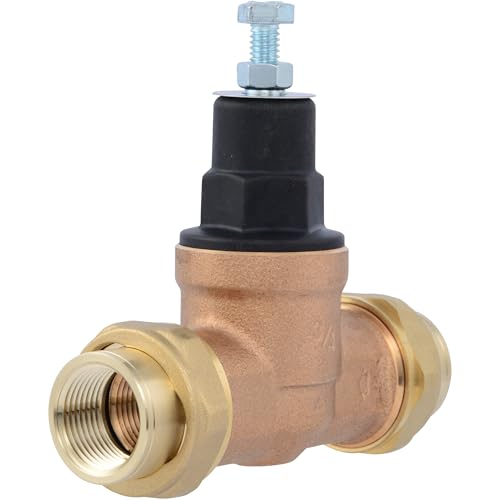
The Cash Acme EB45 inline regulator delivers a compact, tamper-resistant design with a half cartridge layout for quick access to the adjusting screw. It regulates downstream pressure in commercial and residential water systems and uses brass, stainless steel, and polymer components to resist corrosion. The 3/4″ NPTF double-union configuration supports straightforward installation and reliable, long-term operation in a variety of plumbing environments, making it a solid choice for preventive pressure management.
Buying Guide: Key Considerations For Choosing A PRV
- Flow capacity and size: Match valve size to your pipe diameter and expected downstream flow to avoid excessive pressure drop.
- Pressure range and adjustment: Look for a valve with adjustable settings within a typical 25–75 psi range, ensuring it can be finely tuned to your system.
- Materials and compliance: Prefer lead-free construction (for potable water) and NSF/ANSI compliance to meet health and safety standards.
- Installation environment: Consider compact designs for tight spaces, or inline/pit installations with bypass features for thermal expansion control.
- Maintenance and serviceability: Cartridge-loaded designs and replaceable seats simplify maintenance and reduce downtime.
- Backflow prevention: If required by local codes or risk assessment, choose PRVs with integrated or compatible backflow prevention.
- Durability under temperature variations: A high-temperature diaphragm and corrosion-resistant components extend service life in varied climates.
- Ease of integration: Ensure the chosen model supports common connections (NPT, unions, PEX, copper sweat, CPVC) used in your plumbing system.
When selecting a PRV, evaluate both current requirements and potential future changes to your water system. A slightly larger, adjustable valve often provides more flexibility and a longer service life as demand evolves. Regular testing and periodic inspection of seals, diaphragms, and bypass features help maintain consistent protection against pressure fluctuations and water hammer.