
Choosing an all-in-one solar charger inverter combines multiple power, charging, and storage functions into a single unit. This article reviews five prominent models to help American readers compare performance, versatility, and integration with different battery types. Each option blends an MPPT charger, a pure sine wave inverter, and a battery charger, with some offering UPS capabilities and parallel expansion for larger setups.
Summary of Selected Products
- LiTime 24V 3000W All-in-One Solar Inverter Charger
- SUNGOLDPOWER 5000W DC 48V All in One Solar Inverter Charger
- SUNGOLDPOWER 10000W 48V Solar Inverter (Built-in MPPT)
- ECO-WORTHY 3000W 12V Pure Sine Wave Inverter Charger
- LiTime 5000W Solar Hybrid Inverter Charger
LiTime 24V 3000W All-in-One Solar Inverter Charger

The LiTime 24V 3000W unit integrates an MPPT solar controller, inverter, and charger in one chassis, supporting 9000W surge for high-demand loads. It delivers pure sine wave output and includes an UPS mode for uninterrupted power. This model is compatible with lead-acid and lithium battery banks and supports multiple user modes, including MPPT First, Grid First, and Inverter First, to adapt to various energy policies and backup needs.
Key features include an LCD display for real-time system data, RS485 communication for monitoring, and robust protection during charging and discharging. It is designed for home energy storage and off-grid solar installations, with flexible battery configurations and seamless solar-to-load transfer. This inverter is suitable for users seeking a compact, all-in-one solution with UPS capability for critical circuits.
For users planning expansions, its 24V configuration aligns well with common battery formats, and the unit’s 60A MPPT controller helps harvest solar energy efficiently. The LiTime system emphasizes reliability and user-friendly diagnostics, making it a strong consideration for off-grid cabins, retrofits, or backup power systems in homes that prioritize continuous power.
SUNGOLDPOWER 5000W DC 48V All in One Solar Inverter

This 5000W all-in-one package combines an 80A MPPT solar charger with a 40A AC charger and a pure sine wave inverter for 120V output. It supports up to 5500W PV input capacity and is intended for backup and off-grid use. Note that this model does not support parallel connections, which affects scalability for larger homes or farms.
The unit offers multiple charging modes, including AC Priority, Solar Priority, Only Solar, and Hybrid modes, ensuring you can tailor charging behavior to weather, grid reliability, and battery state. Four output configurations—PV priority, utility priority, inverter priority, and hybrid—enable flexible power management across appliances, computing gear, and essential devices. This makes it a practical choice for households seeking reliable off-grid capability without complex expansion pathways.
Users should consider the need for parallel expansion in the future; since this unit cannot be paralleled, it remains a great fit for smaller or mid-sized setups where a single, reliable all-in-one is sufficient. The broad charging modes help optimize energy use when solar production varies seasonally or daily, reducing reliance on conventional electricity during outages.
SUNGOLDPOWER 10000W 48V Solar Inverter

This 10 kW inverter includes built-in dual MPPT controllers and supports up to 200A charging, offering a robust option for larger homes or workshops. It provides split-phase 120V/240V or single-phase 120V outputs, with WiFi and BMS communication to monitor status remotely. The unit is designed for high-demand loads with a maximum open-circuit PV voltage of 500V DC and protective features for over-voltage and over-current conditions.
Smart protections encompass PV input, battery, and AC input safeguards, with multiple charging/output modes to accommodate diverse energy strategies. The WiFi-enabled app access enables remote monitoring of inverter status, MPPT data, battery health, and load distribution. This model appeals to users planning substantial solar integration, multi-appliance backup, or industrial-style off-grid setups, while still fitting typical single- or two-phase residential configurations.
Consider parallel expansion if you anticipate needing even higher power, as this unit is designed to scale with additional inverters in compatible configurations. The combination of reliability, monitoring, and power reserve makes it suitable for households with high energy needs or for backup power during outages in harsh weather regions.
SUNGOLDPOWER 5000W UL1741 All-in-One With Parallel Kit

This 5000W all-in-one inverter includes a parallel kit allowing up to six units to run in parallel, enabling larger power rails and higher surge capacity—ideal for sizable homes, cabins, or multi-building setups. It supports 120V single-phase or 120/240V split-phase operation, plus options for 208V three-phase configurations when multiple units are paralleled. The base inverter provides a Pure Sine Wave output with a 110V nominal output and 4HP motor capability, matching a range of household appliances.
With 100A MPPT solar charging and a 40A AC battery charger, this model emphasizes scalable solar integration alongside dependable grid or off-grid operation. The parallel capability makes it a strong candidate for users planning substantial solar PV production, high daylight variability, and the need to consolidate multiple subsystems into a single, manageable solution.
SUNGOLDPOWER UL1741 5000W All-in-One With Parallel Kit
This UL1741-listed 5000W all-in-one unit provides a parallel kit for up to six inverters, enabling the creation of a 30 kW system. It supports 120V single phase, 120/240V split phase, and 208V three-phase operation when paralleled. The device delivers a pure sine wave output with a configurable charging strategy and comprehensive protection schemes, ensuring stable performance across backup and off-grid applications. It is well-suited for larger properties, workshops, or multi-unit dwellings that require scalable power infrastructure.
Potential buyers should weigh the complexity of parallel systems against their power needs and budget. While parallel expansion unlocks significant capacity, it also requires careful planning around wire sizing, battery management, and system monitoring. This model offers strong scalability with mature protection features and remote visibility via optional connectivity modules.
ECO-WORTHY 3000W 12V Pure Sine Wave Inverter Charger

The ECO-WORTHY 3000W 12V inverter charger combines a 3000W inverter with a 25–100A adjustable charger, delivering UPS functionality for uninterruptible power and grid-absent operation. It supports charging from both grid and solar sources and is compatible with a variety of 12V battery types, including LiFePO4, GEL, AGM, and other common chemistries. The device emphasizes compact installation, straightforward operation, and flexible charging currents to suit battery capacity and budget.
This model is practical for RVs, cabins, boats, and off-grid homes where a simple, reliable all-in-one solution is preferred. The adjustable charging current helps optimize battery longevity and charging time, while the UPS mode ensures loads experience minimal disruption during grid interruptions. It’s a straightforward entry point into mixed power sources for small to mid-sized energy setups.
LiTime 5000W Solar Hybrid Inverter Charger
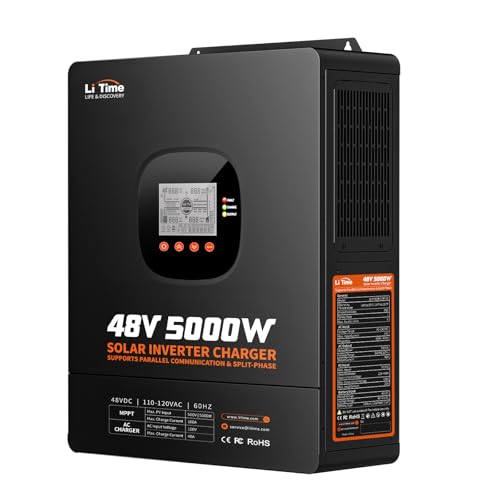
The LiTime 5000W solar hybrid inverter combines a 48V DC input, a 120V AC output, and an integrated 100A MPPT solar charger with UPS-like functionality. It supports parallel operation to reach up to 30 kW, enabling large, resilient backup power for homes or farms. The system is designed for split-phase operation, offering both 120V and 240V outputs in parallel arrangements and a user-friendly LCD display to monitor PV, battery, and load conditions in real time.
Smart energy management includes PV-only and hybrid modes, enabling PV-first or mixed power strategies that maximize sunlight utilization while preserving battery health. The ability to run multiple units in parallel makes it a scalable option for expanding off-grid or backup power across larger properties, while retaining straightforward control and diagnostics for everyday use.
Overall, these all-in-one solar charger inverters provide robust options across small to large energy setups. When selecting, consider battery chemistry compatibility, the need for parallel operation, UPS requirements, and the level of remote monitoring you prefer. The following buying guide highlights critical considerations and how to compare these models effectively.
Buying Guide: Key Considerations For All-In-One Solar Charger Inverters
Power and Surge Capacity
Match inverter continuous power (W) and surge capacity to the loads you plan to run. High-wattage appliances like HVAC, ovens, and motor-driven devices demand robust surge support. If planning to expand, prioritize models that offer parallel expansion with compatible controllers and battery banks.
Battery Compatibility
Check which battery chemistries are supported (lead-acid, LiFePO4, lithium-based). Some inverters support user-customizable battery modes and provide battery health monitoring, which helps maximize lifespan and reliability in off-grid or backup scenarios.
Charge Control And MPPT
MPPT efficiency improves solar energy capture, particularly under fluctuating conditions. Ensure the MPPT current rating aligns with your solar array size and that the controller can handle the anticipated PV input voltage and temperature conditions.
UPS And Load Management
Uninterruptible power supply (UPS) features minimize downtime for essential circuits. Evaluate how quickly the transition occurs, which loads are prioritized, and how the system handles grid outages versus solar charging during a blackout.
Monitoring And Connectivity
Remote monitoring via WiFi or RS485 can simplify management. Apps or web interfaces help track battery state, MPPT performance, and energy flows, enabling informed decisions about charging schedules and load shifts.
Expandability And System Design
Consider whether you may need to add more inverters or parallel multiple units. Systems that scale well are advantageous for expanding solar capacity, generator integration, or multi-building setups, but require careful wiring and management.