
For compact workshops, a reliable planer is essential to produce even thickness and clean edges. This guide highlights five compact planers that suit small shops, hobbyists, and weekend woodworkers. The selections balance power, versatility, and portablility to help you choose the right tool for your space. Each product is evaluated for who it’s best for, what it excels at, and a practical limitation to consider. The summary table below compares core attributes to aid quick decisions.
| Product | Best For | Key Benefit |
|---|---|---|
| DEWALT DW735X | Shop with bigger projects | Three-knife cutter head for longer life |
| WEN PL1252 | Medium to larger boards | Two-blade setup with solid capacity |
| WEN 6530 | Versatile small projects | Multiple depth stops and rabbeting |
| WEN 6528 | Lightweight, portable jobs | Very light, easy to handle |
| DEWALT DCP580B | Cordless flexibility | Brushless motor, battery-powered |
DEWALT DW735X 13-Inch Thickness Planer

The DEWALT DW735X is a 13-inch wood planer with a powerful 15-amp motor and 20,000 RPM cutterhead speed, designed for larger cuts in wider materials. It features a three-knife cutter head that contributes to longer knife life and faster knife changes, making it better for frequent planing tasks in a home shop. A two-speed gear box lets users optimize feed speed for different cut counts per inch (CPI). Best for: shops tackling thicker boards or wider stock where efficiency and longer blade life matter. Caution: two-speed gearing adds complexity; ensure proper setup for optimal results.
WEN PL1252 15-Amp 12.5-Inch Thickness Planer

The WEN PL1252 offers a 12.5-inch width capacity and a 15-amp motor delivering up to 20,000 cuts per minute. It comes with two reversible blades for solid edge quality and long blade life. Best for: moderate-width boards and projects that benefit from a stable, higher-capacity bench planer. Caution: weight and footprint are larger than mini models, so ensure enough bench space.
WEN 6528 3.8-Amp Electric Hand Planer

The WEN 6528 is a compact hand planer with a 3.8-amp motor and a cutting depth range from 0 to 1/16 inch, offering up to 32,000 cuts per minute. Weighing roughly 4.3 pounds, it is designed for lighter, precise shaping and molding tasks. Best for: small trim work or hobby projects where portability is key. Caution: lower power limits heavy stock removal; use on softer woods for best results.
JORGENSEN No.101 Mini Wood Planer

The Jorgensen No.101 Mini Wood Planer provides a professional blade and a ductile iron body designed for durability in small, detail-focused work. Its adjustable cutting depth supports fine shaping and trimming for intricate projects. Best for: precision work in compact spaces or as a secondary tool for edge finishing. Caution: this is a mini planer; expect slower throughput on thick stock.
DEWALT 20V MAX Planer (Bare Tool)

This cordless DEWALT DCP580B 20V MAX planer operates with a brushless motor for efficiency and runtime, delivering up to 30,000 cuts per minute and a maximum depth of 5/64 inch. Best for: shop setups needing cordless flexibility or tighter, on-site work where a corded option isn’t practical. Caution: being a bare tool, you’ll need compatible batteries and charger.
VEVOR 13-Inch Spiral Thickness Planer
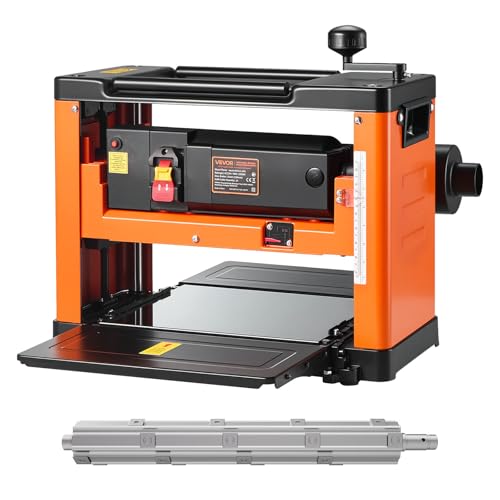
The VEVOR 13-inch spiral thickness planer uses a 2000W motor and 24 spiral blades to reduce noise and deliver smooth edges on hardwoods. It features dual-roller feeding to minimize snipe and a large worktable for long boards. Best for: users who need a robust benchtop unit with long-board capacity. Caution: bulky weight may limit portability in smaller spaces.
Buying Guide
What should you consider when buying a small-shop planer?
- Board size you plan to plane: choose width and thickness capacity that matches your typical stock.
- Power source: corded models offer consistent performance; cordless models add mobility.
- Cut quality and blade life: fixed-knife vs. spiral or multi-knife heads impact finish and replacement intervals.
- Footprint and weight: ensure your bench or workspace accommodates the unit and allows safe operation.
- Depth of cut and feed speed: higher CPI and adjustable depths help tailor results for different woods.
Frequently Asked Questions
- What is the advantage of a two-speed planer?
– It allows optimizing feed rate for better cuts per inch, especially on varying wood densities. - Are cordless planers as powerful as corded ones?
– Cordless models offer portability but may have shorter runtimes and slightly lower continuous stock removal. - What blade type is best for hardwoods?
– Spiral or high-quality carbide knives typically provide smoother finishes on hardwoods. - How do I avoid snipe on a benchtop planer?
– Use proper bed supports, feed boards, and consistent board placement; many planers include snipe-reduction features. - Is a mini planer sufficient for hobby work?
– Yes for detail work, trimming, and small projects; not ideal for large boards or heavy stock removal.