
Programmable light switches offer precise control over when lights and motor loads operate, helping you save energy, enhance security, and add convenience to daily routines. This guide highlights five top options, spanning solar-powered timers, digital in-wall timers, and Wi‑Fi-enabled smart switches. Each entry summarizes key features, compatibility and typical use cases to help you pick the right switch for your home.
| Product | Brand | Key Use | Power/Compatibility |
|---|---|---|---|
| ECONOswitch 7-Day Solar Programmable Switch | Honeywell Home | General lighting and motors, indoor/outdoor | 1800W, ¾ HP, 120V |
| SunSmart Digital In-Wall Timer | GE | Daily ON/OFF with sunrise/sunset presets | Switch with neutral; LED/CFL/incandescent |
| myTouchSmart In-Wall Digital Timer | myTouchSmart | 4 programmable On/Off + override buttons | Indoor/outdoor lights, fans; 24-hour cycles |
| BN-LINK 7 Day Programmable Timer | BN-LINK | Versatile on/off scheduling; 3-way capable | Single-pole/3-way; neutral required |
| Leviton VPT24-1PZ Astronomical Timer | Leviton | Astronomical clock, flexible weekly schedules | Single-pole/3-way; neutral required |
Below is a closer look at each option, with practical notes to help you compare installation requirements, scheduling capabilities and automation potential.
Honeywell Home ECONOswitch 7-Day Solar Programmable Switch

The ECONOSwitch provides 7-day solar programming for lights and motor loads. It supports scheduling to automate lights and motors, contributing to energy savings and time management. It can control multiple devices—up to 1800W or ¾ HP on a 120V line—making it suitable for ceiling fans, pumps, and general lighting across interior and exterior installations. A simple, timer-based approach helps reduce unnecessary usage without requiring a hub or cloud connectivity.
GE SunSmart Digital In-Wall Timer
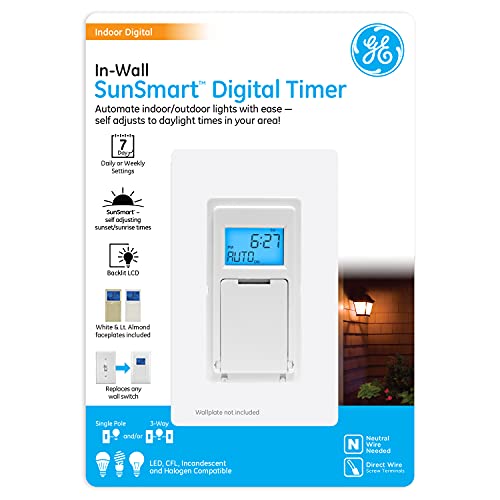
GE’s SunSmart timer features sunrise/sunset presets that adjust with the seasons, enabling automatic lighting schedules aligned to daylight. It supports weekly programming with up to seven ON/OFF programs and includes a security feature that randomizes times by up to 30 minutes for a lived-in appearance. This makes it a strong option for exterior lighting or security-conscious interior setups, and it supports LED, CFL and incandescent fixtures with a neutral wire.
myTouchSmart In-Wall Digital Timer

The myTouchSmart timer offers four programmable On/Off buttons plus two motorized override functions, designed for quick manual control when needed. It supports 24-hour daily cycles and blue LED indicators show active programs. It’s compatible with a range of bulb types including dimmable LED/CFLs, and it includes a battery backup to preserve settings during outages, making it suitable for indoor and outdoor lighting setups that require reliable automation.
BN-LINK 7 Day Programmable Timer

BN-LINK’s 7-day timer supports up to 18 On/Off programs with flexible 7-day scheduling. It offers AUTO and MANUAL modes and features a backup battery to retain settings during power outages. A daylight saving option helps adjust timing automatically, while a “Random” vacation mode makes lights appear active during trips away from home, boosting security and curb appeal without extra hardware.
Leviton VPT24-1PZ Astronomical Timer
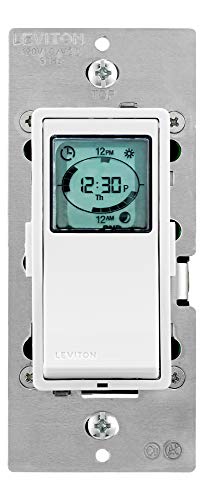
The Leviton VPT24-1PZ uses an astronomical clock that automatically adjusts to local sunrise and sunset, a feature that minimizes manual programming across seasons. It allows up to 49 ON/OFF events and supports randomization for security. It’s designed for both single-pole and 3-way installations, with neutral wire required. This makes it versatile for living room lighting, exterior porch lights, and other motorized loads where timing needs align with natural light cycles.
Buying Guide: Key Considerations for Programmable Light Switches
- Scheduling capabilities: Determine whether you need daily, weekly, or custom multi-program schedules. Some models include sunrise/sunset or astronomical timing for automated seasonal adjustments.
- Load compatibility: Check maximum wattage, horsepower rating, and whether the switch handles motors (e.g., fans, pumps) in addition to lighting.
- Wiring requirements: Some switches require a neutral wire and a stable 2.4 GHz network for smart features; others are standalone timers with no network dependency.
- Connectivity vs. standalone: Decide if you want a hub-free timer (no internet) or a Wi‑Fi/Smart app-enabled switch for remote control and voice assistants.
- Security and realism features: Randomized timing modes (vacation mode) and randomization help simulate occupancy to deter burglars when you’re away.
- Installation versatility: Look for single-pole or 3-way compatibility, as well as compatibility with LED, CFL, incandescent, and dimmable lighting.
- Ease of use: Programs should be intuitive, with clear labels and straightforward backup options to preserve settings during outages.
Note: When selecting a programmable switch, match the device to your specific lighting or motor-load needs (indoor vs. outdoor use, single-pole vs. 3-way circuits) and verify that your home’s wiring supports the switch’s requirements.