
Finding a reliable non-contact voltage tester is essential for electrical work, whether you’re a professional electrician or a DIY homeowner. The right tester quickly detects live electrical lines, helps identify wiring problems, and reduces the risk of shocks. This guide highlights five top-rated non-contact voltage testers, covering models with broad voltage ranges, bright indicators, built-in flashlights, and extra features like GFCI testing compatibility. Read on to compare key capabilities and determine which tester best fits your typical projects and safety needs.
Summary of selected products

- KAIWEETS Voltage Tester/Non-Contact Voltage Tester — 12V/70V-1000V, LCD display, dual range
- Klein Tools NCVT1P Voltage Tester — 50V to 1000V AC, audible and LED alarms
- Klein Tools NCVT3P Dual Range Non-Contact Voltage Tester — 12-1000V AC, flashlight
- Klein Tools NCVT-4IR Non-Contact Voltage Tester — 12-1000V AC with IR thermometer
- Fluke 2AC Alert Voltage Tester — non-contact detection 90-1000 V AC with Voltbeat technology
KAIWEETS Voltage Tester: Dual Range 12-1000V AC
The KAIWEETS non-contact voltage tester combines versatility with clear, intuitive readings. It uses an NCV inductive probe to detect AC voltage near terminals, outlets, or supply cords. An LED indicator illuminates red for live voltage and green for null or low voltage, while a red light and audible alert increase with voltage level and proximity to the source. The device supports dual voltage ranges (12-1000V AC and 70-1000V AC) to accommodate sensitive circuits like doorbells or thermostats. A configurable sensitivity button allows users to tailor detection for various tasks. The LCD bar graph and percentage display provide a quick sense of signal strength in real time.
Key features include:
- Non-contact voltage detection with NCV inductive probe
- Live/Null wire indication via color and audible alerts
- Dual range detection for standard and low-voltage applications
- LCD display showing voltage signal strength as a percentage
- Automatic live/neutral recognition and user-adjustable sensitivity
Klein Tools NCVT1P: Basic Non-Contact Voltage Tester

The Klein NCVT1P offers dependable non-contact AC voltage detection in a compact pen form. It indicates operation with a green LED and emits a beeping alert when voltage is detected. The tester covers a broad 50V to 1000V AC range, enabling quick checks on typical household circuits, wiring, outlets, and breakers. Its pocket-friendly design makes it ideal for everyday use on service panels, switches, and lighting fixtures, providing clear cues without requiring direct contact with live components.
Representative features include:
- Non-contact AC voltage detection across 50-1000V
- Green operational indicator and red audible alarm on voltage presence
- Compact, pocket-ready design for easy everyday carry
Klein Tools NCVT3P: Dual Range Voltage Tester

The NCVT3P adds versatility with a dual-range measurement suitable for broader professional use. It detects non-contact voltage from 12 to 1000V AC and includes a bright flashlight to illuminate work areas, particularly in dim environments or interior panels. Visual and audible indicators provide simultaneous feedback, helping technicians confirm voltage presence quickly while reducing misreads. The device is designed for durable field use with a pocket clip for convenient attachment during inspections and repairs.
Highlights include:
- Non-contact detection across 12-1000V AC ranges
- Audible alert plus bright LED indicators
- Integrated flashlight for low-light tasks
- Pocket clip for hands-free carrying
Klein Tools NCVT-4IR: Non-Contact Voltage Tester with IR Thermometer

Designed for HVAC and broader applications, the NCVT-4IR combines non-contact voltage testing with an infrared thermometer. It detects AC voltage from 12 to 1000V and provides clear visual and audible indicators. The infrared thermometer enables fast surface temperature checks, helping identify overheating components or electrical hotspots. The tool is compact and features a pocket clip, making it suitable for service calls and fieldwork where quick voltage checks and temperature readings are needed.
Notable capabilities include:
- Non-contact voltage detection 12-1000V AC
- IR thermometer for temperature readings from -22 to 482 F
- LED and audible alarms for voltage presence
- Portable with clip for easy carrying
Klein Tools RT250KIT: Voltage and GFCI Receptacle Tester
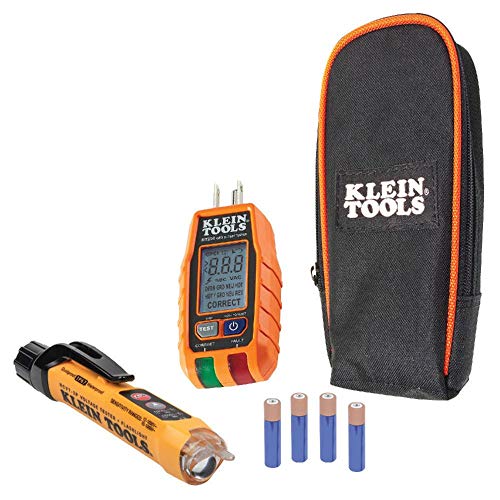
The RT250KIT bundles a non-contact voltage tester with a GFCI receptacle tester and uses an LCD readout to display voltage conditions. The kit helps identify wiring faults and improper GFCI functionality, making it a practical choice for electricians who need to troubleshoot outlets and circuits efficiently. The compact tools integrate well into a single testing workflow, reducing the need to switch devices during job sites.
Key features include:
- Non-contact voltage detection across standard ranges
- GFCI testing with a dedicated receptacle tester
- Clear LCD readout and wiring fault detection
Fluke 2AC Alert Voltage Tester

The Fluke 2AC Alert combines Voltbeat technology with continuous self-test to ensure reliability. It provides non-contact voltage detection from 90 to 1000 V AC and includes a tip glow for immediate voltage indication. Fluke’s reputation for rugged test tools makes the 2AC a favored choice for professionals who require dependable indicators and regular self-checks, especially in busy job sites where tool readiness matters.
Important aspects include:
- Non-contact detection 90-1000V AC
- Voltbbeat self-test for ongoing reliability
- Tip glow and audible alert on voltage presence
Buying Guide: Key Considerations When Choosing a Non-Contact Voltage Tester
- Voltage range and sensitivity: Choose a tester that covers your common working voltages. Dual-range models offer flexibility for low- and high-voltage tasks, while single-range units can be more affordable and compact.
- Inductive probe quality: A reliable NCV probe should detect voltage without requiring contact and provide clear indicators (audible, visual, or both).
- Indication methods: Look for testers with a combination of LEDs, beeps, and a readable LCD or bar graph. Red indicates live voltage, while green often signals safe or null wiring.
- Additional features: Integrated flashlight, IR thermometer, or GFCI testing compatibility can expand a tester’s usefulness for specific jobs.
- Durability and ergonomics: Field tools should be lightweight, easy to carry, and robust enough for rough environments. Pocket clips and compact form factors help with handling on ladders and in panels.
- Safety certifications and brand reliability: Choose models from established brands with proven safety records to minimize false readings and ensure consistent performance.
- Price vs. value: While premium models offer extra features, many users will find essential accuracy and reliability in mid-range devices suitable for routine tasks.
When selecting a tester, consider your typical electrical environments, whether you often work with HVAC or electronics, and how often you need features like temperature readings or GFCI testing. A single device with broad voltage detection and clear indicators can handle most residential and commercial tasks, while specialized models excel in professional service environments.