
Choosing a hybrid solar charger inverter can simplify off-grid and backup power setups. This guide highlights five high‑performing models that combine solar charging, an inverter, and battery management in a single unit. Each option supports battery‑less or battery-backed configurations, pure sine wave output, and various MPPT charging capabilities to maximize solar yield. Use the summary table below to compare core specs at a glance.
| Product | Brand | Rated Inverter Power | MPPT Range | Battery Compatibility | Special Feature |
|---|---|---|---|---|---|
| SUMRY Solar Inverter Charger 3600W | SRGFTS | 3600W | 60V-500VDC | AGM/Lithium/LifePO4 | Built‑in 120A MPPT |
| SUMRY Hybrid Solar Inverter 4000W | SRGFTS | 4000W | Up to 5600W PV | Battery-Less or AGM/Lithium | Glass top LCD, 140A MPPT |
| LiTime 5000W Solar Hybrid Inverter | Litime | 5000W | PV plus battery input (MPPT) | Lithium/Lead-Acid | Parallel up to 6 units |
| SUNGOLDPOWER 10000W 48V | SGPWATT | 10000W | Open Circuit up to 500V | Multiple (Lithium/Lead-Acid) | WiFi + BMS, 2 MPPT |
| ECO-WORTHY 2560Wh Station | ECO-WORTHY | 3500W | PV/Hybrid modes | 48V LiFePO4 | Smart charge/discharge modes |
Remember to verify compatibility with your existing battery bank, local grid rules, and the appliances you plan to run. The right model balances inverter power, MPPT efficiency, and expandability for future solar additions.
Best Hybrid Inverter: Sumry 3600W Inverter Charger

The SUMRY 3600W Inverter Charger provides a unified power solution with 3600W continuous inverter power and a built‑in 120A MPPT solar charger. It supports 24V battery systems and can operate with or without a battery. The unit accepts a wide PV input range (60V-500V) and up to 4200W PV input power, offering flexible solar configurations. It is suitable for home energy systems that demand reliable power with clean pure sine wave output for sensitive electronics.
Key features include a robust peak capacity of 7200W, compatibility with AGM, Gel, Lead-Acid, and LiFePO4 batteries, and the option to run loads directly from PV power when batteries are not present. The system can work with various battery technologies, which is beneficial for users transitioning to solar storage or optimizing existing setups.
Sumry Hybrid Solar Inverter 4000W

This hybrid inverter features a 4000W rated output with an impressive 8000W peak, a glass top with a 6.25-inch LCD display, and a built‑in 140A MPPT charge controller. It supports PV inputs up to 350VDC and up to 5600W PV input capacity. The pure sine wave output ensures stable operation for sensitive electronics, while the glass cover adds a premium touch and durability. It excels in battery‑less or AGM/Lithium configurations, enabling users to harness solar power directly when available.
Users should consider real-time data visibility via the LCD and the overall efficiency of the MPPT stage to maximize daily solar production. The unit’s charge controller and inverter are designed for reliable off‑grid or backup power in homes with variable solar conditions.
LiTime 5000W Hybrid Inverter Charger
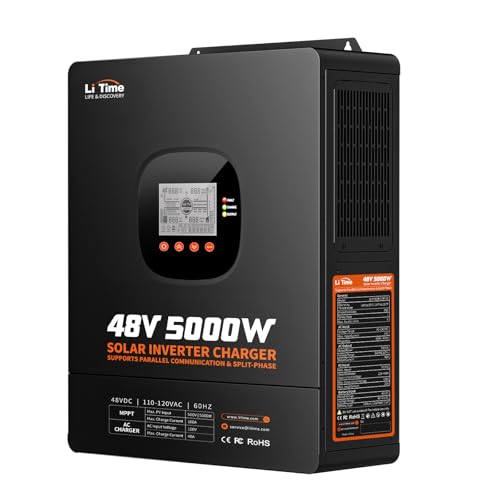
The LiTime 5000W inverter combines a 5000W inverter with a built‑in 100A MPPT solar charger and supports 240V split‑phase output through parallel configurations. It includes a user-friendly LCD to monitor performance and can operate with 48V lithium or lead‑acid batteries, or a user-defined mode. Parallel capability enables up to six units, delivering up to 30kW total output, which is ideal for larger backup systems or commercial-grade off‑grid applications.
Smart energy management features multiple output modes (Inverter Priority, PV Priority, Utility Priority, Mix Load) and two charging modes (PV‑Only and Hybrid). This flexibility helps maintain continuous power during outages and optimizes PV utilization when grid conditions vary.
SUNGOLDPOWER 10000W 48V Inverter With Dual MPPT

This 10kW inverter from SUNGOLDPOWER combines a 48V DC input with dual MPPT solar controllers and a built‑in battery charging capacity up to 200A. It supports 120V/240V split phase or single-phase 120V output, and includes a WiFi module for remote monitoring. With a high open-circuit voltage tolerance and multiple protection schemes, it is suitable for larger home systems, workshops, or small businesses relying on solar power. The four charging/output modes provide flexibility for various energy strategies, including solar-first and grid‑hybrid configurations.
When sizing for a home setup, ensure the simultaneous load does not exceed the inverter’s capacity, and account for the possible parallel expansion to meet higher power demands. WiFi connectivity enables proactive maintenance and performance tracking.
SUNGOLDPOWER 10000W 48V UL1741 Inverter (Parallel Ready)
This variant mirrors the earlier SUNGOLDPOWER 10kW model, featuring UL1741 certification, built‑in 200A charging, and parallel capability for adding units up to a larger system. It offers the same 120V/240V options, a WiFi module for monitoring, and the four_output_mode logic to tailor power delivery to loads. The device is designed for reliability in off-grid or hybrid grid environments with robust protection features to safeguard both equipment and users.
Opt for this option if you anticipate expanding your array or need a scalable solution for a larger household or small business using solar energy as a primary power source.
SunGoldPower 5000W UL1741 Inverter

The 5000W DC 48V SunGoldPower unit provides a compact yet capable hybrid solution with 100A MPPT solar charging and a 40A AC battery charger. It supports parallel configurations up to six units, enabling higher total output and improved surge capacity. The inverter delivers a clean Pure Sine Wave 110V output suitable for household and office loads, with overload protection to safeguard appliances during peak demand. Parallel operation expands system resilience and load handling.
This model is well-suited for users seeking a scalable, modular approach to solar backup with straightforward integration into existing solar PV systems and a steady supply of clean power during outages or grid interruptions.
Buying Guide: Key Purchase Considerations and Comparisons
- Power rating and surge capacity: Match inverter continuous power to your essential loads plus a margin for startup surges. If you run HVAC, water heaters, or refrigeration, prioritize higher continuous and peak ratings.
- Battery compatibility: Confirm whether the inverter supports your battery chemistry (LiFePO4, Li‑ion, AGM, Gel, Lead‑Acid) and voltage (24V, 48V, etc.).
- MPPT performance: Look for higher MPPT current and broader PV input voltage ranges to improve solar harvest, especially under partial shading or varied sun angles.
- Paralleling capability: If planning to scale, choose models that allow multiple units in parallel to reach higher total power while maintaining synchronization.
- Efficiency and heat management: Higher efficiency reduces energy losses; check cooling methods and ambient operating temperatures to avoid throttling in hot weather.
- Monitoring and connectivity: WiFi or app-based monitoring helps track battery state, solar input, and load in real time, enabling better energy management.
- System design: Decide between battery‑less operation (PV powers loads directly when possible) versus battery-backed operation for true backup power and UPS behavior during outages.
- Safety certifications and warranties: Verify UL1741/CSA approvals where applicable and review manufacturer warranties for long‑term reliability.
- Installation and space: Some units are compact and wall‑mountable, while others require more space for heat dissipation and venting. Plan cord lengths and mounting location accordingly.
When evaluating options, create a load plan listing essential devices and estimated wattage. Compare not only the peak output but also the continuity of support during simultaneous appliance use. Consider future expansion—paralleling units can significantly raise total system capacity, but ensure the electrical infrastructure (cable sizes, protection devices) is capable of handling the combined load.