
The right HVAC vacuum gauge helps technicians verify deep vacuums, monitor pressure changes, and ensure refrigerant systems are leak-free. This guide highlights five reliable options, covering digital readouts, temperature compensation, alarms, and multi-unit measurements. Each product section includes a quick overview, key features, and practical considerations to help you choose. All selections emphasize accuracy, durability, and ease of use in field conditions, from tight spaces to outdoor environments.
| Product | Brand | Key Benefit |
|---|---|---|
| CPS VG200 Digital Vacrometer | CPS | High accuracy with NIST calibration and self-cleaning sensor |
| CPS-AO-42500-08 VG200 Portable | CPS | Compact electromechanical gauge for quick checks |
| Fieldpiece MG44 | Fieldpiece | Wireless micron readings with Job Link compatibility |
| Digital Vacuum Gauge HVAC (RALBIL) | RALBIL | Auto-calibration, 4 units, buzzer alert |
| Super Stars ST-VG90 | Super Stars | High-accuracy Pirani sensor with multiple units |
CPS VG200 Digital Vacrometer Vacuum Gauge

The CPS VG200 provides precise vacuum measurements across multiple units, including microns, millibar, TORR, and inches of mercury. It features a 5-digit LCD display and automatic temperature compensation, improving accuracy in varying job-site conditions. A self-heated thermistor bridge enhances stability, while a padded case helps protect the instrument during transport. The sensor is designed to withstand up to 400 PSI of positive pressure, making field cleaning and maintenance practical. Calibration under strict NIST standards supports reliable performance for critical evacuations.
CPS-AO-42500-08 VG200 Portable Digital Vacuum Gauge

This electromechanical gauge aims for straightforward, portable use with an LCD display. It operates from atmospheric pressure down to near zero microns for quick checks in field environments. While compact, it preserves essential functionality for technicians who need reliable vacuum readings without relying on more complex instrumentation. Its simple package dimensions support easy storage in tool bags and carry cases, helping crews stay efficient on job sites with limited space.
Fieldpiece MG44 HVACR Wireless Vacuum Gauge

The Fieldpiece MG44 stands out with wireless micron readings and a robust matching system for deep vacuums. The gauge can be used standalone or integrated with the Job Link System App and SMAN Manifold Screen. An innovative reversible angled coupler helps ensure a secure fit in tight spaces, reducing the chance of leaks. Readouts range from 50 to 2000 microns and are displayed on a backlit LCD. Operators can monitor rate, bar graphs, or rate meters to confirm accurate evacuations quickly and confidently.
Digital Vacuum Gauge HVAC (RALBIL)
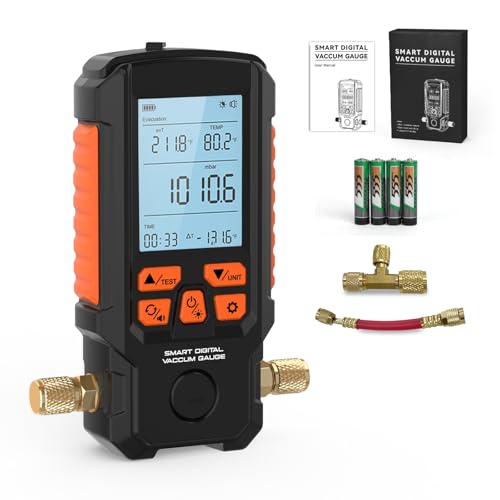
RALBIL’s digital vacuum gauge emphasizes precision with a wide range (0 to 2000 mbar) and four measurement units (hPa, mbar, Torr, inHg). It supports temperature compensation and auto-calibration to adjust for altitude and environmental conditions. A buzzer alarm alerts when approaching maximum pressure, helping prevent over-evacuation. The device offers quick unit switching and intuitive operation, making it suitable for automotive, household, and refrigeration maintenance tasks where accurate vacuum readings matter most.
Super Stars ST-VG90 Digital Micron Vacuum Gauge

The Super Stars ST-VG90 uses a Pirani vacuum sensor for high-precision readings from 99999 down to 0.1 Pa (0.75 microns). It supports four units and includes a backlit LCD for visibility in dim environments. A built-in vacuum alarm provides audible and visual alerts to prevent over-evacuation. The device is designed for technicians who need rapid, accurate measurements with reliable alarm features, and it includes a carrying case for convenient transport to job sites.
Buying Guide
Key considerations when selecting an HVAC vacuum gauge include accuracy, range, and readout format. For professional mechanics, digital gauges with auto-calibration and temperature compensation reduce measurement drift across temperatures and altitude changes. Wireless options offer convenience in tight spaces, while standalone models prioritize rugged simplicity in field use. Unit versatility matters: gauges that switch between microns, Torr, mbar, and inHg save time and reduce conversions. Alarm features are valuable for preventing over-evacuation, and a robust, protective case extends instrument life in demanding environments. Compatibility with existing manifolds and systems also guides tool compatibility decisions.
Practical needs may vary: technicians focused on quick checks may favor compact electromechanical gauges, whereas those performing full evacuations and leak testing might prefer high-precision digital meters with multi-unit support and data logging. Durability, ease of cleaning, and battery life are additional factors that influence long-term reliability and return on investment. Compare models by reading user reviews, testing calibration reliability, and considering how each accessory—such as angled couplers or carrying cases—fits your typical workflow. A balanced choice combines accuracy, usability, and durability to meet diverse HVAC maintenance demands.