
Exploring the best CoreXY 3D printers reveals options that blend high-speed performance with reliable print quality. This guide highlights five standout CoreXY models, detailing what each brings to the table, from auto-leveling and high-temp capabilities to multi-color printing and open-source flexibility. Whether you’re prototyping drones or producing precise parts, these printers are designed to maximize throughput without sacrificing accuracy.
| Product | Brand | Build Volume | Key Strength |
|---|---|---|---|
| ELEGOO Centauri Carbon 3D Printer | ELEGOO | 256x256x256 mm | Auto calibration and high-speed CoreXY |
| FLASHFORGE AD5X | FLASHFORGE | 220x220x220 mm | Ultra-fast CoreXY with multi-color capability |
| FLASHFORGE Adventurer 5M | FLASHFORGE | 220x220x220 mm | Fully auto leveling and high-speed performance |
| Sovol SV08 Core-XY | Sovol | 350x350x345 mm | Open-source with quad-gantry auto leveling |
| FLASHFORGE AD5M | FLASHFORGE | 220x220x220 mm | Fully auto calibration and all-metal CoreXY |
The following sections review each model with practical details, focusing on what matters most for CoreXY enthusiasts: speed, reliability, versatility, and maintenance ease. All product sections include a direct link to the official Amazon listing for quick reference.
ELEGOO Centauri Carbon 3D Printer Review
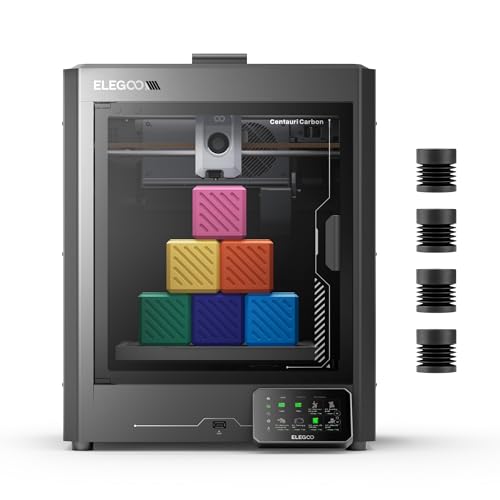
The ELEGOO Centauri Carbon offers a ready-to-print experience with auto bed leveling and a user-friendly touchscreen. Its CoreXY configuration supports high speeds up to 500 mm/s and a robust acceleration of 20,000 mm/s², enabling rapid prototyping. A 320°C brass-hardened steel nozzle and enclosed chamber expand material options to carbon fiber reinforced filaments and similar advanced materials. The printer arrives fully assembled and pre-calibrated, delivering smooth operation out of the box with a 256x256x256 mm build volume.
FLASHFORGE AD5X CoreXY Multi-Color Printer

AD5X brings vivid multi-color printing and a CoreXY chassis designed for speed and stability. With up to 600 mm/s travel speed and 20,000 mm/s² acceleration, it excels in rapid prototyping while maintaining print quality. A single 1-Click Auto Leveling process ensures reliable first layers, and the multi-color capability supports up to four colors simultaneously, expanding creative possibilities for detailed prototypes and small-batch productions.
FLASHFORGE AD5X Multi-Color with IFS
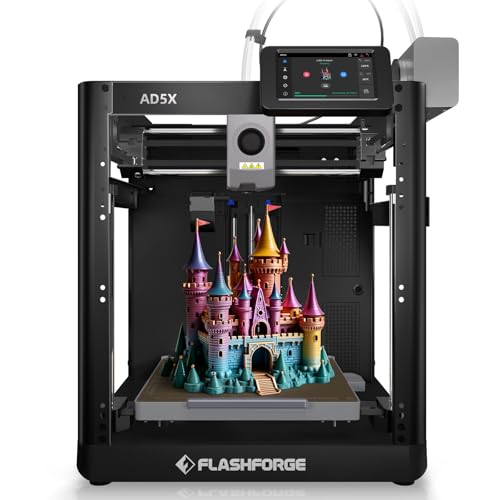
This variant emphasizes multi-color printing through an Intelligent Filament System (IFS). It supports four-color printing and includes auto filament loading/unloading with an automated refill function, reducing manual intervention. The printer uses a 300°C high-temperature nozzle and a high-flow hotend designed to shorten print times, making it suitable for durable materials like carbon fiber-infused filaments and PETG. CoreXY all-metal construction reinforces stability at high speeds.
FLASHFORGE Adventurer 5M CoreXY System

The Adventurer 5M emphasizes ease of use combined with high-speed capability. It features automatic bed leveling for flawless first layers, a CoreXY all-metal frame, and a 600 mm/s travel speed with 20,000 mm/s² acceleration. A 280°C direct extruder with a detachable nozzle supports quick changes, and the printer’s robust design aims to deliver stable high-speed performance for both beginners and experienced users.
FLASHFORGE AD5M CoreXY Auto Calibration

The AD5M focuses on fully automatic calibration and high-speed capability within a compact 220x220x220 mm build volume. Its all-metal CoreXY motion structure provides reliable performance at up to 600 mm/s, with easy maintenance and a quick-swap nozzle to streamline workflow. This model is well-suited to users who prioritize automation, repeatable results, and ease of setup in a smaller footprint.
FLASHFORGE Adventurer 5M Review

The Adventurer 5M integrates a CoreXY all-metal structure with a fully automatic leveling system. Its maximum speed reaches 600 mm/s with a rapid 3-second nozzle change capability and a 280°C direct extrusion system. The printer emphasizes a quick warm-up and dependable high-speed performance, making it a practical option for education, makerspaces, and prosumer use with frequent changeovers and quick iterations.
Buying Guide: CoreXY 3D Printer Purchase Considerations
- Print speed vs. reliability: CoreXY designs boost speed but may require robust frame construction and quality belting to prevent artifacts at high speeds. Look for models with rigid all-metal frames and proven acceleration performance.
- Build volume needs: Larger beds enable bigger parts but can add weight and complexity. Choose a size that fits your typical projects and workspace.
- Automation features: Auto bed leveling and auto-calibration save setup time and improve first-layer consistency. For busy makers, these features are highly valuable.
- Material compatibility: Consider nozzle temperature ranges and enclosed chambers for advanced filaments like carbon fiber-reinforced materials. Ensure heat management aligns with your material portfolio.
- Multi-color capabilities: If you need color variety, models with multi-color printing or intelligent filament systems can reduce manual filament swaps and speed up production.
- Open-source and community support: Open-source slicers and active communities help with troubleshooting and customization, especially for Voron-style or community-driven platforms.
- Maintenance and upgradability: Look for printers with easily accessible components, modular hotends, and replaceable parts to extend lifespan and adapt to evolving needs.
- Software ecosystem: Compatibility with popular slicers and firmware (like OrcaSlicer and open-source options) can influence daily workflow and print quality.
Selecting the best CoreXY 3D printer depends on your priorities: speed, automation, material versatility, or open-source flexibility. The models reviewed here emphasize fast, stable motion, reliable first layers, and practical features that support a range of applications from prototyping to small-scale production. Review your workspace, material goals, and whether you value turnkey setup versus customization to determine the right fit for your workflows.