
Answering the common buyer question, this guide highlights five reliable combat folding knives suited for EDC, camping, survival, and self-defense. Each pick targets a different need: compact pocket usability, assisted opening for quick access, rugged build for outdoor tasks, or a karambit-style design for tactical handling. Whether you’re new to knives or an outdoor enthusiast, these selections help you balance blade reliability, portability, and value.
Summary at a glance:
| Product | Key Fit | Blade Type | Best For |
|---|---|---|---|
| Smith & Wesson Accessories Extreme Ops SWA24S | Everyday carry and outdoor use | 3.1 inch serrated clip point | Best for versatile daily tasks |
| Tac-Force SAWBACK Bowie | Emergency and rescue scenarios | Partially Serrated Combo | Best for quick access and utility |
| Smith & Wesson M&P Special Ops | Rugged outdoor and tactical work | 4 inch Tanto | Best for heavy-duty tasks |
| AUBEY Folding Pocket Knife | Versatile everyday and camping | Tanto with 440C steel | Best for grip and control |
| Smith & Wesson SWMP4LS | Outdoor, tactical, and EDC | 3.6 inch serrated clip point | Best for larger, robust cutting |
Smith & Wesson Accessories Extreme Ops SWA24S
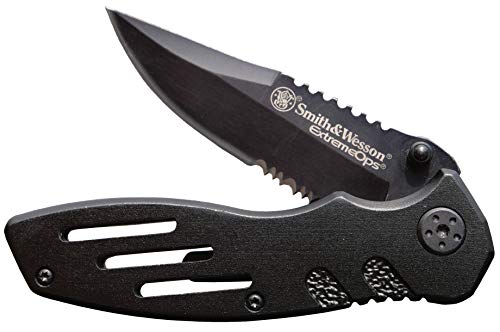
The 7.1 inch overall knife offers a 3.1 inch blade made from 7Cr17Mov high-carbon stainless steel with a black oxide finish and a lightweight aluminum handle. It includes a pocket clip, finger flipper, and ambidextrous thumb knobs for easy, one-handed access. Best for: everyday carry and outdoor tasks where quick deployment matters. Limitation: serrated edge may be less suitable for clean, precise cuts in some tasks.
Tac-Force SAWBACK Bowie Tactical Rescue

This pocket knife features a 440 stainless steel blade with a partially serrated edge plus a glass breaker and seatbelt cutter. The tool is designed for emergency or rescue scenarios, with a clip and quick-access design. Best for: rescue-focused EDC and quick utility access. Caution: a partially serrated blade may wear differently on fine tasks compared to a full straight edge.
Smith & Wesson M&P Special Ops

With a 9.3 inch overall length and a 4 inch blade, this knife uses 9Cr18MoV stainless steel with a titanium nitride coating and a black G10 handle. It’s equipped with a tip-up pocket clip, finger flipper, and an assisted opening system for rapid deployment. Best for: rugged outdoor and tactical use where a larger blade is advantageous. Limitation: heavier than lighter pocket knives, which may impact carry comfort for some users.
AUBEY Folding Pocket Knife

Equipped with a Tanto blade made from 440C steel, this knife uses a frame-lock design with G10 front and steel back for a secure grip. Brass washer pivots enable smooth one-handed opening, and a pocket clip adds carry convenience. Best for: reliable EDC and camping tasks requiring strong edge retention. Limitation: heavier build than ultra-light comps, which may affect portability for some users.
Good Worker Pocket Knife 6680

This black 2.95 inch serrated blade locks with a liner lock and measures 7.17 inches in total length. The handle uses aluminum with a protective grip, and a seatbelt cutter and glass breaker are included. Best for: light-duty EDC and emergency utility tasks where compact size is preferred. Limitation: smaller blade may require more strokes for tougher materials.
Buying Guide: How To Choose A Combat Folding Knife
What is your primary use?
Identify whether you need a compact everyday carry tool, a larger blade for camp tasks, or a karambit-style design for tactical handling. Each style serves different cutting demands, grip comfort, and deployment speed.
Blade material and edge
Stainless steels like 440C, 9Cr18MoV, or 7Cr17Mov balance edge retention and corrosion resistance. Consider straight edges for fine work and serrated edges for rope or heavy materials. Determine if you prefer a coated blade for durability or a plain finish for easier sharpening.
Opening mechanism and grip
Assisted opening speeds up deployment, while thumb studs or flippers offer simple one-handed use. Look for textured handles, G10 scalings, or aluminum for a robust, slip-resistant grip in wet conditions.
Weight and size
Heavier blades feel sturdier but may be less comfortable for all-day carry. Choose a knife that fits your pocket or belt, with blade length appropriate to your typical tasks.
Safety and legality
Check local laws on blade length and locking mechanisms. A secure frame or liner lock reduces accidental closure, which is critical in demanding environments.
Maintenance
High-carbon steels require more regular cleaning and oiling to prevent corrosion. Stainless steels tend to be more forgiving in tough outdoor conditions but may sharpen differently.
FAQ
- What blade material is best for outdoor use? 440C and 9Cr18MoV offer strong edge retention and corrosion resistance, suitable for camping and survival tasks.
- Is a assisted-opening knife safer for beginners? Yes, it provides quicker deployment with a consistent opening motion, reducing the chance of a dropped blade during use.
- Should I prefer serrated or plain blades? Serrated edges excel at rope and rough materials, while plain edges provide cleaner cuts and easier sharpening for general tasks.
- What size knife should I carry every day? A blade around 2.5 to 3.5 inches is common for EDC, offering balance between portability and utility.
- Are karambit-style knives practical for general use? Karambit models offer unique grip and control but may be less intuitive for first-time users and require deliberate training.
- What maintenance is recommended? Regularly oil moving parts, clean the blade after use, and sharpen according to steel type to maintain edge performance.