
Answering the common question for DIY RV owners: the best caulk for RV roofs and seams is a durable, flexible sealant that adheres to EPDM, TPO, metal, and other substrates without cracking or shrinking. The right choice protects against leaks on roof edges, vents, windows, and skylights. The top picks highlighted below suit different needs—quick repairs, long-term maintenance, indoor/outdoor use, and self-leveling convenience. This guide targets RVers, campers, and trailer owners looking for reliable waterproofing with clear reasons to choose each option. A quick buying table summarizes key choices for fast comparison.
| Product | Best For | Key Benefit |
|---|---|---|
| BEEST RV Roof Sealant (Pack 1) | Vertical surfaces and walls | Hybrid silicone, non-drip on vertical/overhead surfaces |
| Geocel 28100V Pro Flex | Damp surfaces and multi-surface adhesion | Excellent adhesion, resealable cartridge |
| Dicor 610SASLW-1 Self-Leveling Ultra Sealant | Roof surfaces, fast-curing repair | Non-yellowing, solvent-free formula |
| WELLUCK 4PC Self Leveling RV Roof Sealant | Big projects and leveling required | Self-leveling, high elasticity for temperature swings |
| Kohree RV Roof Sealant 4 Pack | Multiple surfaces and large patches | Self-leveling with broad substrate compatibility |
Notes: Each product is designed to seal RV roofs and seams, with variations in levelness, curing time, and substrate compatibility. Use only as directed on the package for best results, and ensure surfaces are clean and dry before application. This overview focuses on practical, purchase-ready details to help you compare quickly.
BEEST RV Roof Sealant (Pack 1) — Non-Leveling Hybrid Silicone

Features: ULTIMATE LEAK PROTECTION, quick-drying, UV resistant, non-toxic. This sealant adheres to vertical and overhead surfaces, making it suitable for walls, windows, doors, and roof edges on EPDM, TPO, and metal substrates. It remains flexible to prevent cracking during temperature shifts.
Best for: RV owners needing a reliable lap sealant for vertical surfaces and roof edges. It’s particularly well-suited for quick repairs and multi-surface use around campers and trailers.
Why selected: It offers strong adhesion on difficult surfaces, a non-drip formulation, and a hybrid silicone composition that balances waterproofing with flexibility. It’s a good all-rounder for irregular RV roofs and vertical seams.
Caution: As with any sealant, protect skin and eyes; ensure surfaces are clean prior to application to maximize adhesion. Some users may prefer a translucent option for aesthetic purposes on lighter surfaces.
Geocel 28100V Pro Flex RV Sealant — 10 oz
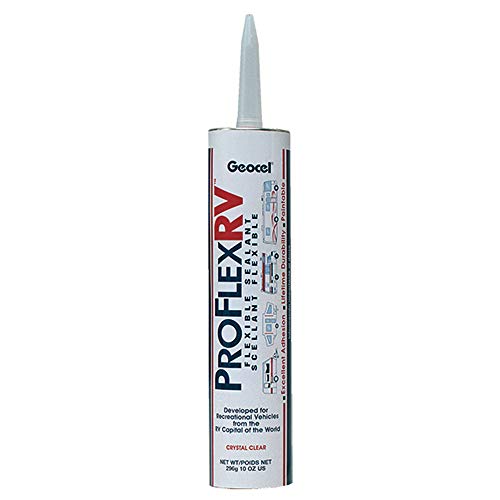
Features: 93.0°C flash point, excellent adhesion to many surfaces, even when damp, resealable cartridge. It is designed to seal around vents, screws, and joints on RV roofs and other damp environments, providing flexible performance when temperatures vary.
Best for: RV owners who frequently seal joints around vents or who work in damp conditions. It’s a good match for those who need ongoing resealability and reusability of the cartridge.
Why selected: Its ability to adhere while damp and its resealability support reliable, repeatable sealing. Choose this if you value user-friendly re-entry into sealed joints without removing existing material.
Caution: Not all colors are suited for all RV exteriors; confirm color compatibility with your roof color for a neat finish.
Dicor 610SASLW-1 Self-Leveling Ultra Sealant

Features: High-performance polyether sealant that sticks to roofs and accessories without primers. Non-yellowing, fast curing, durable, UV stabilized, and highly compatible with various RV roofing materials.
Best for: RV owners seeking a non-yellowing, fast-curing solution for large roof surfaces and irregular shapes. Ideal for EPDM, TPO, PVC, and related roofing materials without priming steps.
Why selected: The self-leveling property ensures a smooth, uniform seal with minimal manual shaping, reducing application time on large areas. It’s a solid choice for new roof installations and repair work.
Caution: Ensure proper ventilation during curing and avoid applying in extreme temperatures to maintain optimal leveling and cure rates.
WELLUCK 4PC Self Leveling RV Roof Sealant

Features: Self-leveling, white, flexible repair caulking with UV resistance and odorless formula. Designed to seal RV roofs, vents, and edges with high elasticity to withstand weather and vibrations.
Best for: RV owners tackling larger roof repairs or wanting a self-leveling option for an even, continuous seal across irregular surfaces.
Why selected: The self-leveling characteristic simplifies application on roof planes and edges, helping avoid gaps or sagging that can occur with non-leveling formulations. Suitable for varied weather conditions.
Caution: Some users may find it less suitable for vertical walls; stick with vertical-surface products for walls and vertical joints if needed.
Kohree RV Roof Sealant 4 Pack — Self-Leveling White

Features: Self-leveling lap sealant with wide substrate compatibility, including EPDM, TPO, PVC, aluminum, steel, wood, and more. Low odor and safe for indoor/outdoor use, designed to form a flat seal quickly.
Best for: RV owners needing a broad-application sealant that works across multiple roof materials and large repair areas. Its fast leveling reduces manual smoothing time.
Why selected: The broad material compatibility and quick leveling make this a practical choice for owners managing diverse roof surfaces, from metal to rubber membranes.
Caution: If you require a non-leveling sealant for vertically oriented seams or walls, consider a dedicated vertical-surface product to prevent sagging.
Buying Guide: Key Purchase Considerations
- Surface type: Check substrate compatibility (EPDM, TPO, PVC, metal, wood) and whether you need a self-leveling or non-leveling formula for your roof shape and seams.
- Leveling behavior: Self-leveling products are ideal for wide roof areas; non-leveling options are better for vertical joints and walls.
- UV exposure and color: Non-yellowing and UV-stabilized formulas preserve roof aesthetics over time; white finishes match many RV roofs.
- Curing time: Fast-curing sealants reduce downtime but require careful handling to avoid smudging; plan installations when weather is favorable.
- Odor and safety: Some formulations are low-odor or odorless, which helps for indoor applications or small spaces.
- Application ease: Self-leveling variants minimize manual smoothing; non-sag formulas prevent dripping on vertical surfaces.
- Environmental and health: Look for solvent-free or low-VOC options when possible for indoor use and DIY projects.
Frequently Asked Questions
- What is the difference between self-leveling and non-leveling RV sealants?
Self-leveling sealants spread evenly across horizontal surfaces, ideal for large roof areas. Non-leveling sealants stay in place on vertical joints and edges, reducing dripping. - Can I mix brands on my RV roof?
While some brands are compatible with a variety of substrates, it’s best to seal edges and joints with compatible products from the same family to ensure consistent adhesion and curing. - How long does RV roof sealant take to cure?
Curing times vary by product and temperature; typically 24 hours or more for full cure, with some formulations offering faster initial sets. Refer to product labels for specifics. - Is a primer needed for EPDM roofs?
Some sealants claim no primer is required, especially newer formulations. Always verify the product’s instructions for your roofing material. - Can these sealants be used indoors?
Many are suitable for indoor use if ventilation is adequate and surfaces are clean. Low-odor options are preferable for enclosed spaces. - Which product is best for large, flat roof repairs?
The self-leveling options (like well-rated self-leveling sealants) are generally best for large, flat roof areas to achieve a smooth, even seal.