
For homeowners and landscapers, selecting the right brush cutter blade can dramatically accelerate yard work, especially when dealing with thick brush, saplings, and small trees. This guide highlights five top-performing blades, detailing compatibility, performance, and installation notes to help you choose the best option for straight-shaft trimmers. Each entry includes a direct Amazon link for quick reference and a photo to visualize the blade design.
| Product | Brand | Arbor & Teeth | Approx. Diameter |
|---|---|---|---|
| Forester Chainsaw Brush Cutter Blade + File Set | FORESTER | 1″ arbor; 20 teeth | 9 in |
| SHUZIYU 8″ 32T Brush Cutter Blade | SHUZIYU | 1″ arbor; 32T | 8 in |
| Renegade Blade 8″ 56T Carbide | Renegade Blade | 1″ & 25.4mm options; 56T | 8 in |
| Kurt-Saw 9″ 36 Teeth Carbide | Kurt-Saw | 9″ dia; 36T | 9 in |
| FORESTER Carbide Tip 9″ 50T | FORESTER | 1″ arbor; 50T | 9 in |
Summary: The five blades featured here are designed for straight-shaft trimmers, with most models using a 1″ arbor or compatible adapters and a range of teeth counts to balance cutting speed and durability. Several blades emphasize carbide or high-carbon steel for longer wear life, while others focus on aggressive cutting through thick brush. Always verify your trimmer’s shaft type and the required adapter before installation. A conversion kit may be needed to fit certain blades to your trimmer head.
Forester Chainsaw Brush Cutter Blade + File Set

The Forester 9-inch brush cutter blade is designed to fit most straight shaft trimmers while excluding curved shaft and many electric models. It features a 1-inch arbor hole and includes a 20mm bushing to broaden compatibility, enabling a stable mounting point for tough jobs. This blade uses 20 chainsaw teeth that can slice through saplings, thick brush, weeds, grass, and small trees up to about 2.5 inches thick, with a high RPM rating to deliver fast, aggressive cutting. For setups requiring a trimmer head, a corresponding conversion kit is sold separately. Safe installation depends on selecting the correct adapter for your specific trimmer model.
Key considerations:
- Compatibility: Predominantly for straight-shaft trimmers; confirm arbor size and adapter needs.
- Durability: Chainsaw tooth design emphasizes heavy-duty cutting in dense growth.
- Speed: Rated up to high RPM to maximize cutting efficiency; ensure your engine can safely match torque demands.
- Maintenance: Includes a file set for sharpening to extend blade life.
SHUZIYU 8″-32T Brush Cutter Blade

The SHUZIYU 8-inch blade features 32 carbide-tipped teeth with a universal 1″ arbor and a multilayer washer adapter, designed for circular arbors. Its lightweight construction allows use with battery-powered and corded units, expanding suitability beyond gas-powered models. The carbide tips offer substantially longer wear life, enabling repeated passes through thick brush with reduced blade maintenance. The product notes emphasize the need for blade mounting parts (discs, nut, cotter pin) and proper blade kit compatibility for your trimmer model.
Key considerations:
- Universal fit: 1″ arbor with adapters supports a wide range of trimmers.
- Carbide tips: Higher durability and sharper edge for dense vegetation.
- Weight: Lighter blades reduce operator fatigue on extended jobs.
- Safety: Follow manufacturer instructions for mounting and balancing to prevent wobble or kickback.
Renegade Blade 8″-56T Carbide Hybrid

The Renegade Blade 8″ 56T carbide hybrid blade is designed as a versatile, multi-purpose option. It uses carbide-tipped teeth and is marketed as a universal fit, provided the correct blade kit parts are used for your trimmer model. The blade kit approach involves selecting the compatible mounting discs, nut, and cotter pin to integrate the blade with the trimmer’s spindle. The carbide composition is claimed to extend tooth life well beyond standard steel, offering value for high-frequency trimming tasks.
Key considerations:
- Arbor compatibility: Ensure you select the right adapter kit for your model.
- Carbide longevity: Expect longer life under dense vegetation but consider replacement costs.
- Teeth design: 56T balances cutting speed with the ability to handle tougher debris.
- Installation: Proper mounting parts are essential for safe operation.
Kurt-Saw 9″ 36 Teeth Carbide

The Kurt-Saw 9″ blade is sold as a 2-pack option featuring 36 carbide-tipped teeth designed for brush cutter use. The blade is sized at 9 inches in diameter, matching common straight-shaft trimmer configurations. It emphasizes two blades in one pack, which provides value and consistent performance for tasks requiring extended cutting sessions. As with other blades, compatibility depends on arbor size and the need for mounting hardware or a blade kit.
Key considerations:
- 2-pack value: More blades for longer projects or multiple trimmer setups.
- Carbide teeth: Enhanced longevity under tough vegetation.
- Diameter and fit: Ensure your trimmer can safely handle a 9″ blade with proper balance.
- Replacement strategy: Have spare discs and hardware on hand for quick swaps.
FORESTER Carbide Tip 9″ 50 Teeth
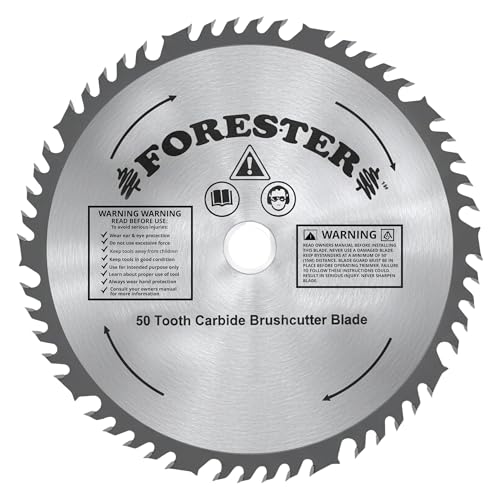
The Forester carbide-tipped 9-inch blade with 50 teeth focuses on faster, smoother cutting through heavy vegetation while maintaining a robust edge. This option uses the standard 1-inch arbor hole with a 20mm bushing to broaden compatibility across different straight-shaft trimmers. As with other blades, a conversion kit may be necessary for trimmer heads that require specific mounting components.
Key considerations:
- Carbide durability: Increased tooth life reduces downtime for sharpening or replacements.
- Cut speed: More teeth can produce a smoother cut but may require more cutting power from the engine.
- Adapter needs: Verify the correct adapter and mounting hardware for safe operation.
- Safety and balance: Proper installation minimizes vibration and improves control.
Buying Guide: Key Purchase Considerations
Selecting a brush cutter blade requires balancing arbor compatibility, tooth count, material, and the nature of the vegetation you routinely clear. Consider the following perspectives to make an informed choice:
- Material and durability: Carbide-tipped blades last longer under tough conditions, but may come at a higher upfront cost. For occasional light trimming, standard steel blades can be adequate.
- Teeth count and blade geometry: More teeth generally yield smoother cuts and less tearing, but increase the load on the engine. Fewer teeth cut aggressively through dense brush but may wear faster on hard wood.
- Arbor compatibility and adapters: Confirm arbor size (1″ is common) and whether your trimmer requires a conversion kit or washer adapter. Incompatibility can lead to unsafe operation.
- Installation and safety: Use the correct mounting discs, nuts, and cotter pins. Balance the blade properly to reduce vibration and maximize control.
- Maintenance: Many blades include optional filing sets. Regular sharpening extends blade life and maintains cutting performance.
- Application scope: For saplings up to a few inches in diameter, select blades with sufficient tooth count and carbide tips. For lighter yard work, consider blades with fewer teeth and lower weight for ease of use.
- Cost vs. value: Carbide blades last longer, which can justify a higher price for frequent users. If blades are only used occasionally, a standard blade may be more economical.
Weighting these factors against your equipment and workload will help determine the best blade for your needs. Always follow the trimmer manufacturer’s safety recommendations and consult the blade’s installation guide to ensure a secure, balanced fit.