
Choosing the right amp clamp meter helps professionals and DIYers quickly diagnose electrical issues by measuring current, voltage, resistance, and more without interrupting circuits. The following five options represent a mix of consumer-friendly and professional-grade meters, offering true RMS readings, non-contact voltage testing, and robust safety features. This guide highlights key specs, features, and how they compare to help you pick the right tool for your needs.
| Product | Brand | Key Features | Typical Use |
|---|---|---|---|
| AstrоAI Digital Clamp Meter | AstroAI | AC/DC current, voltage, capacitance, frequency, NCV, backlit display | DIY and light industrial tasks |
| Klein Tools CL390 | KLEIN TOOLS | AC/DC current, NCVT, high-visibility display, TRMS | Professional electrical work |
| KAIWEETS Digital Clamp Meter | KAIWEETS | TRUE-RMS, D-shaped jaw, NCV, temperature, backlight | Home and professional use |
| Fluke 302+ Digital Clamp Meter | Fluke | 400 A jaw, AC current up to 400 A, AC/DC voltage up to 600 V | Residential/commercial troubleshooting |
| FNIRSI DMC-100 Digital Clamp Meter | FNIRSI | 9999 counts, 600 A, NCV, data storage, color display | Advanced data analysis and tracking |
AstroAI Digital Clamp Meter
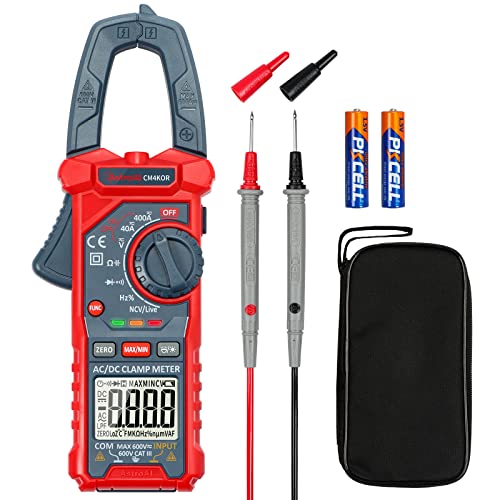
The AstroAI clamp meter offers versatile measurement capabilities, covering AC/DC current and voltage, resistance, capacitance, frequency, and more. It includes non-contact voltage testing with audible and visual alerts, a backlit LCD display, and a flashlight for dim work areas. Features like Data Hold, Max/Min, and auto power-off assist in obtaining accurate readings while reducing user error. The ZERO function helps minimize interference from Earth’s magnetic field, improving measurement accuracy in practical environments.
Klein Tools CL390 AC/DC Digital Clamp Meter

The Klein Tools CL390 combines versatility with reliability, measuring AC/DC current and voltage, resistance, and continuity, plus frequency and duty cycle via test leads. It features non-contact voltage testing and a high-visibility, reverse-contrast LCD display for easy readings in varying lighting. With TRMS readings and a rugged design, it’s well-suited for professional electricians tackling commercial and residential tasks.
KAIWEETS Digital Clamp Meter

The KAIWEETS clamp meter is designed for true-RMS accuracy across AC and DC current and voltage, with a D-shaped jaw that opens up to 1.1 inches for easier clamping on larger conductors. It includes NCV detection with audible and visual alarms, a backlit display, and a temperature sensor. This model is suitable for electricians, DIY enthusiasts, and professionals needing reliable troubleshooting for solar systems, automotive work, and industrial applications.
Fluke 302+ Digital Clamp Meter

The Fluke 302+ is a compact meter with a 30 mm jaw capable of handling large conductors. It provides dependable measurements for AC current up to 400 A, as well as AC/DC voltage up to 600 V and resistance measurements. Its true RMS sensing helps maintain accuracy with non-linear loads, making it a staple for residential and light commercial troubleshooting. A two-year warranty accompanies its professional-grade reliability.
Fluke-301D/ESP Clamp Meter

The Fluke 301D/ESP offers a slim body and thin jaw for tight spaces, with AC current measurements up to 600 A and safe operation under CAT III 300V. It focuses on practical everyday maintenance, combining a compact form with reliable measurement capabilities for quick checks in both residential and commercial environments.
ANENG Digital Clamp Meter

The ANENG clamp meter provides quick detection of AC and DC current, voltage, resistance, capacitance, diodes, continuity, and frequency with an NCV detector. Its double-open clamp design accommodates large wires up to roughly 1.33 inches, enabling efficient troubleshooting in diverse scenarios. The NCV feature adds safety during live electrical checks.
FNIRSI DMC-100 Digital Clamp Meter

The FNIRSI DMC-100 offers a wide measurement range with 9999 counts and a maximum current of 600 A. In addition to AC/DC voltage and current, it measures capacitance, resistance, diode checks, temperature, and continuity. It includes data analysis features with curves, max/min tracking, and stored historical data. Its color display and backlight enhance readability in various conditions.
Buying Guide: Key Purchase Considerations
- Measurement capabilities: Ensure the meter covers essential functions for your needs—AC/DC current, voltage, resistance, capacitance, and frequency. True RMS sensors improve accuracy with non-linear loads.
- Safety features: Look for CAT ratings appropriate to your environment, non-contact voltage testing (NCV), and audible/visual alarms to reduce risk when testing live circuits.
- Jaw design and size: A larger jaw can measure bigger conductors but may reduce precision for tight spaces. D-shaped jaws can simplify clamping around multiple conductors.
- Display readability: Backlit or high-contrast displays help in dim environments. Some meters offer flexible viewing angles or reverse-contrast screens for better visibility.
- Data storage and analysis: Meters with data hold, max/min, and storage of readings support trend analysis and long-term troubleshooting.
- Portability and ergonomics: Slim, lightweight meters are easier to handle in concourses or field work, especially when working in tight spaces.
- Build quality and warranty: Reputable brands (like Fluke and Klein Tools) often provide longer warranties and greater durability for professional use.
- Accessory compatibility: Check if the meter supports thermocouples, test leads, or additional probe accessories you already own or plan to buy.
Usage Scenarios And Perspectives
For DIY projects, a meter with auto-ranging, a backlit display, and NCV will streamline common checks such as charging outlets, automotive circuits, and basic appliance diagnostics. Professionals may prioritize true RMS accuracy, larger current ranges, durable construction, and a robust warranty to handle daily field work in residential or commercial settings. For educational or hobbyist use, cost-conscious models with intuitive interfaces and essential features deliver reliable value while teaching fundamental electrical concepts. In industrial environments, meters offering higher current capacities, data logging, and compatibility with standard safety protocols are critical for maintaining uptime and safety.
Additional Considerations
When selecting a clamp meter, consider the typical conductor sizes you’ll test, the need for temperature measurements, and whether you require dual-display or multi-parameter readouts. If you frequently work in dark or confined spaces, prioritize models with backlighting and compact form factors. Finally, assess whether you need optional accessories such as infrared thermometers, additional probes, or docking stations for on-site data capture.