
Three-phase AC generators are essential for hands-on learning, small wind or hydro projects, and educational demonstrations. This guide highlights five reliable, user-friendly options from Amazon that suit hobbyists, students, and makers who want efficient brushless or permanent-magnet designs. Each pick balances performance, ease of use, and durability, with features ranging from compact micro generators to larger wind turbine alternators. The following sections provide concise overviews, key specs, and practical considerations to help readers compare at-a-glance.
| Product | Brand | Key Feature |
|---|---|---|
| CrocSee Micro 3 Phase AC Mini Hand Brushless Motor Generator | CrocSee | Compact brushless 3-phase, 3V–24V output |
| ECSiNG 3-24V 3 Phase Micro Hand Generator | ECSiNG | Wide 3–24V range, smooth 3-phase output |
| Kadimendium 3 Phase Hydro Generator | Kadimendium | Hydro/water flow driven, high sensitivity |
| AVAN 100w 3-Phase Permanent Magnet Generator | Hilitand | Direct-drive PM alternator for wind setups |
| 12000W Low RPM PM Generator for Wind | Generic | High-power, low-speed three-phase alternator |
CrocSee Micro 3 Phase Brushless Generator
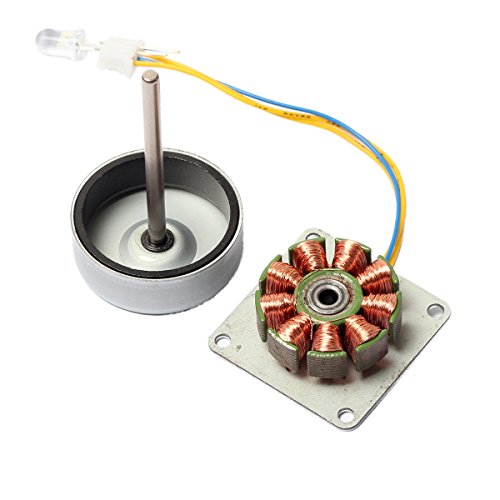
The CrocSee model is a micro 3-phase brushless AC generator designed for classroom demonstrations and small-scale experiments. It operates as a compact educational tool to illustrate how three-phase systems produce smoother AC output compared to single-phase options. Typical output ranges from 3V to 24V with current between 0.1A and 1A, enabling students to observe voltage regulation and load effects in a safe, controlled setting. The device emphasizes simplicity and portability, making it ideal for hands-on labs and DIY projects where space is limited.
ECSiNG 3-24V Micro Hand Generator

The ECSiNG unit supports a flexible voltage window of 3–24V and employs a three-phase brushless design for smooth performance with minimal maintenance. Its compact form is suitable for model builds, teaching aids, and DIY experiments that demonstrate how phase-shifted windings generate balanced AC output. Users can explore efficiency, current limits, and the effect of load on voltage across a safe, hands-on platform.
Kadimendium 3 Phase Hydro Generator

This hydro-oriented generator is designed for water-flow applications and multipurpose use, including LED or signaling displays powered by small hydro setups. It features a G1/2in interface and a robust plastic body with good temperature tolerance. Suitable for experiments with fluid dynamics, it demonstrates how flow rates influence generated voltage in a 3-phase system, making it a practical teaching aid for labs focused on renewable energy concepts.
AVAN 100w Three Phase Permanent Magnet Generator

This three-phase permanent magnet generator uses NdFeB magnets and copper windings to deliver stable, efficient power. With a compact profile—about 5.5 inches high and 5.9 inches in diameter—it is well-suited for vertical or horizontal wind turbine projects. The direct-drive design minimizes maintenance and reduces mechanical complexity, making it a reliable choice for hobbyists exploring wind-powered generation and educational demonstrations of rotor dynamics.
12000W Low RPM PM Generator for Wind

This high-capacity three-phase permanent-magnet generator is designed for large wind or hydro setups that require significant power at low rotational speeds. Built with NdFeB magnets and high-grade copper windings, the unit emphasizes efficiency and robust performance under variable wind conditions. Its die-cast aluminum housing offers durability and corrosion resistance, making it appropriate for outdoor installations and educational demonstrations that simulate utility-scale generation in a compact form factor.
Buying Guide: Key Considerations for Choosing a 3-Phase Generator
- Application goals: Teaching demos, model turbines, or real-world small-power systems will dictate the appropriate size, output range, and mounting options.
- Output voltage and current: Ensure the generator’s voltage range aligns with your load, batteries, or DC-AC conversion needs; consider how voltage holds up under varying speeds and loads.
- Brushless vs brushed and permanent magnet design: Brushless and PM designs tend to require less maintenance and offer longer life, but may have higher initial costs.
- Speed versus power: Low RPM designs benefit wind and hydro applications with slow rotation, while higher-speed units suit compact bench experiments.
- Durability and enclosure: Outdoor or lab environments call for durable housings, corrosion resistance, and temperature tolerance.
- Integration with systems: Look for compatibility with PWM controllers, rectifiers, and data logging equipment to study efficiency and performance curves.
- Safety and handling: Consider insulation, safe operating voltage ranges, and user-manageable current limits to prevent shocks or equipment damage.
- Maintenance needs: Brushless PM generators generally require less maintenance; confirm available spare parts and service options.
- Cost-to-performance balance: For educational purposes, balance price with reliability, availability of parts, and ease of use for students or hobbyists.