
Answering the most common buyer question: which combustible gas leak detector best fits your space and needs? This guide highlights five reliable options, explains who each is best for, and clarifies limitations to help you choose with confidence. Ideal buyers include homeowners safeguarding kitchens and basements, RV travelers monitoring propane and natural gas, HVAC technicians, and DIY enthusiasts tackling tight spaces with flexible probes. A quick summary table below lists the top picks and their key strengths.
| Product | Best For | Key Strength | Limitations / Cautions |
|---|---|---|---|
| Klein Tools ET120 Gas Leak Detector | General home safety and professional use | Wide range 50–10,000 ppm with dual sensitivity | Higher-end model; monitor in varying environments |
| TOPTES PT520A Natural Gas Detector | Hard-to-reach spaces and RVs | 17-inch gooseneck, fast 0.5 s response | Non-removable battery insight not shown |
| UEi CD100A Combustible Gas Leak Detector | HVAC technicians and contractors | Broad gas detection and long 18″ gooseneck | Calibration and warm-up considerations apply |
| TOPTES PT199 Natural Gas Leak Detector | Home inspections and RV use | Fast 0.5 s to 3 s response with bright LEDs | Includes batteries; 30-second warm-up required |
| FORENSICS DETECTORS FD Gas Detector | Industrial or classroom-level demonstrations | Japan-made sensor; robust ABS housing | Limited feature description; ensure compatibility with needs |
Klein Tools ET120 Gas Leak Detector

The Klein Tools ET120 provides a wide detection range from approximately 50 to 10,000 ppm, enabling versatile gas monitoring across different environments. It offers adjustable sensitivity with High (50–1000 ppm) and Low (1000–10,000 ppm) modes, helping users tailor detection to the task. Audible alerts reach 85 dB, complemented by five red LEDs that intensify with concentration. This model is best for professionals who need precise range control and clear visual/audible cues in varied settings, including tight plumbing areas or floors with potential leaks. A potential limitation is that higher-end features require careful setup to avoid false positives in noisy environments.
TOPTES PT520A Natural Gas Detector

The PT520A from TOPTES emphasizes accessibility in tight spaces with a 17-inch flexible gooseneck. It detects a range of gases including methane, propane, natural gas, LPG, and butane, making it suitable for home, RV, and outdoor use. The device responds quickly (within 0.5 seconds) and provides a visual bar indicator along with a 75 dB alarm that increases with gas concentration. Best for users who frequently access hard-to-reach areas or need rapid localization of the leak source. A caution: ensure the warm-up period is respected for accurate readings and avoid relying on it in highly dynamic environments without confirmation from other methods.
UEi Test Instruments CD100A Combustible Gas Leak Detector

The UEi CD100A stands out for comprehensive gas detection, capable of sensing acetone, ammonia, butane, methane, natural gas, LPG, jet fuel, and more. Its long 18-inch gooseneck improves access to constrained spaces, a key advantage for HVAC professionals or DIYers working around appliances or ducts. The device provides audio and visual cues as leaks are detected. Best for users who require broad compatibility with multiple gases and a flexible reaching tool. A limitation is that users should allow a brief warm-up and understand the tic-rate signaling to avoid misinterpretation in very quiet environments.
TOPTES PT199 Natural Gas Detector
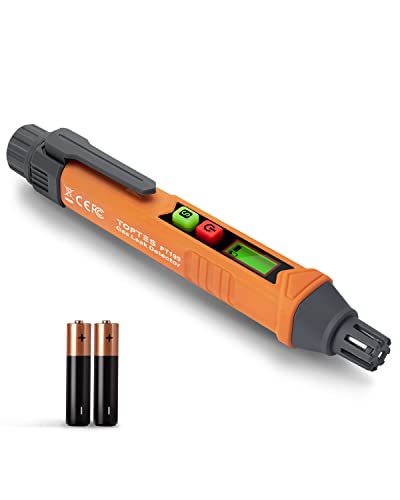
The PT199 from TopTes is a compact option designed for home use and RV applications. It detects natural gas, methane, propane, butane, LPG, and related gases, with a 0.5–3 second alarm response. The device includes two AAA batteries and a 30-second warm-up. It is best for quick spot checks and pocket portability. Choose this if you want a lightweight, ready-to-use detector for routine safety checks; avoid relying on it for continuous monitoring in large spaces where a more robust unit is preferred.
FORENSICS DETECTORS FD Gas Detector

The FORENSICS DETECTORS FD model emphasizes robust construction, including a 10-foot drop tolerance with ABS housing and a Japanese-made sensor calibration, which can be attractive for demonstrations or industrial-style use. It features a large color LCD display for readability and a simple interface. Best for users requiring a sturdy tool with a clear visual interface. A caveat is that product details are less extensive about gas list and sensitivity ranges, so verify gas compatibility with your specific needs before purchase.
Buying Guide
What to consider when choosing a combustible gas leak detector
Detection range and gas compatibility: Look for devices that cover common household gases (methane, propane, natural gas) and consider if you need multi-gas support for industrial or HVAC work. A wider ppm range and flexible probes help in locating leaks more effectively.
Probe length and accessibility
A longer gooseneck (around 17–18 inches) improves reach in tight spaces like behind appliances, inside cabinets, or near pipelines. For RV use or portable inspections, ensure the probe length suits your typical work areas.
Response speed and sensor alerts
Faster response times help quickly identify leaks. Audible alarms (often 75–85 dB) and visual indicators (LED bars or LCD readouts) enable detection in noisy environments or low-light settings. Consider whether you need continuous audible alerts or visual-only cues.
Power, warmth, and calibration
Many units rely on internal rechargeable batteries or disposable batteries. Warm-up time is a practical factor for accurate readings; some models require 30 seconds to a minute. Calibration requirements vary; verify whether the detector needs routine calibration and how easy it is to perform.
Durability and use context
For DIY use, a compact, user-friendly detector with clear alarms may suffice. For professional or industrial settings, a rugged build and broad gas detection capability are advantageous. Consider housing material, drop resistance, and warranty terms if relevant to your risk environment.
Price-to-value balance
Higher-end detectors may offer broader gas compatibility and longer probes, but evaluate whether you will benefit from features like advanced LED indicators, dual sensitivity modes, or extended warranty based on your planned usage.
Practical tips for safe use
- Always perform a warm-up as instructed by the manufacturer before relying on readings.
- Test the detector in a known safe area first to confirm proper operation.
- Use the flexible probe to minimize exposure and maximize access to suspect leak zones.
- Keep detectors accessible and replace batteries as needed to prevent failures during critical checks.
FAQ
- What is a typical detection range for these devices?
Most units detect leaks in the 50–10,000 ppm range, which covers common household leak scenarios.
- How should I use the gooseneck probe?
Point the probe toward suspected leak sources and move slowly to get as close as possible without causing damage or safety concerns.
- Do these detectors require calibration?
Some models include auto-calibration or require periodic checks; follow the manufacturer’s guidance for accuracy.
- Can I rely on these for professional HVAC work?
Yes, several models (such as UEi CD100A and Klein ET120) are designed with professional use in mind, offering broader gas detection and robust probes.
- Are there safety cautions to consider?
Avoid relying on a single device for critical safety decisions. Verify readings with proper ventilation and follow local safety guidelines when leaks are suspected.