
Direct answer: choose high‑quality carbide blades with a Modified Triple Chip Grind (MTCG) and a non‑stick coating for clean, cool cuts in composite decking. This guide covers top blades that excel at cutting Trex and similar materials, helping pros and DIYers get melt‑free, precise results. The featured products are best for: heavy users (12″ blades) needing longer life; mid‑size decks (7‑1/4″ blades); and precision cuts on rugged composites. Below is a concise comparison and a buying guide to help you select the right blade for your deck project.
Summary of chosen products
| Product | Diameter | Teeth | Arbor | Coating/Tech | Best For |
|---|---|---|---|---|---|
| Diablo TrexBlade D1284CD | 12″ | 84 | 1″ | TiCo carbide, MTCG, Perma‑Shield | Heavy‑duty composite decking and plastics |
| Diablo TrexBlade D0744CD | 7-1/4″ | 44 | 5/8″ | TiCo carbide, MTCG, Perma‑Shield | Decking undercuts and smaller projects |
| Norske NCSBP226 | 7-1/4″ | 48 | 5/8″ | Japanese steel, MTCG | Composite decking and bamboo on standard saws |
| Norske NCSBP228 | 10″ | 64 | 5/8″ | Japanese steel, MTCG | Longer life on larger boards |
| Bosch DCB1072CD | 10″ | 72 | – | Brute Carbide, MTCG | High‑abrasive composites with precision |
Diablo TrexBlade Saw Blade for Composites and Plastic – 12″

Features: TiCo Hi‑Density Carbide; Modified Triple Chip Grind (MTCG); Perma‑SHIELD Non‑Stick Coating. These elements maximize cutting life in composite decking materials and plastics, keep the blade cool for melt‑free cuts, and reduce heat buildup and gumming.
- Best for: professionals and serious DIYers cutting Trex or similar composites with a 1″ arbor saw.
- Why selected: high tooth count and durable carbide deliver long life and smooth finishes on dense decking composites.
- Caution: larger 12″ blades require compatible saws and steady feed to prevent deflection on thick boards.
Diablo TrexBlade Saw Blade – 7-1/4″ x 44T

Features: TiCo Hi‑Density Carbide; MTCG; Perma‑SHIELD Non‑Stick Coating. Engineered to cut composite decking materials and plastics with reduced heat and melt risk.
- Best for: mid‑size deck projects and portable saws needing a precise, cool cut.
- Why selected: a compact option with similar heat‑management to larger blades.
- Caution: fewer teeth than the 12″ version means slightly slower finish on very hard composites.
Norske Tools NCSBP226 7-1/4″ Composite Decking Saw Blade

Features: 7-1/4″ diameter, 48T; Specially designed for composite decking and cellular PVC; MTCG tooth profile for clean, cool, melt‑free cuts.
- Best for: homeowners or pros needing a cost‑effective blade for Trex and similar boards.
- Why selected: optimized for melt‑free finishes with a standard 5/8″ bore.
- Caution: may be less aggressive on very dense alloys or exotic decking materials.
Norske Tools NCSBP228 10″ Composite Decking Saw Blade
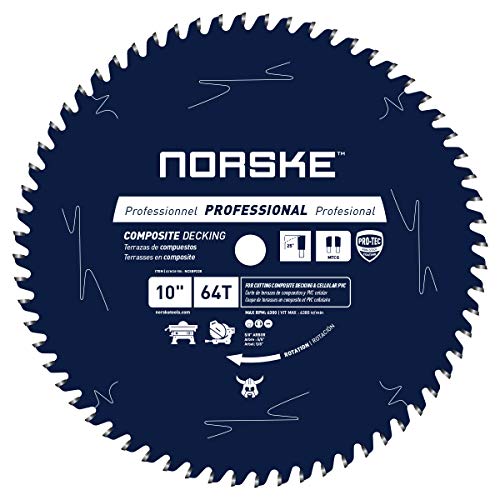
Features: 10″ diameter, 64T; designed to maximize cutting life in composite decking; MTCG tooth profile for clean, cool, and melt‑free cutting.
- Best for: larger deck projects where longer blade life and wider kerf are advantageous.
- Why selected: offers a good balance between aggression and heat management for bigger boards.
- Caution: ensure your saw can accommodate a 10″ blade and stock the proper arbor compatibility.
Bosch DCB1072CD 10″ Edge Circular Saw Blade
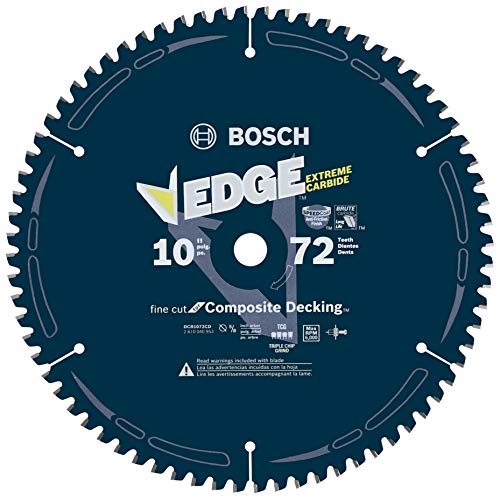
Features: Brute Carbide with a micrograin formulation; triple chip grind tooth geometry; extra‑hard blade body for accuracy and resistance to deflection.
- Best for: users needing a robust blade for highly abrasive decking materials and demanding cuts.
- Why selected: premium carbide formulation and geometry optimize finishing quality.
- Caution: heavier blades may require a more powerful saw and careful alignment for long straight cuts.
Buying Guide: Key Considerations For Blade Selection
- Blade diameter and arbor size: Ensure the blade fits your saw’s capacity and arbor (e.g., 1″ or 5/8″). Larger blades cut faster but require compatible saws.
- Tooth count and geometry: Higher tooth counts (64–84T) yield smoother finishes on composite decking but cut more slowly; lower counts (40–48T) cut faster but may leave rougher edges.
- Tooth design: Modified Triple Chip Grind (MTCG) helps stay cooler and reduce heat buildup, which minimizes gumming and melting of decking materials.
- Carbide grade: TiCo or similar hi‑density carbide blades offer longer life in composites than standard steel blades.
- Coatings: Perma‑Shield or equivalent non‑stick coatings reduce heat, friction, and resin buildup.
- Durability vs. cost: Premium blades often reduce replacement frequency and improve cut quality on choice decking products.
- Application scope: Some blades are designed for jigsaws or circular saws only; verify tool compatibility before purchase.
Frequently Asked Questions
- What blade is best for composite decking? A carbide, MTCG blade with a non‑stick coating is generally best for clean, melt‑free cuts in composite decking.
- Can I use a regular wood blade on composite decking? No—composites are harder and can melt or fray; use blades specifically designed for composites.
- Does larger diameter always mean better cuts? Not always. Larger blades cut faster but require a compatible saw and may be harder to control on tight corners.
- Is more teeth always better for decking? More teeth yield a smoother edge but can reduce cutting speed; choose based on balance between finish and efficiency.
- Should I choose a blade with a non‑stick coating? Yes, coatings help reduce heat and resin buildup, extending blade life and improving cuts on decking materials.
- Do I need special setup for these blades? Ensure correct arbor, adequate clearance, and proper feed rate to achieve melt‑free results.