
Answering the demand for efficient dust control, this guide compares five top dust collectorVacuum hybrids suited for woodworking shops and home workshops. Each option targets different needs—from portable separator units to high-capacity extractors with automatic features. Best-for buyers are noted to help you choose quickly based on your space, tools, and noise tolerance. Use the quick table below to compare core strengths.
| Product | Best For | |
|---|---|---|
| Festool CT 15 Dust Extractor | Professional shops needing reliability and HEPA filtration | Large-capacity, automatic tool start, robust build |
| DEWALT DWV010 HEPA Dust Extractor | Do-it-yourself to small shop setups with automatic cleaning | Automatic filter cleaning, solid airflow |
| DEWALT Dust Separator with 6 Gallon Tank | Separation before the vacuum to protect filters | High efficiency cyclone separation |
| WEN DC3474 Dust Collector | Budget-conscious woodworkers needing mobility | Mobile base and sizable bag with decent power |
| Dustopper PRO Low-Profile Dust Separator | Dust separation first to save on filters and bags | Low-profile, optimized separation design |
DEWALT Dust Separator With 6 Gallon Tank

The DEWALT DXVCS002 dust separator is designed to capture wood chips and debris before they reach the vacuum, protecting filters and extending service life. It supports 1-7/8″ or 2-1/2″ ports for compatibility with most vacuums. The four-caster base makes it stable and mobile across a workshop, and the 6-gallon tank is easy to empty. Best for workshop setups where filter maintenance is a concern or where a wide range of debris is collected.
Best for: hobbyists and small shops that want a simple, effective pre-separator to reduce suction loss and filter changes. This unit is a solid choice when you want to maximize the life of a primary vacuum by pre-filtering common wood and debris particles.
Limitations: Not a standalone extractor; relies on a separate vacuum for suction. May require a compatible vacuum with the correct port sizing and power to maximize performance.
DEWALT DWV010 HEPA Dust Extractor
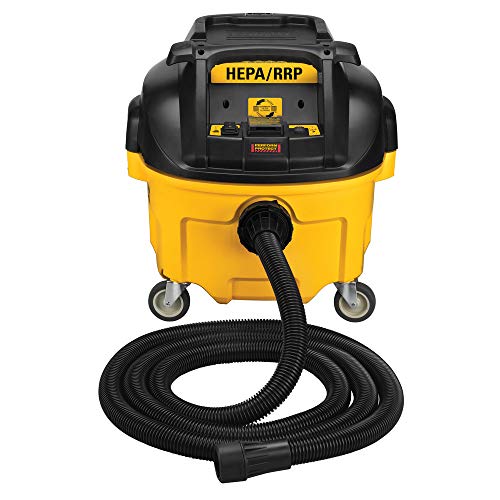
This DEWALT DWV010 HEPA dust extractor features automatic filter cleaning every 30 seconds, enabling continuous operation without manual filter maintenance. It delivers about 150 CFM of airflow with a 15-amp motor and includes power-tool actuation for On/Off control when using connected tools. Best for: small to mid-size shops needing a self-cleaning, consistently strong vacuum with convenient tool-actuated control.
Best for: users who want automatic filter maintenance and straightforward control integrated with their power tools.
Caution: The unit’s efficiency depends on a compatible hose and tool setup; ensure your tools’ power requirements align with the 15-amp motor to avoid tripping circuits.
Festool CT 15 Dust Extractor

Festool CT 15 combines HEPA filtration with an adjustable high-performance turbine and a generously sized 3.96 gallon container. It includes tool-start automation and an AutoClean system for uninterrupted sanding and cutting work. Best for: professionals who need a quiet, compact, high-capacity extractor with reliable filtration and integrated accessories storage. This model is well-suited for continuous production environments and long sessions.
Best for: shop owners who prioritize filtration quality and long-term durability over portability. A caution is that higher upfront cost and footprint may be a consideration for very small spaces.
WEN DC3474 Woodworking Dust Collector

The WEN DC3474 offers a robust 7.4-amp induction motor and a 15-gallon bag for dust collection, paired with a 4-inch dust port for versatile connections. It comes with a mobile base for easy relocation around the shop. Best for: budget-minded woodworkers who want a portable, capable dust collection setup for medium-duty tasks. The unit’s larger bag helps reduce bag changes during longer sessions.
Best for: users needing mobility without sacrificing significant dust capacity. Caution: Motor size and airflow may be less suited for very large tool runs or high-volume sanders compared with higher-end systems.
Dustopper PRO Low-Profile Dust Separator

The Dustopper PRO is engineered for maximum separation, prioritizing dust capture before it enters the vacuum to save on filters and vacuum bags. It features a low-profile design and includes high-flow 90-degree elbows and a standard 5-gallon bucket compatibility. Best for: users who want to extend vacuum life and lower ongoing consumables with a dedicated separation phase. The patent-pending design is highlighted for improved separation efficiency over simply increasing CFM.
Best for: operators who want to minimize filter usage and bag replacements, especially in households or small shops with frequent dust-generating tasks.
Buying Guide
What should I consider when choosing a dust collector vacuum system?
- Dust generation and volume: Match the system’s CFM and suction to your tools. Large planers or drum sanders need stronger airflow than small benchtop tools.
- Filtration level: HEPA-filtered extractors trap fine dust, improving air quality and reducing health risks in enclosed spaces.
- Separation vs. collection: Cyclone separators and dust right-sizing can protect vacuums and reduce bag/filter replacements.
- Mobility and footprint: Consider shop space and whether wheels, casters, or wall-mount configurations fit your layout.
- Noise and vibration: If you operate in a shared or quiet space, prioritize quieter models with better isolation.
- Maintenance costs: Look at filter/bag replacement intervals and the availability of replacement parts.
Do I need a HEPA filter or a simple dust collector?
HEPA filters capture finer dust and improve indoor air quality, which is important for enclosed spaces or long-duration projects. Non-HEPA systems may suffice in well-ventilated shops or for rough cleanup tasks where fine particulate exposure is lower.
How do separators extend vacuum life?
Separators remove most of the bulk dust before it reaches the vacuum, lowering clog risk and reducing the need for frequent filter or dust bag changes. This can improve suction stability and reduce maintenance time.
What is the trade-off between mobility and capacity?
Portable units with small bases and bag sizes are easier to move but may require more frequent bag changes. Stationary, larger-capacity models reduce maintenance but require more shop space and dedicated mounting solutions.
What installation considerations matter?
Check port sizes (commonly 1-7/8″ or 2-1/2″), ductwork compatibility, and whether the system supports tool-actuation for automatic start when connected to power tools.
Maintenance tips
- Regularly inspect hoses and connectors for wear or leaks.
- Clean or replace filters according to the manufacturer’s guidance.
- Empty collection bins promptly to maintain optimal airflow.
Frequently Asked Questions
- What is the best dust collector for a small hobby shop?
– A compact unit with a good bag capacity and simple maintenance, such as a mobile collector or a separator combined with a standard vacuum, can be efficient for hobby work. - Do I need a separator if my vacuum already has a bag?
– A separator can still protect the vacuum by catching heavier debris before it enters the bag or filter, extending the life of components. - Is HEPA filtration necessary for woodworking?
– It improves air quality by trapping fine dust, which is beneficial in enclosed spaces and for users with sensitivities. - Can I use any vacuum with a dust separator?
– Compatibility depends on port sizes and airflow. Ensure the separator ports match your vacuum’s inlet. - How loud are these systems?
– Noise varies by model; some units optimize for quieter operation, which is preferable for daytime work or shared spaces.