
Direct answer: For particle board and plywood projects, choose blades with carbide teeth, thin kerf, and an appropriate arbor size to minimize chipping and deliver clean cuts. The top picks below are best for fast, accurate results on wood composites, plywood, and similar materials. They are suited for DIY projects, cabinetry, and light framing where clean edges matter and grain direction varies. The following selections emphasize edge finish, kerf smoothness, and compatibility with common saws.
| Product | Brand | Arbor | Main Benefit |
|---|---|---|---|
| Revvstark 5-1/2″ 24T/48T | Revvstark | 10 mm | Versatile framing and finishing cuts for wood and composites |
| FOXBC 5-1/2″ 130T | FOXBC | 5/8″ (16 mm) | Smooth cuts on plywood, OSB, and plastic panels |
| Makita A-93675 10″ 60T | Makita | Full sized arbor (as specified) | Ultra-clean finish with micro-polished carbide edges |
| Revvstark 6-1/2″ 24T/60T | Revvstark | 5/8″ (15.8 mm) | High-precision cuts for larger sheets and thicker materials |
| OA-BRES 3-Pack 7-1/4″ 24T/40T/60T | OA-BRES | 5/8″ (16 mm) | Clear set for framing, ripping, and finishing in wood projects |
Revvstark 5-1/2″ 24T & 48T Carbide Blades

Features: 5-1/2 inch diameter, 10 mm arbor, max 8000 RPM. Carbide teeth come in 24T and 48T options. Made from durable alloy steel with hardened tungsten carbide teeth for heat resistance and stable, true cuts. The thin kerf enables fast, clean drafting of edge lines and reduces waste. Best for versatile wood and composite material cutting, with good performance on particle board and plywood.
Best for: light framing, finish work, and DIY projects where you need both rough and finish options in one blade set. Choose this if you want flexibility for different cuts without switching blades frequently. Caution: ensure your tool’s RPM matches the blade rating to avoid overheating.
WEN BL0704 7-1/4″ 4-Tooth PCD Blade
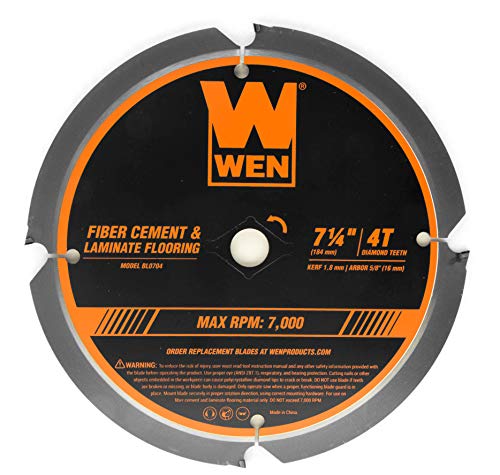
Features: 7-1/4-inch diameter, 5/8-inch arbor, rated up to 7000 RPM. Diamond-tipped PC blades are designed for fiber cement and laminate flooring, delivering ultra-thin kerf for clean, precise cuts. Best for hard composites and materials that resist traditional carbide blades, with reduced wear on fiber cement boards.
Best for: fiber cement and laminate projects where a super-smooth edge is essential. Limit: not ideal for thick hardwoods or very soft plastics that may gum up with diamond tips.
FOXBC 5-1/2-Inch 130T Three-Pack

Features: 5-1/2 inch, 130T, 5/8 inch arbor with 1/2″ and 3/8″ bushings in a 3-pack. Designed for fast, smooth cuts through plywood, OSB, plastic panels, and veneers. The high tooth count improves edge quality and reduces tear-out on layered materials.
Best for: cabinet-grade plywood and veneer work where edge clarity is critical. Caution: very fine teeth can produce more heat with dense materials; maintain steady feed and proper pressure.
Revvstark 6-1/2″ 24T & 60T

Features: 6-1/2 inch diameter, 5/8 inch arbor, up to 8000 RPM. Carbide teeth counts include 24T and 60T, with a durable alloy steel body and thin kerf. Designed to deliver fast, clean cuts along and across the grain, making it suitable for larger panels and thicker boards.
Best for: medium-to-large panels and thick stock, where a finer finish is desired or where a secondary precision cut is needed after roughing. Limitation: larger blades require compatible saws with adequate motor power and space.
OA-BRES 3-Pack 7-1/4″ Blades (24T/40T/60T)

Features: Includes 24T framing blade, 40T cross-cutting blade, and 60T finish blade. Arbor size 5/8 inch. The blades feature durable alloy steel with carbide teeth and a polished chrome-plated surface for extended life. ATB design helps with clean, precise cuts across varied wood types.
Best for: an all-in-one solution for framing, ripping, and finishing in wood projects, especially when working with particle board and plywood. Caution: 7-1/4″ blades require compatible saws and proper clearance for safe operation.
Buying Guide: Key Purchase Considerations
- Material type: Particle board, plywood, OSB, and veneer each respond differently to tooth count and tooth geometry. Higher tooth counts (40–60T) give smoother finishes, while lower counts (24–40T) cut faster for framing.
- Kerf width: Thinner kerf blades (1/16″ or thinner) reduce material waste and speed up cuts but may require steadier feed to prevent burn marks.
- Arbor size: Match the blade arbor to your saw’s arbor to avoid slippage or unsafe operation. Common sizes include 5/8″ and 10 mm; always verify your tool’s compatibility.
- Blade material: Carbide-tipped teeth offer longer life and better edge quality on composites. Diamond-tipped blades excel with hard fiber cement and certain laminates but may be overkill for standard plywood.
- Finishing needs: For cabinetry or visible edges, prioritize blades with finish-oriented tooth geometry (ATB or similar) and a polished surface for minimal tear-out.
- Safety and maintenance: Keep blades sharp, use the correct cutting direction, and replace blades showing significant dulling, warping, or missing teeth. Proper clamping and feed rate reduce chipping and burns.
FAQ
- What blade is best for particle board?
– High-quality carbide blades with 40–60T are generally best for particle board to achieve clean edges and minimize tear-out. - Can I use a plywood blade for laminate flooring?
– Yes, but for laminate flooring, consider a blade with a very thin kerf and a fine tooth count designed for laminates to reduce chipping. - What arbor size is common for circular saw blades?
– Common arbors are 5/8 inch and 10 millimeters. Always match blade arbor to your saw’s arbor and use appropriate bushings if needed.