
Preserving tool longevity requires reliable rust protection and lubrication. The following hand-picked oils and rust-prevention products are widely used for homes, garages, and professional shops. Each option tackles oxidation, reduces friction, and helps extend the life of metal parts. Below, you’ll find practical details and key considerations to help you choose the right product for your needs.
| Product | |||
|---|---|---|---|
| Made Here Co. Multi-use Lubricating Penetrant Oil | Made Here Co. | Stuck parts, general rust prevention | |
| Oil Eater Overnight Rust Remover | Oil Eater | Deep rust removal, tool restoration | |
| Rust Kutter | Rust Kutter | Converting rust to paintable surface | |
| Horace Whitlock’s Industrial Lubricating Oil | Horace Whitlock’s | Robust rust prevention and cleaning | |
| ConwaxNosin Rust Prevention Spray | Conwax | Water-based rust prevention on metal surfaces |
Made Here Co. Lubricating Penetrant Oil

The Made Here Co. lubricating penetrant oil is designed for deep penetration to free stuck parts while providing rust prevention. The high-performance formula aims to lubricate hinges, nuts and bolts, chains, and other metal components. The product emphasizes a non-toxic formulation, making it suitable for use around homes and in confined spaces without strong fumes. It is marketed for both professional and DIY applications, offering broad versatility for automotive, industrial, and general household tasks. For tool maintenance, this oil can help reduce stiffness and corrosion without introducing harsh chemicals.
Oil Eater Overnight Rust Remover

Oil Eater’s Overnight Rust Remover uses Rust-Soak technology to dissolve rust down to the metal surface. It is intended for soaking rusted hardware, tools, antiques, and automotive parts, with a recommended soak time of about 12 hours. After soaking, a rinse reveals a restored surface without sanding or scrubbing. The formula is water-based and biodegradable, avoiding harsh acids, fumes, or odors. This makes it a safer option for restoring tools that have significant rust without disassembly or intense labor.
Rust Kutter Rust Converter
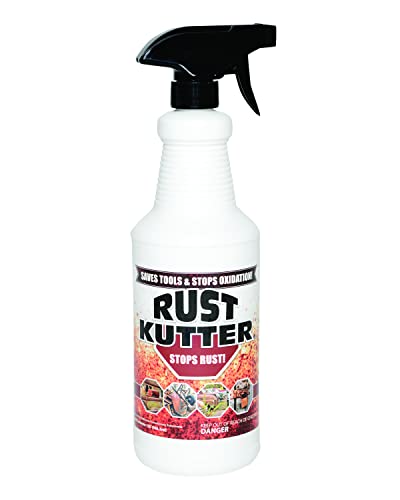
Rust Kutter is a rust converter designed to transform active rust into a stable, paint-ready layer. The converter chemically reacts with rust to form a black, inert surface that can be primed and painted over. This makes it particularly suitable for tools and outdoor equipment where rust has progressed beyond simple surface treatment. The product is marketed for use on various metal surfaces, including car bodies and raised outdoor gear, and it often includes a sprayer for easier application. It provides a practical option when rust has begun to penetrate the surface and needs stabilization before painting.
Horace Whitlock’s Industrial Lubricating Oil

Horace Whitlock’s Industrial Lubricating Oil combines cleaning, lubrication, and rust prevention in a single product. It is described as an industrial-grade solution with resistance to freezing down to -32°F and tolerance for high heat, suggesting broad applicability from cold environments to hot workshops. The oil can serve as a multi-purpose cleaner for dirty, rusty, or worn parts and helps restore moving components while protecting against future degradation. It is positioned for chains, gears, locks, hinges, and similar hardware, as well as equipment like garage doors and knife sharpeners, with compatibility for wood, metal, plastics, and composites.
ConwaxNosin Rust Prevention Spray

Conwax Nosin Rust Prevention Spray provides a water-based rust-inhibiting option for wet surfaces, with a focus on corrosion inhibition for cars and metal tools. The formula supports adjustable dilution to fit coverage needs and balance performance with cost. It can offer forgiveness in applications where a thin, easily spread coating is preferred, serving as a flexible preventative layer in environments prone to moisture exposure. The product’s dual emphasis on water-based and oil-like protection makes it a versatile choice for varying metal conditions.
Buying Guide: Key Purchase Considerations
- Application method: Choose a product that fits your workflow—sprays and penetrants for quick coverage, or soaking formulas for heavy rust.
- Rust stage: For light surface rust, penetration oils or multi-purpose lubricants may suffice; for deep rust, consider rust converters or removers.
- Safety and emissions: If you work in small spaces or have sensitivities, prioritize non-toxic or water-based formulations with low fumes.
- Material compatibility: Verify that the chosen product is safe for the specific metals you use (steel, alloys, wood or plastics near treated metal).
- Environmental impact: Water-based and biodegradable options generally have a smaller environmental footprint than traditional solvent-based products.
- Longevity and maintenance: Some oils offer long-lasting protection but require occasional reapplication; others provide quick relief with frequent refreshes.
- Ease of use: Consider whether you need a quick spray, a brush-on converter, or a soak for heavily encrusted parts.
- Finish and appearance: If aesthetics matter (paintable surfaces or clean finishes), rust converters that leave a primed surface may be preferable.
When selecting a rust-prevention product, match the tool material, its exposure environment, and your preferred maintenance routine. For restoration projects, a rust remover or converter can prepare surfaces for paint, while a penetrant oil or multi-purpose lubricant helps ongoing protection during use. For regular maintenance, consider a water-based spray or oil that prevents moisture-induced corrosion without creating hazardous fumes.