
Choosing the right concrete moisture meter is essential for reliable floor installations, screeds, and slab projects. This guide reviews top options that deliver non-destructive or minimally invasive readings, helping builders, inspectors, and homeowners determine moisture conditions quickly and accurately. The selections below emphasize concrete and related building materials, with clear comparisons to support informed purchasing decisions.
| Product | Brand | Type | Key Benefit |
|---|---|---|---|
| Tramex CME5 | Tramex | Analog/Non-destructive | Depth up to 3/4″ with Carbide Method readings |
| Wagner C555 | Wagner Meters | Pinless | Fast, non-destructive readings with hotspot detection |
| Tramex CMEX5 | Tramex | Digital/Hybrid | Integrated hygrometer; RH, temp, and dew point |
| Klein ET140 | KLEIN TOOLS | Pinless | Non-destructive detection up to 3/4″ deep |
| RDINSCOS Pinless | RDINSCOS | Pinless | 40 mm depth; REF mode for baseline comparison |
Tramex CME5 Concrete Moisture Encounter
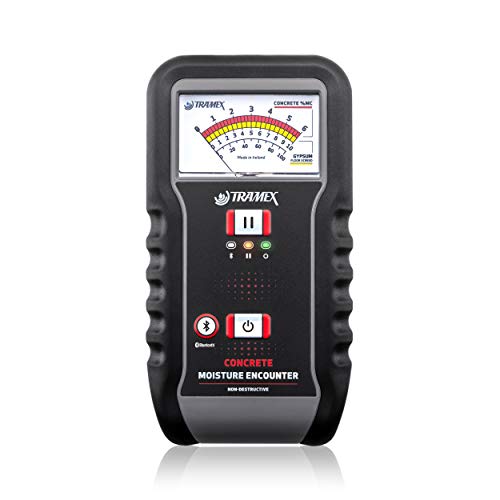
The CME5 is a non-destructive analog moisture meter designed for concrete floors, slabs, and screeds. It follows ASTM F2659 testing standards and provides rapid, quantitative moisture content readings as a baseline for gravimetric comparisons. Its depth of approximately 3/4 inch (20 mm) makes it suitable for standard concrete slabs and screeds, aligning well with professional workflows that require quick pass/fail decisions on moisture migration and potential curing issues. Carbine Method equivalent readings offer compatibility with traditional testing benchmarks and provide actionable data for flooring installations.
Klein Tools ET140 Pinless Moisture Meter

The ET140 is a pinless moisture meter designed for non-destructive moisture detection in drywall, wood, and masonry. It detects relative moisture content up to 3/4 inch beneath the surface using electromagnetic field (EMF) technology. This makes it ideal for quick inspections of walls, floors, and ceilings where invasive probing is undesirable. The device provides a straightforward readout and helps identify potential water intrusion or elevated moisture zones before more invasive testing is required.
Wagner Meters C555 Pinless Concrete Moisture Meter

The C555 delivers fast, non-destructive moisture readings on concrete surfaces. It helps pinpoint problem areas and supports strategic placement of additional in-situ RH tests. In addition to moisture level data, it monitors ambient temperature and humidity to assess environmental suitability for flooring installations. Its ability to locate hotspots makes it useful for guiding corrective actions during construction or remodel projects.
Tramex CMEX5 Concrete Moisture Encounter

The CMEX5 is a digital moisture meter with an integrated hygrometer, offering pin and RH probe functionalities. It measures moisture content in wood and concrete, including readings for anhydrite, gypsum, and other screeds. Its built-in humidity sensor reports ambient relative humidity, temperature, dew point, and humidity ratio, enabling a comprehensive environmental context for moisture-related decisions, especially in multi-material installations or mixed-slab systems.
RDINSCOS Pinless Moisture Meter For Wood, Concrete, Floors

RDINSCOS offers a versatile pinless moisture meter designed for wood, concrete, drywall, plaster, and floors without damage. Its 40 mm depth capability and non-invasive sensing provide quick scans across different surfaces, making it suitable for home inspections and professional projects. The device includes reference mode (REF) to compare current readings against a baseline, helping users identify changes over time or across rooms and materials.
Buying Guide: Key Considerations When Selecting a Concrete Moisture Meter
- Measurement type: Pinless meters are non-destructive and ideal for quick scans on finished surfaces, while pin-type meters can offer precise material-specific readings in some contexts but may cause minor surface damage.
- Depth and substrate compatibility: Choose meters that can read to the required depth for your floors or screeds (commonly 3/4″ or 20 mm) and that support concrete, wood, drywall, and related substrates when needed.
- Environmental data: Models with built-in hygrometers and temperature sensors provide context for readings, helping determine if environmental conditions affect curing or installation.
- Calibration and references: Some meters offer reference modes or baseline comparisons (REF mode) to track changes over time, which is valuable for ongoing monitoring in renovations or new builds.
- Durability and ease of use: Look for rugged construction, clear displays, backlit screens for dim work areas, and audible or visual alerts for high moisture levels.
- Data interpretation: Prefer devices with straightforward indicators (color scales, high/low alerts) and compatibility with standard testing methods (e.g., ASTM F2659) to align with professional expectations.
- Maintenance and batteries: Check battery types, life, and whether replacement parts or calibration tools are readily available to minimize downtime on job sites.
Comparative Considerations
- Non-destructive readings reduce surface disruption and are suitable for finished floors, drywall, and wood framing where locking in moisture context is needed.
- Pinless models excel for rapid surveys across large areas, while pin-based units may still be preferred where precise, localized wood moisture content is required.
- Integrated environmental sensing (RH, dew point, ambient temperature) adds valuable context to moisture measurements, particularly for slab-on-grade installations.
- Calibration baselines and reference modes help track moisture trends, useful in new construction timelines or renovation projects with changing humidity.
Each of the featured meters serves different project needs—from quick spot checks on concrete floors to comprehensive environmental assessments for complex multi-material installations. When selecting, align the tool’s capabilities with your typical project types, material substrates, and the level of data detail you require for moisture control and flooring success. The right meter helps prevent curing delays, floor lifting, and moisture-related damage across residential, commercial, and industrial settings.