
Choosing a versatile TIG welder can simplify your shop tasks, enabling precise aluminum and steel welds with multiple waveform options. This article reviews five top-performing 7-in-1 or multi-process TIG welders that suit DIY hobbyists and professionals alike. Each option offers AC/DC capability, pulse control, and dual voltage to handle a range of metals. Read on to compare features, ease of use, and how these machines perform in real-world welding scenarios.
| Product | Brand | Voltage | Key Features |
|---|---|---|---|
| ARCCAPTAIN TIG Welder AC/DC 200Amp | ARCCAPTAIN | 110V/220V | 7-in-1: TIG (AC/DC, pulse, square/triangular), Stick, Spot; large LED display; aluminum welding 0.5–5 mm |
| YESWELDER 200A AC/DC TIG Welder | YESWELDER | 110V/220V | Large LED display; HF non-touch start; hot start; memory recovery; TIG/Stick |
| Sunstac 250A AC/DC TIG Welder | Sunstac | 110V/220V | AC/DC TIG with pulse; SPOT/STICK; LCD display; dual voltage |
| bestarc AC/DC TIG Welder 215A | bestarc | 110V/220V | 6-in-1: DC TIG, AC TIG, pulse, square wave, stick; 5-pin pedal; post gas, down-slope |
| TOOLIOM 200A AC/DC TIG Welder | TOOLIOM | 110V/220V | 6-in-1; large digital display; foot pedal compatible; TIG/Stick/SPOT |
ARCCAPTAIN TIG Welder AC/DC 200Amp

ARCCAPTAIN’s 7-in-1 TIG welder supports AC/DC TIG with pulse, square and triangular waveforms, as well as Stick and Spot welding. It handles aluminum and non-ferrous metals with AC TIG for finesse and DC TIG for deeper penetration. A large LED display provides clear parameter visibility for precise control. It welds aluminum from 0.5 mm to 5 mm and other metals up to 10 mm, making it a versatile choice for hobbyists and small shops.
YESWELDER 200A AC/DC TIG Welder

YESWELDER’s 200A AC/DC TIG offers a large LED display for parameter readability and a hot-start feature for stable ignition. It supports dual voltage input and includes High-Frequency non-contact starting for reliable aluminum welding. The unit is designed for ease of use and compact portability, with memory functions that recover saved settings after power-off, making it suitable for consistent results across projects.
Sunstac 250A AC/DC TIG Welder

Sunstac’s 250A TIG welder combines AC/DC TIG with pulse features and dual voltage. It supports SPOT and STICK as well, broadening its utility. The unit includes an LCD display for intuitive parameter adjustment, helping welders maintain consistency during aluminum and steel fabrication tasks.
bestarc AC/DC TIG Welder 215A

bestarc offers a 6-in-1 TIG welder with 215A output and dual voltage. It includes a pedal-ready TIG configuration, pulse modes, and square waveform for cleaner aluminum welds. Post gas control and down-slope options help refine crater formation and weld quality on thin and thick materials alike.
TOOLIOM 200A AC/DC TIG Welder

TOOLIOM’s 200A welder provides six modes, including AC/DC TIG and TIG Spot, with a large digital display for easy monitoring. It accepts a foot pedal (sold separately) to offer remote current control, appealing to users who value hands-free arc initiation and precise adjustment during long welds.
Weldpro TIG Welder AC/DC 200A
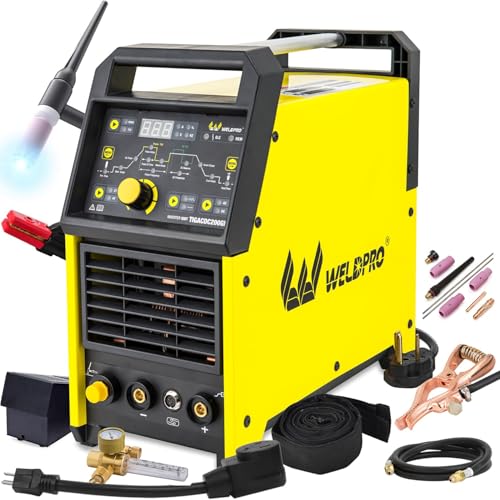
W Weldpro combines 200A AC/DC TIG with pulse TIG and spot welding in a 6-in-1 format. It champions dual voltage operation and a large LED display for viewing weld parameters. Built for finesse welding on aluminum and non-ferrous metals, it also emphasizes safety features to minimize burn-through and distortion.
Buying Guide: Key Purchase Considerations
When selecting a TIG welder for aluminum and steel, consider these factors to ensure the right fit for your projects.
- Voltage and power: Dual voltage (110/220V) expands where you can weld, from garages to job sites. Higher amperage supports thicker materials, but ensure your power supply supports the unit.
- AC vs DC TIG: AC TIG excels at aluminum and oxide removal; DC TIG provides deeper penetration for steels. A machine with both modes offers maximum versatility.
- Pulse and waveform control: Pulse reduces heat input, improving welds on thin sections. Square and triangular waves influence cleaning action and heat distribution, affecting arc stability.
- Accessories and controls: A clear digital display, post-flow gas control, down-slope, and 2T/4T modes can improve control and reduce operator fatigue, especially for long runs.
- Portability vs power: Heavier units may offer higher duty cycles; lighter models are easier to move but may have lower continuous welding capability.
- Foot pedal compatibility: Foot pedals provide hands-free current control. Verify compatibility and availability of the pedal with your chosen model.
- Material compatibility: Ensure the welder handles typical metals you work with (aluminum, stainless steel, copper) and the thickness ranges you encounter.
- Ease of setup: Look for intuitive interfaces and clear parameter readouts to minimize setup time on job sites or in the shop.
Across these options, users should match a welder’s capabilities to their typical projects. For aluminum-intensive work, dual-frequency or pulse features, along with reliable arc starting, are advantageous. For stainless and steel, robust DC TIG performance and stable current control are equally important. Consider whether you need spot welding or stick welding in addition to TIG to maximize versatility without buying multiple machines.
Each model highlighted here balances versatility with practical features, offering a blend of user-friendly interfaces, measurable control, and durable construction suitable for American workshops and hobbyists. Always follow manufacturer safety guidelines and wear appropriate PPE when welding.