
Attic insulation is a key defender against energy loss and indoor comfort. The right spray foam can seal gaps, reduce drafty spots, and improve acoustics. This guide highlights five highly capable spray foam kits that are well-suited for attic projects, from sealing hard-to-reach corners to creating a durable, fire-rated barrier. Each product is evaluated on performance, ease of use, fire safety, and value for DIYers and professionals alike.
| Product | Best For | Key Benefit |
|---|---|---|
| Attics, Walls, Garages | Class-A fire rated with strong R-value per inch | |
| Comprehensive DIY kits | All-in-one package with guns, cleaners, PPE | |
| Comprehensive insulation projects | Monolithic, high-performance insulation | |
| High coverage, single-component | Reduced energy loss with strong acoustic performance | |
| Professional-grade DIY kits | Fast curing, complete with nozzle set and safety gear |
Kraken Bond Fastcoat Fire Rated Kit

The Kraken Bond Fastcoat kit is a closed-cell polyurethane system designed for attics, walls, and crawl spaces. It is Class-A fire rated and meets safety standards such as ASTM E84, providing both fire resistance and robust insulation performance (R-value around 5.66 per inch). The kit includes 12 cans, an ergonomic application gun, foam cleaner, safety goggles, a worksuit, gloves, and a dual-nozzle setup for versatile application. Its comprehensive package supports efficient sealing of hard-to-reach areas and a reliable airtight barrier. This kit suits project crews and serious DIYers seeking consistent results.
Performance notes: closed-cell formulation delivers a watertight seal with good rigidity. The included applicator and cleaning gear help maintain equipment longevity, while the safety gear supports compliant work practices. The kit is appropriate for applications requiring both thermal and acoustic insulation, with strong resistance to air leaks. For attic use, plan for vertical and ceiling spray patterns to ensure complete coverage, particularly around joist bays and duct penetrations.
Y’allCanDIY Closed Cell Insulation Kit
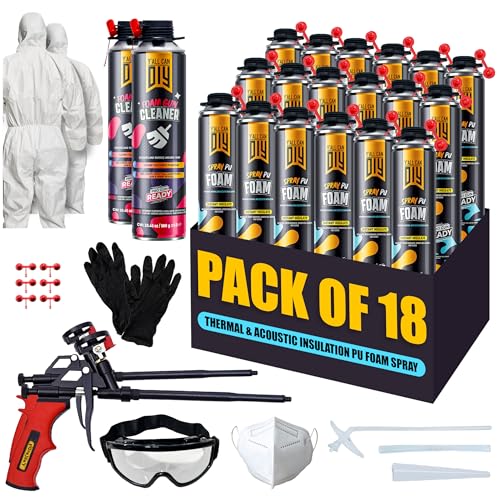
The Y’allCanDIY kit is a large, all-in-one package designed for DIY enthusiasts and professionals. It includes 18 cans (750 ml each) of closed-cell spray foam, two PU foam gun cleaners, two Teflon-coated guns, multiple safety items, gloves, glasses, masks, and protective suits, along with numerous straws, nozzles, and spreaders. The content mix provides an end-to-end solution for sealing attic gaps, windows, doors, and irregular cavities. The foam’s density supports both thermal and sound insulation, performing well in typical attic temperature ranges (60°F–90°F). It’s ideal for users who want a single purchase covering multiple steps of installation.
Notes on usage: with a predominantly closed-cell structure (high closed-cell content), expect strong air sealing and moisture resistance. Humidity levels can influence curing time, so plan accordingly. Ensure you follow safety guidelines, particularly when handling multiple components and PPE in a confined attic space.
Loctite Tite Foam Big Gaps

Loctite Tite Foam Big Gaps is a high-density polyurethane sealant designed to fill larger gaps up to 3 inches. While commonly used for gaps around windows and penetrations, its versatility makes it a practical option for attic sealing tasks where larger voids exist around pipes, ducts, or framing gaps. The foam adheres to most building materials and resists UV exposure, contributing to long-term durability. It’s a good choice when combined with broader spray foam kits for targeted repair work and to boost overall airtightness in attic assemblies.
Usage guidance: for attic projects, apply in layers to avoid excessive expansion that could warp framing or trim. Pair with a comprehensive kit for a full system approach—primary spray foam for continuous sealing and Loctite Big Gaps for detailing around irregular spaces.
Vega Bond Closed Cell Insulation 29 Oz

Vega Bond offers a single-component closed-cell spray foam with an aggressive coverage profile. Each 29 oz can provides substantial board-foot coverage at 1-inch thickness, delivering an R-value of about 5.66 per inch. The formula aims to deliver airtight seals and strong acoustic performance, which can be particularly beneficial for attic spaces prone to both heat gain and sound transfer from living areas. The kit format supports DIY installation while delivering the reliability expected from professional-grade products.
Key considerations: Vega Bond’s closed-cell chemistry yields a compact, rigid foam that resists moisture absorption. It’s well-suited for attic penetrations, around ductwork, and rim joists. Ensure adequate ventilation during application and follow curing instructions to optimize curb appeal and performance in the long term.
Adhesive Guru Fastcoat Spray Foam Kit

Adhesive Guru’s kit is a professional-grade DIY option, featuring 12 cans of closed-cell foam, a dispensing gun, cleaners, safety gear, and a robust selection of nozzles. The product emphasizes fast curing and strong bonding, with an R-value around 5.66 per inch and a documented thermal conductivity of roughly 0.025 W/(m.K). The kit is tailored for complete attic and wall projects, offering solid coverage and reliable sealing for air leaks. It’s a strong choice for users who want a turnkey solution with substantial protective equipment included.
Usage guidance: for attics with uneven surfaces or irregular cavities, plan for multiple passes to ensure complete fill and to minimize post-install shrinkage or voids. Pair with joints and edge detailing for best results, and always adhere to safety recommendations, including PPE and proper ventilation during spray applications.
Buying Guide: Key Purchase Considerations For Attic Spray Foam
- Fire rating and safety standards: Attic spaces benefit from Class-A fire-rated formulations and compliance with standards like ASTM E84. Choose kits that emphasize fire resistance where applicable.
- Closed-cell vs open-cell: Closed-cell foams provide higher R-value per inch and better vapor resistance, ideal for attics with moisture concerns. Open-cell foams offer lower density and greater flexibility for irregular gaps but lower R-value.
- Cure time and climate suitability: Temperature and humidity influence curing. Many products perform best within a moderate range (roughly 60°F–90°F). Plan work windows accordingly.
- Coverage and can count: Check board-foot coverage to estimate how many cans are required for attic spaces. Some kits bundle guns, cleaners, PPE, and accessories for a smoother workflow.
- Application ease and tools: Ergonomic guns, compatible nozzles, and cleaning gear reduce operator fatigue and improve seal quality in tight attic corners.
- Air sealing strategy: For optimal energy efficiency, pair spray foam with caulking or sealants at larger gaps and around penetrations to avoid heat transfer through discontinuities.
- Ventilation and safety: Always use PPE such as gloves, goggles, and respirators. Ensure adequate ventilation during application and curing, especially in enclosed attic spaces.
- Project scale and budget: Larger DIY kits provide more cans and accessories but may require more storage and handling. Balance the project scope with the included tools to minimize extra purchases.
- Environmental considerations: Choose formulations with favorable environmental and safety profiles, and dispose of spent cans per local regulations.
- Compatibility with existing materials: Some foams bond better to wood, metal, or drywall. Verify compatibility with attic framing, insulation boards, and any existing vapor barriers.
In summary, selecting the best kit depends on attic size, the level of sealing required, and whether a comprehensive, all-in-one package or a more targeted solution is preferred. The listed products offer a spectrum of options from fully equipped, DIY-friendly kits to high-performance, professional-grade systems designed to deliver durable, energy-saving insulation for attic spaces.