
When you need reliable power for woodworking and tough-cut projects, a corded skill saw is a staple tool. This guide highlights five top corded circular saws, focusing on weight, motor strength, bevel capacity, and practical features that help you achieve accurate cuts. Each model below offers robust performance for DIY enthusiasts and pros alike. Explore key specs, real-world benefits, and how to choose the best corded saw for your workshop.
Summary of chosen products
| Product | Brand | Key Feature | Bevel Range |
|---|---|---|---|
| DEWALT 7-1/4-Inch Circular Saw | DEWALT | Lightweight at 8.8 lbs with 15A motor | 0°–53° |
| DEWALT Circular Saw with Bevel | DEWALT | Lightweight, electric brake, strong 15A motor | 0°–57° |
| Enventor Circular Saw (11A) | Enventor | Laser guide, 2 blades, 6,000 RPM | 0°–45° |
| CRAFTSMAN Circular Saw 7-1/4″ | CRAFTSMAN | 5,300 RPM for fast cuts, easy blade changes | 0°–45° |
| Inequalit Mini Circular Saw | Inequalit | Compact 4A motor, laser guide, dust extraction | 0°–45° |
DEWALT 7-1/4-Inch Circular Saw, Lightweight, Corded (DWE575)

The DEWALT DWE575 is among the lightest corded circular saws in its class, tipping the scales at about 8.8 pounds. Its 15-amp motor delivers solid cutting power for demanding tasks, while a compact footprint helps with maneuverability in tight spaces. Bevel capability reaches up to 53 degrees with stops at 45 and 22.5 degrees, enabling angled cuts for framing and trimming. The balance of light weight and solid power makes it a versatile option for long sessions on the job site or in the shop.
DEWALT Circular Saw, 7-1/4 inch, Pivoting with up to 57 Degree Bevel, Corded (DWE575SB)
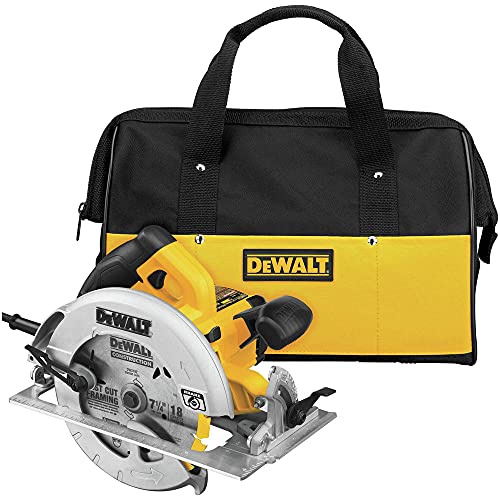
This DEWALT model adds an electric brake that stops the blade quickly after the trigger is released, enhancing safety during repetitive cuts. It shares the same 15-amp motor as the DWE575 and remains very lightweight at 8.8 pounds. The pivoting bevel design provides a broad range of cutting angles, supporting framing, decking, and finish work. If you value quick blade control and strong overall performance, this version is a strong pick.
Enventor Circular Saw Corded, 11A with Laser Guide

The Enventor 11A saw introduces a powerful copper motor and two blades (40T and 24T) for versatile cutting. A built-in laser guide and scale ruler help produce precise lines, while a 6.56-foot power cord adds reach when working away from outlets. The bevel range goes from 0° to 45°, with a maximum cutting depth of 2-7/16 inches at 90°. This model suits users who want accuracy and efficiency with laser-assisted cutting for woodworking projects.
CRAFTSMAN Circular Saw, 7-1/4 inch, 13 Amp, Corded (CMES500)

The CMES500 from CRAFTSMAN delivers robust 5,300 RPM for fast cuts and uses a 7-1/4 inch blade with 18T carbide tips for clean results. Blade changes are streamlined due to a spindle lock, making adjustments quicker on busy job sites. This model balances power, blade performance, and ease of maintenance, making it a practical choice for everyday carpentry and upgrades to a workshop toolkit.
Inequalit 4Amp Mini Circular Saw

The Inequalit mini circular saw is compact but capable, featuring a 4-amp motor with up to 3,500 RPM. It includes a laser guide and a rip guide to help maintain straight cuts, along with a dust extraction system and vacuum adaptor for cleaner work. The depth and bevel adjustments allow precision up to 45 degrees with a shallow footprint ideal for panelwork and small projects where a full-size saw would be unwieldy.
Buying Guide: How to Choose the Right Corded Circular Saw
- Power and speed: Look for a 13–15 amp motor for heavy-duty cuts and a steady rate of 5,000–6,000 RPM for clean, fast performance. A higher no-load speed helps with smoother cuts in hardwoods and thicker stock.
- Weight and balance: Lighter saws reduce fatigue on long projects, but ensure the tool remains stable and powerful enough for required tasks. A balanced grip improves control and reduces wobble during bevel cuts.
- Bevel and depth adjustments: Bevel ranges should cover common angles (0°–45° or 0°–57°) for framing, decking, and finish work. A clear depth scale helps you set consistent cut depths for dadoes and pocket-cutting.
- Safety features: Electric brakes, blade guards, and tool-free blade changes increase on-site safety and efficiency. Consider models with automatic braking for rapid stopping after release.
- Blade compatibility and quality: Common 7-1/4 inch blades with carbide tips work well for wood and composites. Check spindle size and blade change mechanisms to ensure quick blade swaps.
- Laser guides and auxiliary accessories: Laser guides aid accuracy, especially for long rip cuts. Dual blades or zero-clearance features can improve finish quality depending on your project type.
- Weight of accessories and cord length: Longer cords improve reach on larger jobs; consider vacuums or dust-collection compatibility to maintain a clean workspace.
- Warranty and brand support: Reputable brands with solid service networks offer better long-term value, replacement parts, and support for repairs.
- Budget and intended use: For occasional DIY, a mid-range saw with reliable safety features suffices. For frequent framing or cabinetry, prioritize power, bevel range, and ease of blade changes.