
As an Amazon Associate I earn from qualifying purchases.
Small CNC cutter shopping works best when you begin with a specific part. A fine engraving line, a pocket with a flat bottom and a sculpted surface can require different tool geometry even on the same machine. Pack quantity and coating color come later, after the cutter can fit your holder and suit the intended operation.
This guide compares five original end-mill sets. It concerns cutting tools rather than complete CNC machines, and it separates confirmed pack specifications from seller performance claims. We have not run machining trials or measured tool life, runout, surface finish or dimensional accuracy. The useful choice is an exact tool and process match, not a promise that every desktop router can machine every material named in a listing.
Write the job specification before opening a tool catalog
Start with the material identity, part drawing and intended operation. Record the smallest feature that matters, required depth and the finish you expect. Include whether this is an ordinary decorative project or a part whose dimensions or function need independent verification. Precision in a product title does not establish that the finished part will meet a tolerance.
Next, record the machine model, spindle or router, supported tooling and available holders. Have the machine manual ready when checking a candidate. A seller’s compatible-with-desktop-CNC statement cannot replace that machine’s actual limits.
Keep five requirements visible while comparing sets:
- Holding: the exact shank and an approved matching collet or holder.
- Geometry: a flat, ball or tapered profile appropriate to the planned feature.
- Reach: dimensions that can reach the work without an improvised mounting arrangement.
- Material: documented suitability for the identified workpiece.
- Process data: usable instructions for the cutter, operation and machine.
Read these selected packs as different tool collections
The Genmitsu forty-piece collection offers several profiles and sizes, while SpeTool’s four-piece set offers tapered ball tips with different radii. HOZLY’s selected ten-pack repeats a half-millimeter cutting diameter. The SainSmart ten-pack repeats a 3.175-millimeter flat-nose size. ASNOMY’s ten-piece HSS set covers larger metric cutting diameters. They solve different purchasing questions.
Decide whether you need a variety of tools or spare examples of one tool. A repeated-size pack should not receive credit for a diameter range it does not contain. Conversely, a mixed collection is only useful if the relevant tools fit your holder and have a defined job.
Five original candidates, with their specifications corrected
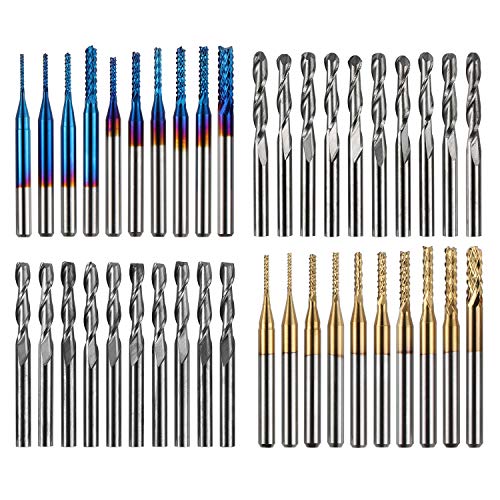
Genmitsu MC40A: forty-piece carbide collection
Compare the original cutter set on Amazon
The verified selection is the MC40A forty-piece collection with 3.175-millimeter shanks. The listing describes two-flute flat- and ball-nose tools at a 3.175-millimeter cutting diameter, plus two ten-size groups ranging from 0.8 to 3.0 millimeters. It states a seventeen-millimeter cutting length and thirty-eight-millimeter overall length.
The seller describes carbide construction with blue or titanium coatings. Its eight-hundred-minute continuous-machining claim is not an established life estimate for your project. Do not use it to schedule a job or compare cost per finished part without relevant performance evidence.
Buying decision: investigate this collection when several of its exact profiles and sizes have a defined role in your work. Confirm the holder fit, material and operating guidance for each chosen tool. The set’s breadth is convenient inventory, rather than proof that every included cutter should use the same settings.
SpeTool: four tapered ball-nose cutters

Compare the original cutter set on Amazon
The original SpeTool selection contains four tapered ball-nose carbide cutters with 1/8-inch shanks. Their stated tip radii are 0.25, 0.5, 0.75 and 1.0 millimeters. These values are radii, not diameters. The listing describes two flutes, a fifteen-millimeter cutting length and TiAlN coating.
Buying decision: investigate this set for a documented carving or contouring operation that calls for one of those tapered ball profiles. Obtain the relevant tool drawing and enter the actual taper and tip dimensions in your tool definition. A nominal shank size alone does not describe the shape that approaches the workpiece.
Its broad material list and promised smooth finish are seller statements. Confirm the exact material and process with the tooling and machine guidance. This collection is not interchangeable with a straight flat-nose cutter merely because both use a small shank.
HOZLY: ten 0.5 mm cutters

Compare the original cutter set on Amazon
The selected HOZLY package is ten cutters with a 0.5-millimeter cutting diameter and 3.175-millimeter shank. It is a repeated-size pack, not an assortment of micro diameters. The listing describes carbide with a titanium coating and identifies PCB and other precision-material applications.
Buying decision: investigate it when that exact small cutting diameter is required and your process is appropriate for the cutter. Confirm the usable cutting length and geometry directly; the current overview states a three-millimeter cutting length. Check that detail against the delivered specification before programming a deeper feature.
Do not follow a blanket rule that cutting length must exceed board thickness by a fixed amount. Reach, holding and clearance need tool- and setup-specific assessment. The selected quantity provides spare tools of one size; it does not establish that breakage is inevitable or that the machine can achieve a particular detail reliably.
SainSmart Genmitsu: ten 3.175 mm flat-nose cutters

Compare the original cutter set on Amazon
This original ten-pack is the selected blue-coated, two-flute spiral-upcut flat-nose set. The listing states a 3.175-millimeter cutting diameter and shank, seventeen-millimeter cutting length and thirty-eight-millimeter overall length. It is not the 0.8-to-3.0-millimeter assortment described in the earlier comparison.
The listed materials include several plastics, MDF and hardwood. Do not extend that information into an unrestricted metal-cutting recommendation or infer exact coating chemistry from color alone.
Buying decision: investigate the pack when a compatible straight flat-nose cutter of this size is appropriate and you want repeated examples of that tool. Check current material and cutting guidance. Having ten spares is a purchasing feature, not evidence of a longer-lasting edge or a guaranteed clean finish.
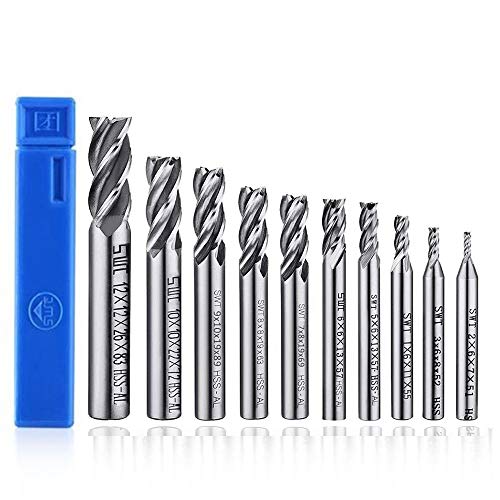
ASNOMY: ten-piece four-flute HSS collection
Compare the original cutter set on Amazon
The verified original selection is a ten-piece high-speed-steel set with four flutes. The listed cutting diameters are 2, 3, 4, 5, 6, 7, 8, 9, 10 and 12 millimeters. These are cutting diameters; do not assume they describe every tool’s shank or that all tools fit a 1/8-inch collet.
Buying decision: investigate the individual tools only where your machine, holder and operation support them. Obtain shank, length and material-specific operating information before ordering. A larger cutting diameter is not automatically suitable for a small high-speed router.
The listing describes general metalworking applications and other materials, but that does not establish your machine’s capacity for them. The overview’s finish field should not be treated as a complete coating specification. Confirm any property central to your purchasing decision instead of promoting an assumed construction detail.
Geometry and units: avoid a plausible-looking wrong tool
Read shank diameter, cutting diameter, tip radius, cutting length and overall length as separate specifications. Convert units only when needed, and keep the original dimensions in the tool record. For a spherical tip, diameter is twice the radius: a 0.5-millimeter radius means a one-millimeter tip diameter, rather than a half-millimeter tip diameter.
Harvey Performance’s ball-nose guide explains that effective cutting diameter can differ from nominal diameter when engagement is less than the full ball radius. That matters when obtaining appropriate cutting data. It does not provide a universal speed prescription for the SpeTool set.
For a tapered tool, request the drawing rather than guessing its complete shape from the tip radius. Check the tool definition used by your software against that drawing. A simulation built with a straight cylinder does not represent a tapered cutter just because the two definitions share a shank dimension.
Holding and reach: assess the assembled setup
Ask the machine or holder manufacturer about the approved shank, clamping arrangement and installation directions. Do not improvise a sleeve, grip an unsuitable section or assume the cutting diameter is the gripping diameter. Keep any necessary holder purchase separate from the advertised contents of the cutter set.
Sandvik Coromant’s milling application guide identifies rigid clamping, tool length and machine stability as relevant to vibration. Its illustrated industrial systems differ from these small-tool packs, but the guidance reinforces why an assembled setup deserves assessment rather than judging a cutter by coating alone.
Describe the feature depth and nearby obstacles to the tool supplier. Ask for an appropriate reach and mounting arrangement for your setup. Overall length is not an approved cutting depth, and a longer tool is not automatically a better purchase. Obtain dimensions that resolve the actual access problem.
Material and cutting data should match the operation
Provide the identified stock material and intended operation when requesting guidance. Wood, a named plastic grade and a specified metal alloy are more useful descriptions than soft material. Keep the supplier’s conditions with the recommendation rather than copying a material name into a universal approval list.
Harvey’s depth-of-cut guide distinguishes axial depth along the tool centerline from radial engagement across the work. It also distinguishes full-width slotting from peripheral cutting. Those are useful terms for describing the job; they are not permission to apply its example industrial parameters to an unidentified desktop setup.
Request cutting data for the exact tool, material and operation, then confirm that your machine can meet it within its instructions. Keep spindle speed, feed, engagement and any applicable cooling or extraction requirements together. A recommendation with one number missing is still incomplete.
Do not assume a slower feed always resolves a problem or that a coating allows high-speed work regardless of the machine. Seek appropriate technical guidance when parameters remain uncertain. This buying guide deliberately avoids an invented one-size-fits-all RPM, feed or depth recipe.
Plan the first job before purchasing a large collection
Choose an ordinary representative project with requirements you can describe. List which tools from the proposed set would perform each operation. If you cannot name a use for most of a mixed collection, that pack’s headline count may matter less than you expected.
Where the machine’s instructions allow a trial on representative stock, define what you intend to assess and how. Keep appearance, dimensions and tooling observations separate. A good-looking sample does not certify a functional part, prove a tool-life claim or validate unrelated settings.
Plan any software setup and training before the cutters arrive. Make sure the person preparing the tool definition has the exact geometry and understands the machine workflow. A new cutter package is not a replacement for learning how the machine, software and workholding interact.
Safe handling and maintenance are part of the purchase
The CCOHS milling-machine guidance calls for training, reading the manual, secure work and tooling, guards in place and stopping the machine before adjustments. It warns against gloves or loose items near running machinery and says not to leave a milling machine operating unattended. Follow the specific machine procedure and appropriate protective-equipment guidance.
Ask how each selected cutter should be cleaned, inspected and stored. Keep the original labeled compartments if they make tool identification easier. Do not treat a blue or gold finish as assurance that the tool needs no care, and do not invent a sharpening method for a small cutter.
For materials that require special dust, chip or coolant controls, resolve those requirements with appropriate instructions before machining. Broad listing material lists do not demonstrate that your workspace has the necessary controls. Include this requirement in the purchase plan rather than considering it after the tool is installed.
Compare value through the tools you will actually use
Compare delivered cost only after suitability is established. A mixed set, a repeated-size pack and a tapered-profile collection should be compared against different needs. Calculate price per usable tool for your own plan without assuming every supplied cutter will be used.
Include approved holders, any required support and the time needed to prepare the tool definitions. Keep spare quantity separate from expected life. A seller’s durability adjective cannot support a precise cost-per-cut calculation, and this comparison supplies no measured lifespan.
Read customer comments as questions to investigate. If someone reports fit or breakage issues, consider whether their tool, machine and operation resemble yours before drawing a conclusion. Give exact product drawings, manufacturer guidance and a documented setup greater weight than a generalized rating.
Three project briefs that change the shortlist
Detailed decorative lettering
Bring the drawing and the actual stock identity to the tooling discussion. Mark the narrowest feature and the intended depth, then ask what cutter profile can create that shape in an appropriate setup. A small number on the HOZLY listing does not establish that its tool is the correct choice for the lettering. Likewise, the SpeTool tip radius does not fully describe the width of a tapered tool farther from the tip.
The purchase decision should follow a tool definition and suitable process, rather than beginning with the smallest available diameter. Ask whether the candidate’s documentation resolves the intended operation. If the geometry remains uncertain, obtain a drawing or application clarification before ordering the pack.
A repeat job using one established flat-nose tool
Start with the documented tool and setup used for that job. Compare the SainSmart pack only if its selected geometry, shank and other important specifications match the requirement. Ten examples of the required cutter may be more relevant than forty tools with several profiles, but quantity alone does not show equivalent performance.
Keep the original process record and any supplier guidance available when comparing the order. Do not silently substitute the same cutting diameter with another profile or a different usable length. Where an important specification is missing, treat the proposed substitute as unresolved.
A new metalworking project on a small machine
Provide the alloy, intended operation and machine model before choosing from the ASNOMY collection. Ask which individual tool, if any, the documented setup supports. Its broad metric range does not prove that the largest cutter can fit or operate appropriately on your machine.
Include workholding and the available spindle range in the discussion. If the advice relies on equipment or conditions you do not have, that is a reason to reconsider the project plan. Choosing a smaller tool from the same package does not automatically resolve all those requirements. A useful supplier answer identifies an actual supported combination, not merely a material appearing in the listing.
A compact pre-order decision
- The part, material, intended operation and important requirements are identified.
- The selected set contains the geometry and dimensions you actually need.
- Shank and holder fit are confirmed without improvisation.
- Reach and clearance are checked for the assembled setup.
- Suitable operating guidance is available and within machine limits.
- Tool definitions, workholding, training and maintenance are planned.
- Value is based on usable tools, rather than unverified life or accuracy promises.
On delivery, compare the package label and supplied tools with the selected order before placing them in your inventory. Retain their identifying information with the tool record, particularly where several visually similar profiles share a storage box.
Buy the tool collection that resolves those questions for a known job. Leave unresolved applications out of the shortlist until the relevant machine and tooling information supports them.