
HVAC leak detectors are essential tools for technicians aiming to locate refrigerant leaks quickly and safely. The right detector combines sensitivity, reliability, and ease of use to minimize downtime and protect the environment. This guide highlights five top-rated models, detailing their capabilities so you can choose the best fit for residential, commercial, or automotive HVAC work.
Product Overview Summary:
- Fieldpiece DR58 – Ultra-sensitive heated diode detector with backlit LCD; detects leaks <0.03 oz/yr; wide refrigerant compatibility.
- SENSYX SFD201 – Rechargeable, cordless, highly sensitive with Japan-made sensor; adjustable sensitivity.
- Elitech ILD-200 – Infrared sensor; fast response; detects all halogenated gases with high precision.
- Fieldpiece DR82 – Infrared leak detector; <0.03 oz/yr sensitivity; durable and long-lasting sensor.
- Inficon 705-202-G1 – Heavily used model with 0.25 oz/yr sensitivity; broad refrigerant detection.
Fieldpiece DR58 Heated Diode Leak Detector

The Fieldpiece DR58 is designed for ultra-sensitive leak detection using a heated diode sensor. It identifies micro leaks rapidly, capable of locating leaks smaller than 0.03 oz/yr. The detector supports all major refrigerants used in HVACR, including HFCs, CFCs, HCFCs, and HFOs, as well as tracer gases and blends. A robust IP54-rated sensor resists moisture and oil, with a long sensor life up to 300 hours, ensuring reliability in challenging field conditions. The large backlit LCD screen provides readable readings in various lighting environments, improving workflow efficiency for technicians who work in attics, basements, or outdoor units.
Key features include ultra-sensitivity, broad refrigerant compatibility, and a durable sensor designed for professional use. The combination of a lightweight build and a user-friendly display helps technicians quickly verify leaks during service calls, maintenance, or evacuation procedures.
SENSYX Rechargeable HVAC Refrigerant Leak Detector

The SENSYX SFD201 detector emphasizes cordless operation with a rechargeable lithium battery and USB-C charging. Its high-sensitivity sensor uses a Japan-made heat dioxide semiconductor to detect gas leaks with reliability, making it suitable for HVACR and automotive applications. The device features adjustable sensitivity with High/Low levels, allowing technicians to tailor detection to the environment (e.g., busy mechanical rooms or tight service spaces). A user-friendly interface and mobile-friendly power setup enhance onsite productivity, eliminating frequent power interruptions during inspections.
This model balances portability with robust detection capabilities, providing dependable performance across a range of refrigerants. The rechargeable design reduces the need for constant battery management on long field days, and the adjustable sensitivity helps technicians differentiate between background readings and real leak signals.
Elitech ILD-200 Infrared Leak Detector
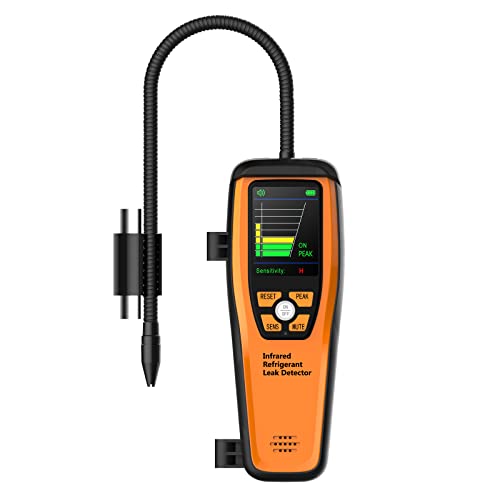
The Elitech ILD-200 uses an infrared sensor to deliver fast response and strong anti-interference performance compared with heated diode devices. It provides high sensitivity with adjustable High/Medium/Low settings, with a maximum sensitivity up to 0.14 oz/yr. This detector is capable of identifying all halogenated refrigerants, including CFCs, HFCs, HCFCs, HFOs, and mixed refrigerants and blends. Infrared technology typically offers longer sensor life and quicker recovery time after exposure to refrigerants, making it a solid choice for high-demand HVAC environments.
Its design emphasizes efficiency and accuracy, allowing technicians to pinpoint leaks in complex systems such as multi-branch networks or equipment with restricted access. The ILD-200 is well-suited for service technicians who require reliable readings under varying temperatures and ambient conditions.
Fieldpiece DR82 Infrared Refrigerant Leak Detector

The Fieldpiece DR82 is an infrared refrigerant leak detector engineered for rapid micro-leak detection. It shares the same high-sensitivity performance as Fieldpiece’s heated diode model, capable of detecting leaks below 0.03 oz/yr. It supports all refrigerants used in HVACR work and features a durable IP54-rated sensor, designed to resist moisture and oil exposure. The unit’s 10-year sensor life helps minimize maintenance costs and downtime, making it a dependable choice for service crews who perform regular leak checks on residential and commercial systems alike.
With its lightweight construction and clear display, the DR82 offers a balance of precision and practicality. It is suitable for technicians who need a quick, accurate read in tight spaces, such as near condensers, panels, or ductwork where leaks may be localized to specific components.
Inficon Inficon Refrigerant Leak Detector Model 705-202-G1
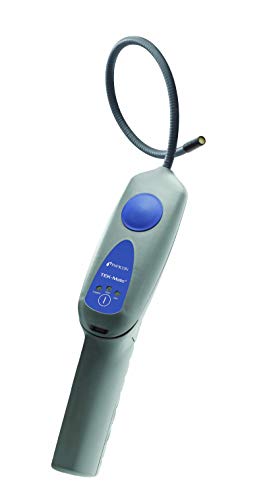
The Inficon 705-202-G1 is a widely used refrigerant leak detector featuring a heated diode sensor with a sensitivity of about 0.25 oz/year (7 g/year). It detects all CFCs, HCFCs, HFCs, and HFOs and is A2L certified, marking reliability for professional HVAC contractors. The model is designed for accuracy and stability across a range of refrigerants and environmental conditions, making it a popular choice for service teams that manage mixed refrigerant systems. The device’s performance is well-documented in field deployments, providing dependable leak checks and contributing to faster service outcomes.
Elitech ILD-100H Handheld Leak Detector

The Elitech ILD-100H model features a heated diode sensor designed for halogenated refrigerants, delivering precise readings for R22, R410A, R134A, and related gases. Its TFT display presents readings, sensitivity levels, battery status, and leak alerts in a clear, color-rich interface. The detector supports adjustable High/Medium/Low sensitivity, enabling technicians to calibrate responses according to system complexity and ambient conditions. The compact form factor makes it suitable for mobile technicians who require quick checks in confined spaces such as rooftops or equipment closets.
Buying Guide: Key Purchase Considerations
- Sensitivity and speed: For small leaks, prioritize detectors with low oz/yr sensitivity such as <0.03 oz/yr and fast response times. Heavily residential-focused models may suffice with moderate sensitivity, while commercial and automotive jobs benefit from top-tier sensitivity.
- Sensor type: Heated diode sensors provide strong baseline performance for most refrigerants, while infrared sensors offer faster responses and longer life but can be more expensive. Consider the refrigerants you encounter most often.
- Refrigerant compatibility: Ensure the detector covers CFCs, HCFCs, HFCs, HFOs, and blends you work with. Some models explicitly mention tracer gases or specific blends.
- Durability and maintenance: IP ratings (like IP54) and sensor lifespans (10–300 hours) influence field reliability. A rugged unit reduces service interruptions and replacements.
- Display and usability: Large backlit or TFT screens improve visibility in dim spaces. Intuitive controls and adjustable sensitivity simplify operation under pressure.
- Power options: Rechargeable batteries with USB-C charging enhance mobility, especially for field technicians who work long shifts without ready electrical access.
- Brand and support: Established brands with long-term parts and accessory support help ensure device longevity and easier maintenance.
For choosing the best model, align device capabilities with your typical work environment. If you frequently handle diverse refrigerants or work in confined spaces, prioritize high sensitivity, infrared technology, and a durable design. If you mostly perform routine checks on residential systems, a balance of portability, ease of use, and broad refrigerant compatibility may be ideal.