
For professionals and serious landscapers, a gas-powered pole saw that delivers reach, power, and reliability can save hours of work. This guide highlights five top options designed to handle thick branches, long reach, and demanding trims. Each product features a robust engine, extended reach, and user-friendly design to keep job sites efficient and safe.
Summary table of selected products:
| Product | Brand | Approx. Engine | Reach / Extension | Bar Length |
|---|---|---|---|---|
| Husqvarna 122LKP Gas Pole Saw | Husqvarna | 21.7cc | Up to 12-foot reach | 12″ |
| PROYAMA 42.7cc Adjustable Pole Saw | PROYAMA | 42.7cc | Up to 15 ft reach with extension | 12″ |
| Homdox 58cc Pole Saw | Homdox | 58cc | Up to 16 ft reach | 11.5″ |
| COOCHEER Gas Powered Pole Saw | COOCHEER | 58cc | Up to 16 ft reach | 11.5″ |
| ECHO PPT-2620 | ECHO | 25.4cc | Telescoping to over 12 ft | 12.1″ |
Husqvarna 122LKP Gas Pole Saw: Compact Power With X-CUT Performance

The Husqvarna 122LKP combines portability and reach for professional pruning tasks. It features a 21.7cc engine and an extended pole-saw attachment that reaches high branches up to 12 feet away, reducing the need to climb. The included X-CUT chain is designed for lasting sharpness and top-tier performance, ensuring efficient cuts through hardwoods. An automatic oiler helps maintain bar and chain life, promoting reliability during long workdays. This model suits professionals who need a nimble tool for seasonal trimming on multi-story properties.
PROYAMA 42.7cc Adjustable Pole Chainsaw for Tree Trimming

PROYAMA’s 42.7cc gas-powered pole saw emphasizes versatility and reach. Its multi-angle cutting head allows precise positioning, reducing the risk of accidental injury by enabling cuts from a safer vantage. The system extends from about 8.2 to 11.4 feet, with an articulated extension to approximate a 15-foot reach when factoring user height. The 12-inch Oregon bar provides substantial cutting capacity, enabling efficient trimming of thicker branches. This model is well-suited for arborists requiring adaptable angle control without sacrificing power.
Homdox 58CC Pole Saw: Extended Reach and Robust Power
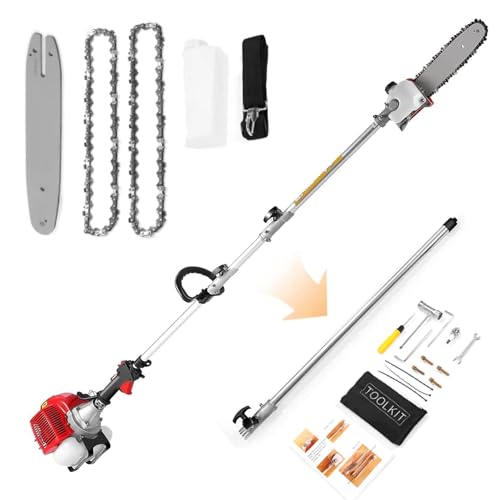
Homdox delivers strong performance with a 58cc engine and an overall reach of up to 16 feet, supported by an 11.5-inch guide bar. The design emphasizes efficiency and durability, with a high-speed chain to tackle thicker limbs. A detachable extension and ergonomic handling help reduce fatigue on longer jobs. This unit targets professional landscapers who require reliable power for mid- to large-diameter branches without frequent refueling.
COOCHEER Gas Powered Pole Saw: Heavy-Duty Cutting for Taller Trees
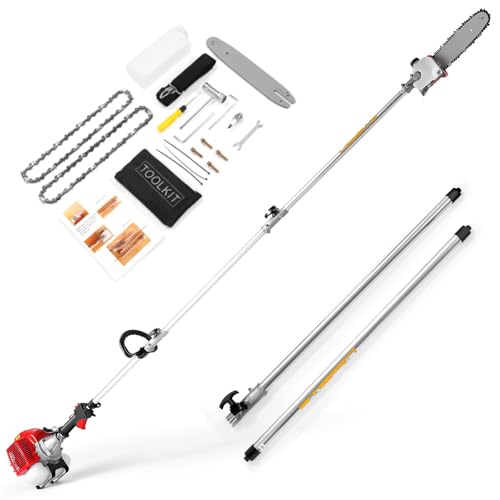
COOCHEER offers a 58cc, 2-cycle gas saw with a robust reach up to 16 feet. The extension pole and 11.5-inch bar pair to handle dense branches quickly, with a 8200 rpm maximum speed to maintain cutting momentum. The unit is designed for reliable yard work and trimming from ground level or elevated positions, reducing the need for ladders or climbs on taller trees. It’s positioned for professionals who demand steady power and extended reach in one tool.
ECHO 12 in. 25.4 cc Gas Pole Saw: Compact Yet Capable

The ECHO PPT-2620 pairs a 25.4 cc gas engine with telescoping capability to reach over 12 feet, thanks to its integrated shaft extension. While compact, it offers dependable power for trimming smaller-to-midsized branches with precision. Its design suits professionals who require a lighter tool for routine maintenance and pruning on larger properties that do not demand maximum torque on hardwoods.
Buying decisions for commercial pole saws rest on several factors. Users should weigh reach versus weight, engine displacement against fuel economy, bar length for cutting capacity, and the ease of maintenance. Operators must consider noise regulations and the availability of replacement parts and service. For frequent elevated work, safe handling, balance, and anti-vibration features are critical. Each model above offers a distinct balance among reach, power, and maneuverability to fit different professional landscapes.
Buying Guide: Key Considerations for Commercial Gas-Powered Pole Saws
- Reach and extension: Long poles increase safety and reduce ladder use, but heavier units can tire operators. Look for adjustable or extendable poles with secure locking mechanisms.
- Engine displacement and power: Higher CC engines deliver more cutting力 through thick limbs but may consume more fuel and weigh more. Match power to typical job requirements (softwood vs hardwood).
- Bar length and cutting capacity: An 11.5″ to 12″ bar is common for pruning; larger bars cut thicker branches but add weight. Consider your typical limb diameter.
- Chain quality and oiling: Durable chains and auto-oiling systems extend bar life. X-CUT or Oregon chains are well-regarded for durability and sharpness.
- Weight, balance, and ergonomics: Anti-vibration features, comfortable grips, and balanced design reduce fatigue on long jobs.
- Maintenance and service: Easy access to spark plugs, air filters, and fuel lines matters. Check for widely available replacement parts and service networks.
- Safety features: Low kickback bars, chain brakes, and sturdy harness compatibility help minimize risk when trimming from height.
- Fuel efficiency and running time: Gas pole saws vary in run time; factor in your daily workload to pick a model with reliable fuel economy.
- Attachments and versatility: Some models offer multi-angle heads or additional extensions, enabling more precise cuts in awkward positions.
- Warranty and support: A solid warranty and responsive customer support reduce downtime and maintenance costs on professional jobs.
When selecting a model, consider a mix of reach, power, and weight that aligns with your typical properties, tree species, and trimming tasks. For crews performing high-limb pruning on multiple properties, a higher-displacement engine with extended reach—such as the 58cc options—can improve efficiency on thick branches, while lighter models with substantial reach suit more frequent, smaller tasks. Always prioritize safety features and maintenance accessibility to sustain performance across demanding seasons.