
Choosing the right solar panels involves balancing efficiency, durability, and the intended use. The following selections highlight top on-grid and hybrid-ready panels and kits that perform well in American environments, including homes, RVs, boats, and cabins. Each option emphasizes high efficiency, weather resistance, and strong value for long-term energy independence.
Summary of Selected Products
| Product | Brand | Type / System | Key Highlight |
|---|---|---|---|
| SUNGOLDPOWER 10PCS 500W Solar Panels | SGPWOSAY | Off-Grid / On-Grid Hybrid | Mono PERC Half-Cut Technology, up to 21.05% efficiency |
| Renogy Solar Panels 1180W 12V/24V N-Type Bifacial | Renogy | On-Grid / Off-Grid | Double-sided power, up to 5–30% extra output |
| ECO-WORTHY 10000W Complete Off-Grid Solar Panel Kit | ECO-WORTHY | Off-Grid / Hybrid | Complete kit with two 48V Li-ion batteries and 5kW inverter |
| ECO-WORTHY 400W Solar Panels 4x100W | ECO-WORTHY | Off-Grid / Portable | Low-light performance with 23% efficiency |
| Renogy 200W Portable Foldable Panel | Renogy | Portable / Off-Grid | Industry-leading efficiency and compact folding design |
SUNGOLDPOWER 500W Modular Solar Panels

The Sungoldpower 500W panel set uses Mono PERC half-cut technology to maximize energy yield per surface area, achieving module efficiency up to 21.05%. Designed for both off-grid and grid-tied applications, these panels are suitable for RVs, tiny houses, marine setups, and residential backup systems. The half-cell construction improves shade tolerance and overall power output, making it a robust choice for variable American weather. The IP68 waterproof rating supports outdoor mounting, while the high tolerance design enhances longevity under challenging conditions.
Renogy 1180W N-Type Bifacial Panels (2 × 590W)

Renogy’s bifacial N-Type panels push efficiency higher with a dual-sided design and advanced 16BB cell technology, delivering up to 25% higher conversion efficiency under optimal conditions. The bifacial backsheet can add 5%–30% more energy by capturing reflected light, boosting real-world output. These panels are built with a corrosion-resistant aluminum frame and IP68-rated junction box for reliable outdoor use, even in windy or snowy environments common across many U.S. regions.
ECO-WORTHY 10000W Complete Off-Grid Solar Panel Kit
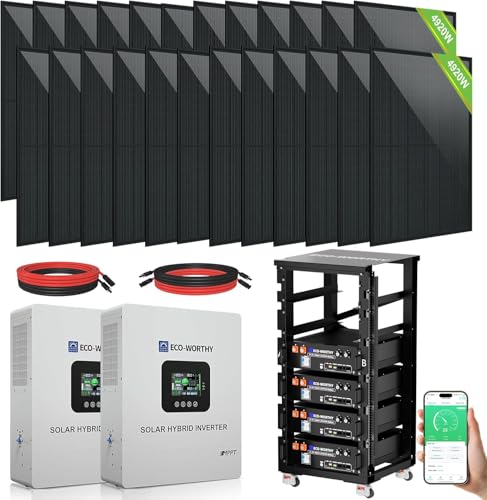
This ECO-WORTHY complete kit targets full off-grid independence, offering 9840W of panel capacity, two 5000W inverter/charger units, and a 10 kWh storage solution with lithium batteries. The system supports 120V/240V split-phase outputs and networked monitoring through mobile apps. It is designed for homes, cabins, and larger RV setups seeking substantial energy reserves and the ability to operate appliances with high startup power needs. The modular design allows expansion by paralleling additional inverters and batteries as power demand grows.
ECO-WORTHY 400W Solar Panels (4×100W)

This four-panel set emphasizes excellent low-light performance and solid durability. With 23% efficiency and PERC technology, the panels deliver about 1600Wh per day under four hours of sun, depending on location. They feature IP65-rated junction boxes, impact-resistant tempered glass, and a corrosion-resistant aluminum frame designed to endure high winds (up to 2400Pa) and heavy snow loads. The kit’s design prioritizes longevity and steady output across a range of climates, from the Northeast to the Southwest.
Renogy 200W Portable Foldable Solar Panel

Renogy’s portable 200W foldable solar panel focuses on compact transport without sacrificing efficiency, achieving up to 25% with upgraded N-Type cells. The foldable design, magnetic closure, and light weight make it ideal for RVs, camping, or emergency backup. It includes MC4 output for straightforward charging of power stations, batteries, or 12V systems, delivering reliable performance in tight spaces or during travel where fixed rooftop panels are impractical.
Buying Guide: Key Purchase Considerations
- Power needs and system type: Determine whether you aim for grid-tied, off-grid, or hybrid operation. Large homes or backup systems benefit from higher total wattage and robust inverters, while portable or compact setups prioritize weight and foldability.
- Panel technology and efficiency: Mono vs. poly, PERC, and bifacial designs impact output and shade tolerance. Higher efficiency panels save space on rooftops or in mobile installations but may come at a higher upfront cost.
- Durability and weather resistance: Check IP ratings for junction boxes, frame corrosion resistance, and wind/snow load tolerances. Regions with harsh winters or coastal exposure may require stronger frames and waterproofing.
- System expandability: If future growth is likely, choose kits that support additional panels, inverters, or battery banks. Parallel inverter configurations can scale AC output efficiently for larger homes.
- Battery compatibility and monitoring: For off-grid or hybrid systems, battery chemistry (LiFePO4, for example) and a robust monitoring app are essential for long-term reliability and maintenance.
- Installation and mounting: Ensure mounting hardware compatibility with your roof type or trailer, and consider modular panels that simplify on-site assembly and alignment.
- Return policy and warranties: Look for panels with 25-year performance warranties and inverters with solid warranties. Manufacturer support can be crucial for long-term reliability.
- Cost of ownership: Compare installation costs, maintenance, and potential tax incentives or rebates available in your state to understand total lifetime value.
The selections above offer a balance of high efficiency, robust build quality, and practical applications across homes, RVs, boats, and off-grid cabins. When evaluating options, align panel specifications with your daily energy usage, climate, and space constraints to optimize both upfront investment and long-term savings.