
Choosing the right inverter is essential for a reliable photovoltaic (PV) setup. This guide highlights five top-rated inverters that balance efficiency, reliability, and versatility for off-grid, backup, and on-grid applications. Each product section includes key features to help you compare performance, safety, and compatibility with solar arrays. A concise buying guide at the end covers essential considerations such as power needs, battery compatibility, and expandability to help you select the best match for your system.
| Product | Brand | Type | Key Strength |
|---|---|---|---|
| 5000W Power Inverter DC 12V to AC 110V/120V | EFFORTWAY | Off-grid / RV Inverter | High continuous power with LCD and remote |
| SUNGOLDPOWER 5000W DC 48V All-in-One Inverter | SGPWOSAY | Hybrid Solar Inverter Charger | Integrated MPPT, multiple charging modes |
| ECO-WORTHY Home Power Station Backup Power | ECO-WORTHY | Hybrid Inverter + LiFePO4 Bank | Expandable storage, Bluetooth/WiFi monitoring |
| PowMr 2400W Solar Inverter with 50A PWM Controller | PowMr | Hybrid Inverter | Four charging modes, good efficiency |
| ROARBATT 4000W Pure Sine Wave Inverter | ROARBATT | Inverter with Remote | High continuous power, robust protection |
Effortway 5000W Inverter With LCD Display

The Effortway inverter converts 12V DC to 110V/120V AC with a continuous 5000W rating and a 10000W peak. It features an LCD display that shows input/output voltage, battery capacity, load, and error codes, aiding troubleshooting. A wireless remote provides control up to 16 feet, enabling flexible operation in RVs, off-grid setups, or emergency power scenarios. The unit targets heavy-duty use for camping, motorhomes, trucks, and solar-powered systems, delivering efficient conversion with dependable performance for diverse power needs.
SUNGOLDPOWER 5000W All-in-One Solar Inverter

This all-in-one solar inverter integrates an 80A MPPT solar charger and a 40A AC charger, delivering up to 5500W PV-enabled output. It provides a pure sine wave at 110V AC and supports four charging/ output modes (AC Priority, Solar Priority, Only Solar, and Hybrid). It does not support parallel operation, but its multi-mode flexibility suits backup power, home off-grid systems, and solar-dominant configurations. The unit supports diverse loads including appliances, computers, and HVAC with stable AC output and clear mode switching.
Eco-Worthy Home Power Station Backup Power
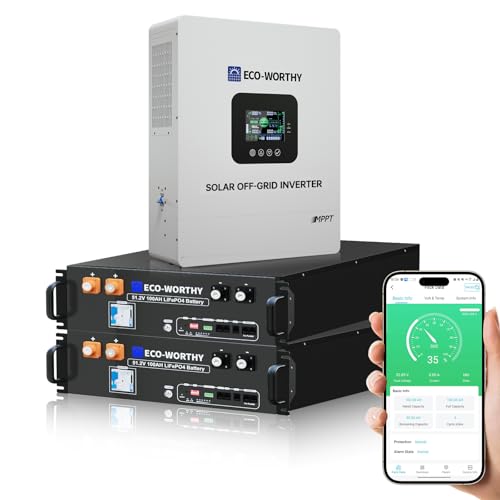
The Eco-Worthy solution combines a 5000W inverter with LiFePO4 batteries and built-in MPPT charging. It supports multiple charging methods (solar, AC mains) and offers Bluetooth/Wi-Fi monitoring. The system is designed for home backup and solar applications, with parallel capability to scale up to 30 kW when adding additional inverters and up to 76.8 kWh of storage with battery expansion. Battery management, safety features, and robust construction make it suitable for long-term energy resilience in homes and remote properties.
PowMr 2400W Solar Inverter with 24V System

The PowMr 2400W inverter converts 24V DC to 110/120V AC with a pure sine wave output and includes a 50A PWM charge controller. It offers four charging modes and three output modes to accommodate solar, utility, or hybrid charging strategies. The device is designed for homes, RVs, and off-grid applications, ensuring efficient energy conversion with a focus on low emissions and reliable operation in diverse environments.
ROARBATT 4000W Pure Sine Wave Inverter

The ROARBATT inverter provides continuous 4000W with an 8000W peak, delivering a pure sine wave suitable for sensitive electronics, computers, and home appliances. It includes a remote control, four outlets, dual USB ports, and an LED display for monitoring. Built with an aluminum housing and a cooling fan, it aims to balance performance and durability in mobile, RV, or solar setups, helping maintain stable power during outages or remote operations.
Buying Guide: Key Purchase Considerations
Power requirements: Assess the total wattage of devices you plan to run simultaneously. Choose an inverter with a continuous (rated) power above your peak load to avoid tripping or shutdowns.
Voltage and waveform: Pure sine wave inverters protect sensitive electronics and ensure compatibility with most appliances. Check that the output voltage matches your region (typically 110-120V in the US).
Battery compatibility: Verify battery chemistry (LiFePO4, lead-acid), voltage (12V, 24V, 48V), and whether the system supports parallel expansion. This affects resilience and future upgrades.
Charging methods: In hybrid units, consider MPPT efficiency, solar input compatibility, and AC charging speed. Four-mode options offer flexibility for off-grid and grid-tied scenarios.
Monitoring and control: LCD displays, remote controls, and wireless connectivity help you track status, usage, and battery health. Look for remote start/stop and error reporting features.
Safety and build quality: Look for over/under voltage, short-circuit, overheat, and grounding protections. Aluminum housings and robust cooling improve durability in outdoor or vehicle installations.
Expandability: For long-term PV systems, growth is common. Units that allow additional inverters or increased battery capacity can scale with growing energy needs.
Environment and certifications: Consider IP ratings for weather resistance and compliance with standards relevant to your location and installation type.