
Discover top-tier 24V all-in-one inverter chargers designed to simplify off-grid living, home energy storage, and backup power. This guide highlights five reliable models that integrate MPPT solar controllers, inverters, and battery chargers into a single unit, offering UPS features, multiple charging modes, and robust protection. Each option supports various 24V battery chemistries and priorities, making it easier to manage solar energy and grid power efficiently.
| Product | Brand | Output (W) | MPPT (A) | Battery Types | Key Benefit |
|---|---|---|---|---|---|
| LiTime 24V 3000W All-in-One Solar Inverter Charger | LiTime | 3000 | 60 | Lead-Acid, Lithium, User Mode | UPS function, versatile output modes |
| SUMRY Solar Inverter Charger, 3600W DC 24V | SRGFTS | 3600 | 120 | AGM/Lithium/LF | High surge, built-in MPPT, pure sine wave |
| 3600W Hybrid Solar Inverter 24V | Generic | 3600 | 120 | Lead-Acid, Lithium | Hybrid solar charging, high efficiency |
| GIANDEL 4000W 24V Pure Sine Wave Inverter | Giandel | 4000 | — | Lead-Acid, Lithium | UL458 GFCI outlets, robust protection |
| SUNGOLDPOWER 3000W DC 24V Solar Inverter Charger | Sungoldpower | 3000 | 60 | Lead-Acid, Lithium | All-in-one with multiple modes, UPS option |
LiTime 24V 3000W All-in-One Solar Inverter Charger

The LiTime model integrates a 24V inverter, MPPT controller, and battery charger, delivering up to 3000W continuous power with a 9000W surge for demanding loads. It provides UPS functionality and supports multiple output modes to adapt to home storage or off-grid systems. Compatibility spans 24V lead-acid and lithium chemistries, including user-defined configurations. Real-time monitoring is accessible via built-in LCD and indicators, simplifying system management.
Features include: 60A MPPT, 9000W surge, UPS, LCD display, and flexible mode selection (MPPT First, Grid First, Inverter First). The unit is designed for seamless integration with standard 24V battery banks and can be paired with various LiTime battery options for scalable storage.]
SUMRY Solar Inverter Charger, 3600W DC 24V to AC 110V

The SUMRY 3600W inverter combines a 24V MPPT solar charger (120A) and a 100A AC battery charger in one robust unit. It operates with a wide PV input range (60V-500VDC) and provides a pure sine wave 110/120VAC output suitable for a broad range of household and sensitive electronics. It supports both battery-backed and battery-less operation, including AGM, Gel, Lead-Acid, and LiFePO4 chemistries. It can function with PV power alone when battery usage is not feasible, given sufficient PV input.
Key benefits include four charging modes (AC Priority, Solar Priority, Only Solar, Hybrid) and three output modes, along with an optional WiFi remote monitor. Uninterruptible power supply is available to prevent outages during grid disruptions and outages. The unit supports flexible integration for off-grid homes or hybrid mains systems.
3600W Hybrid Solar Inverter 24V DC to 110V AC

This hybrid inverter converts 24V DC to 110/120V AC with 3600W continuous and 7200W peak output. It features a built-in 120A MPPT charge controller and supports up to 4200W PV input. The unit is designed for RVs, cabins, and off-grid homes, with a high 500V max PV input and 40A AC input. Real-time monitoring is provided by an LCD screen and indicator LEDs to aid configuration of charging current, voltage thresholds, and priority modes.
The device emphasizes reliable performance in mixed-energy environments (solar plus generator or grid). It supports multiple charging strategies and ensures a quick transition to battery power during outages. It is suitable for users seeking a balanced, mid-range capacity system with strong MPPT efficiency and clear system visibility.
GIANDEL 4000W 24V Pure Sine Wave Inverter

The Giandel 4000W inverter provides a pure sine wave output, converting 24V DC to 110/120V AC with a 7000W surge for short bursts. It includes UL458-listed GFCI outlets for enhanced safety and a broad protection suite, including under/over-voltage and over-temperature safeguards. The larger 4000W rating makes it suitable for higher-demand appliances such as microwaves, air conditioners, and other heavy loads in RVs or off-grid setups.
The inverter ships with an LED/LCD display to monitor input and output voltages, load, and system status. It is designed to protect connected devices while delivering grid-like performance. This model is widely used for reliable, high-capacity off-grid or backup power installations where safer electrical protection is valued.
LiTime 5000W Solar Hybrid Inverter Charger
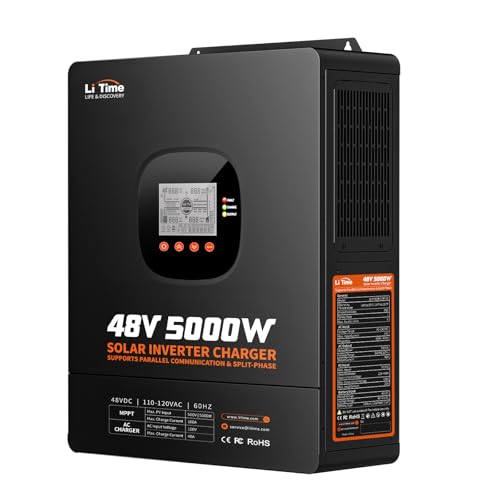
Note: The LiTime 5000W model uses a 48V system and supports parallel operation for higher output. It includes a built-in 100A MPPT controller, 50A battery charging, and dual-mode operation suitable for 48V residential backup, off-grid, and farm applications. It enables up to 30kW when multiple units are paralleled, offering scalable power and UPS-like capabilities for larger loads.
The unit supports split-phase outputs and is designed for seamless energy management, with an emphasis on continuous power delivery and load shifting. Applications include home backup, remote cabins, and small commercial setups leveraging parallel configurations for expanded capacity.
LiTime 3500W All-in-One Solar Inverter Charger

The LiTime 3500W unit integrates a built-in 80A MPPT charge controller, 3500W inverter, and charger in a compact footprint. It supports 48V battery configurations, auto solar tracking, and multiple output modes. Its UPS functionality helps protect sensitive devices during outages. This model is designed for off-grid homes, cabin use, and small energy storage systems that require reliable, integrated power management.
With four charging modes (Solar Only, Utility Priority, Solar Priority, Hybrid) and three output modes (Inverter Priority, PV Priority, Utility Priority), the system offers flexible energy management. The model emphasizes energy savings and efficient solar utilization in 48V configurations.
Buying Guide: Key Considerations For 24V All-In-One Inverter Chargers
When selecting a 24V all-in-one inverter charger, consider these dimensions to match your needs:
- Power and surge: Check continuous wattage and surge capacity to handle startup loads like refrigerators or tools. Higher surge ratings support brief peak demands.
- MPPT charger strength: A higher MPPT current and a wide PV input range improve solar harvesting and system responsiveness under varying light conditions.
- Battery compatibility: Verify support for lead-acid, lithium, and user-defined configurations. Ensure the unit aligns with your battery chemistry and size.
- UPS and transfer time: A fast switch to battery power protects electronics during outages. Confirm transfer speed and latency.
- Output modes and priority settings: Evaluate whether the unit supports inverter-first, PV-first, or grid-first modes to align with your energy strategy.
- Protection features: Look for over-voltage, under-voltage, over-temperature, short-circuit, and EMI protections for safety and longevity.
- Remote monitoring: Some models offer WiFi or LCD/LED dashboards for real-time system data and control. Consider ease of access and app availability.
- Parallel capability: If future expansion is planned, check whether units can be paralleled to scale output (for LiTime 5000W-style or similar systems).
- Physical build and warranty: Confirm enclosure durability, corrosion resistance for outdoor setups, and warranty terms for long-term confidence.
Comparative notes: 24V all-in-one inverters balance capacity and integration. For smaller off-grid cabins or backup systems, a 3000–3600W unit with 60–120A MPPT is typically sufficient and cost-effective. For higher-demand homes or workshops, consider 4000W–5000W options with robust MPPT and parallel capabilities. Always align device selection with your battery bank size, expected solar input, and daily load profile to optimize performance and reliability.