
Choosing the right solar inverter with battery storage requires balancing capacity, efficiency, expansion options, and integration with existing solar panels or battery banks. The following selections are top options for American households seeking reliable off-grid or backup power, with built-in MPPT controllers, multiple charging modes, and scalable storage capabilities. Each product is evaluated for performance, protection features, and ease of use, helping you compare setups from compact starter kits to higher-capacity hybrid systems.
style=”font-weight:bold”>Buying summary table
| Product | Brand | Key Capabilities | Highlights |
|---|---|---|---|
| SUNGOLDPOWER 10000W 48V Inverter (UL1741) | SGPWATT | 10000W rated, 200A charging, 2 MPPT, 120/240V output, WiFi/BMS | All-in-one high power, multiple charging modes |
| ECO-WORTHY 200W Starter Kit | ECO-WORTHY | 200W panel, 30A controller, 50Ah Li battery, 600W inverter | Beginner-friendly, compact solar setup |
| ECO-WORTHY 5KW Off Grid System | ECO-WORTHY | 195W panels x12, 5KW hybrid inverter, 51.2V 100Ah Li battery | Strong off-grid capability with parallel battery compatibility |
| LiTime 24V 3000W All-in-One | LiTime | 3000W inverter, 9000W surge, 3 output modes, UPS | UPS-ready, versatile charge modes |
| ECO-WORTHY Home Power Station (20480Wh) | ECO-WORTHY | 5000W inverter, 48V LiFePO4, 163.84kWh expandable, Bluetooth/WiFi | High-capacity home backup and expandability |
SUNGOLDPOWER 10KW Inverter With Built‑in MPPT

The SUNGOLDPOWER 10KW DC 48V inverter combines a pure sine wave inverter with inbuilt MPPT solar controllers and a robust charging capacity. It supports up to 200A battery charging and can operate in 120V/240V split-phase or 120V single-phase output. A WiFi module enables remote monitoring of status and parameters via a mobile app, providing real-time insight into system performance. This model allows parallel expansion up to six units, enabling scalable backup power for larger homes or workshops.
Key protections include PV input over-voltage/current protection, AC input over-voltage protection, battery over-voltage protection, and overload protection. Four charging/output modes—Hybrid, Utility Priority, Solar Priority, and Only Solar—offer flexibility to match weather, grid conditions, and load requirements. The inverter is positioned for users who want high-capacity, reliable power in a mixed solar-plus-battery setup.
ECO-WORTHY 200W Complete Solar Starter Kit
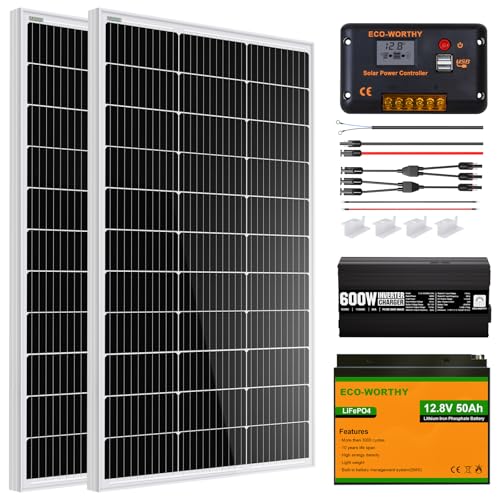
This beginner-friendly kit bundles a 200W solar panel with a 30A charge controller, 50Ah LiFePO4 battery, and a 600W solar power inverter. It provides a simple path into solar storage for RVs, campers, boats, or small off-grid cabins. The panel uses a compact 21% efficiency mono-crystal design, with durable framing and tempered glass for outdoor use. The included LiFePO4 battery promises longer cycle life and safer operation compared to traditional lead-acid systems.
With IP65 protection and a compact footprint, the kit is designed for easy setup and reliable daily use. It’s an optimal choice for individuals starting to explore residential or mobile solar storage, offering straightforward integration and practical energy generation with room to scale by adding more panels or a larger inverter later.
ECO-WORTHY 5KW Off Grid Solar System Kit
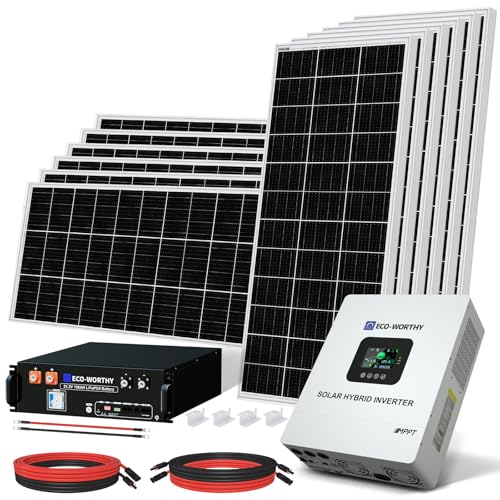
This complete off-grid package centers on a 5KW hybrid inverter with 12 x 195W mono solar panels, delivering a combined 2340W array capacity. Batteries are connected in series to create a higher-capacity 48V stack, simplifying wiring and scalability. The system is designed to deliver reliable off-grid power with parallel operation for higher outputs, supporting 120V and 240V variants when multiple inverters are paralleled. The design emphasizes straightforward assembly and expandability for larger homes or remote cabins.
Beyond power generation, the system supports safe operation with integrated wiring and a focus on reliability. It’s well-suited for users seeking a robust, expandable off-grid network that can evolve as energy needs grow, while maintaining the simplicity of a single-haceted inverter-centric setup.
LiTime 24V 3000W All-in-One Solar Inverter Charger

The LiTime 24V 3000W all-in-one integrates an MPPT controller, inverter, and charger, delivering a UPS-ready solution with 9000W surge. It supports a 24V battery bank with various configurations—including lead-acid and lithium options—and offers three charge modes (MPPT First, MPPT plus Grid, Only MPPT). The device provides auto photovoltaic tracking and a clear display through an integrated LCD, with RS485 for monitorability. This makes it a versatile choice for home storage and off-grid systems, balancing reliable power conversion with flexible charging and monitoring features.
ECO-WORTHY 48V 20480Wh Home Power Station

This high-capacity home backup solution pairs a 5000W inverter with an extensive 48V LiFePO4 battery array, offering up to 163.84kWh of expandable storage when multiple units are paralleled. The system includes CAN/RS485 communication, Bluetooth and WiFi monitoring, and a robust 100A BMS with a 125A circuit breaker for safety. It is designed for large home applications, emergency power, and solar-dominated backup scenarios. The modular design supports scalable power capacity as needs increase, within UL1973 and UL9540A safety standards.
Buying Guide: Key considerations for solar inverter with battery storage
- Power rating and surge: Match inverter wattage to your peak loads. For home backup, plan for at least a 2x peak demand to handle motor starts and multi-appliance use.
- Battery compatibility and chemistry: LiFePO4 offers longer life and better safety than lead-acid; ensure your inverter supports your chosen battery type and voltage (24V, 48V, etc.).
- MPPT controllers: A higher-quality MPPT improves charging efficiency under variable sun. Check the number of MPPT channels and their voltage ranges.
- Output configuration: Decide between single-phase 120V or split-phase 120/240V. If you have appliances across different phases, a 120/240V model is often preferable.
- Charging modes and priority: Look for flexible charging modes (Solar, Grid, Hybrid) to optimize self-consumption and grid interactions.
- Expandability: If you anticipate growth, choose systems that support parallel inverters or additional battery modules without complex rewiring.
- Monitoring and connectivity: WiFi/Bluetooth monitoring, RS485, and mobile apps help you track performance, battery SOC, and alerts remotely.
- Safety certifications: UL1973 and UL9540A certifications indicate compliance with North American safety standards for batteries and systems.
- System integration: Consider whether a bundled starter kit suits your needs or if you require modular components to tailor capacity and layout.