
Marine-ready flexible solar panels offer lightweight, curved-surface power for boats, RVs, campers, and lightweight vessels. This guide highlights five top options, comparing portability, mounting flexibility, and efficiency to help you choose the best fit for a boat roof, deck, or cabin surface. Each product emphasizes bendability, reduced weight, and reliable performance in sun-filled marine conditions.
| Product | Brand | Key Strength | Approx. Flexibility | Best For |
|---|---|---|---|---|
| Renogy Solar Panels 200W | Renogy | High power output; half-cut PERC tech | Up to 240° bend | Large curved surfaces |
| Renogy 100W Solar Panel | Renogy | Balanced power and weight; PERC tech | Up to 240° bend | Smaller curved areas |
| ECO-WORTHY 260W Kit | ECO-WORTHY | Higher wattage; lightweight | Flexible panels with polymer build | Higher daily output on uneven surfaces |
| GRECELL 200W Portable Panel | GRECELL | High efficiency; thin, portable | Very foldable/unfoldable | Compact storage; easy transport |
| BougeRV Arch 200W | BougeRV | Strong fiberglass protection | Up to 270° flexible | Irregular roof contours |
Renogy 200W Flexible Solar Panel For Boats

Renogy’s 200W flexible panel delivers robust daily energy, averaging around 1000 Watt-hours with optimal sunlight. Its 240-degree bendability lets you fit curved boat surfaces, while weighing about half the weight of a rigid panel. The technology uses half-cut PERC cells to boost light capture and electrical performance, enhancing overall efficiency for marine use.
Renogy 100W Flexible Solar Panel For Boats
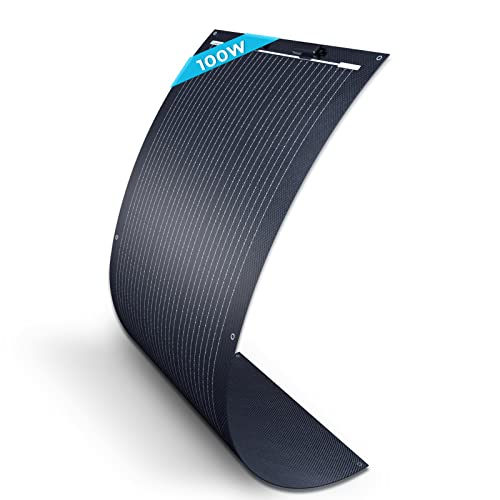
Renogy’s 100W panel provides a compact, highly portable option for smaller curved surfaces on decks or cabin roofs. It also employs half-cut PERC cell technology to optimize solar capture and efficiency. With a bend radius up to 240 degrees, it remains easy to transport, install, and reposition as needed.
ECO-WORTHY 260W Flexible Panel Kit

This kit bundles two 130W flexible panels designed for uneven surfaces like boat hulls. It emphasizes a higher daily output (up to about 1040Wh under good sun) and a lighter, polymer-based build that weighs roughly 70% less than traditional panels. The kit includes a 30A controller and wiring for a marine-ready setup. The panels resist weathering and maintain flexibility for curved surfaces.
GRECELL 200W Portable Flexible Panel

GRECELL UB200 delivers high-efficiency monocrystalline cells with up to 23.5% performance. Its folded size is compact, at 21.46 by 22.95 inches with a lightweight 10.14 pounds. The panel unfolds to a thin profile (about 0.98 inch thick) and includes adjustable kickstands and reinforced mounting holes for flexible, portable marine use. ETFE outer protection enhances durability and weather resistance.
BougeRV Arch 200W Flexible Panel

BougeRV’s Arch 200W adds fiberglass protection to resist impact and cracking on moving vessels. It flexes up to 270 degrees to adapt to curved surfaces and uses ETFE covering for long life, scratch resistance, and better durability in marine environments. Its design aims to preserve performance and ease of installation on uneven rooflines or hull contours.
Buying Guide: Key Considerations For Marine-Ready Flexible Panels
- Flexibility and fit: Assess the minimum bend radius and guaranteed degrees of curvature. Boats often have curved surfaces, so higher bend tolerance improves installation options.
- Weight and portability: Lighter panels ease handling on decks and transition between storage and mounting. Consider whether a foldable or semi-flexible form suits your space.
- Efficiency and cell technology: Look for features like PERC or high-efficiency monocrystalline cells. These boost output in partial shade and lower light conditions, common at sea.
- Durability and protection: ETFE covers, fiberglass backing, and water resistance enhance longevity in salt air and spray. Verify IP ratings and warranties where available.
- System integration: Ensure the kit includes or is compatible with appropriate controllers, cabling, and mounting hardware for marine use. Compatibility with existing 12V/24V systems matters for charging batteries.
- Curved-surface mounting: Consider panels designed specifically for non-flat roofs, rails, or hull surfaces to minimize gaps and maintain a clean installation.
- Portability vs. permanence: Decide between a portable panel setup for multiple vessels or a permanently mounted option for a single boat. Each approach affects mounting hardware and theft risk.
- Warranty and service support: Check warranty duration, coverage specifics, and the supplier’s marine service options in the United States.
- Cost vs. output: Compare wattages, efficiency, weight, and expected daily output under typical sun conditions to determine the best balance for your voyage profile.
These considerations help balance performance, durability, and ease of use for boating applications. When selecting a panel, align its maximum bend angle, weight, and wattage with your vessel’s surface geometry and typical sun exposure to optimize charging reliability on the water.