
Choosing a solar water pump inverter involves balancing power needs, reliability, and compatibility with off-grid systems. This article highlights five top inverters suited for running water pumps and associated loads, ranging from portable sump pumps to off-grid pumping for wells or cabins. Each pick emphasizes efficiency, safety features, and ease of installation to help homeowners compare options quickly.
| Product | Brand | Key Benefit | Approx. Power (W) |
|---|---|---|---|
| Giandel 3000W Pure Sine Wave Inverter | Giandel | High continuous power for pumps and tools | 3000 |
| TVNIKD 3500W Pure Sine Wave Inverter | TVNIKD | Robust surge for motor loads | 3500 |
| ECO-WORTHY 9.36KWH Off-Grid Kit | ECO-WORTHY | Integrated solar charging and inverter for off-grid pumping | 5000PV input / 5000W output |
| 1500W Sump Pump Battery Backup Inverter | SOLAR SPORTS | Backup power during outages for sump pumps | 1500 |
| Renogy 200W Solar Starter Kit | Renogy | Compact kit with built-in inverter for small pumps | 200 |
Introduction to options and what to consider: When selecting a solar water pump inverter, consider continuous wattage versus surge needs (pumps often surge on start), compatibility with battery systems, pure sine wave output for sensitive electronics, and protection features like overload, short-circuit, and thermal protection. This guide reviews five units that cover a spectrum from portable backup to off-grid solar configurations, helping you match capacity to your pumping demand and your solar acreage.
Giandel 3000W Pure Sine Wave Inverter
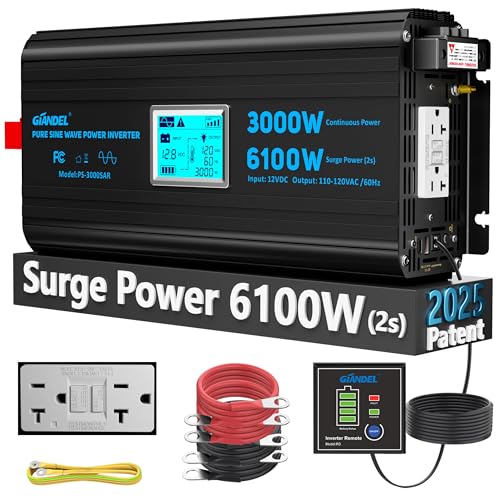
The 3000W Giandel inverter delivers continuous sine-wave power suitable for modest water pumps and related equipment. It supports up to 6100W surge, enabling reliable start-up of motor-driven pumps and auxiliary devices. It is designed to work with various 12V battery banks, including lead-acid and lithium configurations, and provides UL-listed safety features, such as GFCI outlets and protection against short circuits, over-heat, and voltage irregularities. This unit is a practical option for RV, off-grid, or emergency pump scenarios where a robust pure sine wave is essential.
TVNIKD 3500W Pure Sine Wave Inverter

The TVNIKD 3500W inverter provides continuous 3500W with a 7000W peak, suitable for powering water pumps that require a strong start. It uses pure sine wave output to protect motors and electronics, delivering stable voltage for extended pumping runs. The unit includes multiple outlets and supports common 12V battery systems used in off-grid or backup pumping setups. Its design emphasizes reliability for vehicle, marine, or cabin applications where a dependable power bridge between solar energy and a pump is required.
ECO-WORTHY 9.36KWH All-In-One Off-Grid Kit

This all-in-one kit combines a high-output 5000W inverter with a 48V DC-to-110V AC pure sine wave inverter, 195W solar panels, mounting hardware, and a 100Ah lithium battery. It is designed for reliable off-grid pumping and other essential loads, offering 99.9% efficiency and multiple charging modes, including solar and mains hybrid. The integrated MPPT controller helps optimize solar harvest, making it suitable for cabins, farms, or remote well pumps where continuous power is needed during sunny days and beyond.
1500W Sump Pump Battery Backup Inverter

This inverter is specifically designed to keep a sump pump running during power outages. It features automatic switching to battery power when AC is lost and reverts when power returns. With two outlets and a USB port, it can support a small pumping setup and other essential devices. It delivers a stable pure sine wave suitable for pumps and other critical appliances, with built-in cooling fans to maintain safe operation during extended use.
Renogy 200W Solar Starter Kit

The Renogy 200W Starter Kit bundles two 100W panels, a 30A charge controller, and a 100Ah lithium battery along with a 600W inverter. While compact, this kit supports smaller water pumps and auxiliary devices in RVs, boats, or off-grid cabins. Built for efficiency with Grade A+ cells and a Battery Management System for lithium storage, it offers a practical entry point into solar-powered pumping without large-scale arrays. The included inverter provides clean power for a variety of pump loads and electronics.
Buying Guide: Key Considerations For Solar Water Pump Inverters
- Power requirements: Determine the continuous wattage of the pump and its startup surge. Choose an inverter with a higher surge rating than the pump’s starting demand to avoid tripping or stalling.
- Output quality: Pure sine wave inverters are best for motors and sensitive electronics, reducing noise and wear on pumps and controls.
- Battery compatibility: Match the inverter to your battery bank (12V, 24V, or 48V) and consider lithium versus lead-acid for longer life and deeper discharges.
- Solar integration: If you plan to rely on solar, ensure the inverter supports MPPT or PWM charging methods and has adequate solar input capacity to meet daily pumping needs.
- Protection features: Look for overload protection, short-circuit protection, thermal management, and low-voltage/high-voltage cutoffs to safeguard equipment.
- Installation environment: Assess ambient temperature, moisture, and dust exposure. Water pumps often operate outdoors or in damp regions; select enclosures and IP-rated equipment as needed.
- Expandability: For future upgrades, consider kits with scalable panel arrays, larger batteries, or inverters with higher continuous power to power additional loads during pumping.
- Maintenance and safety: Prioritize units with clear manuals, remote monitoring options, and built-in safety features (GFCI outlets, fuse protection, and audible alarms) to ease ongoing operation.
In summary, the Giandel 3000W and TVNIKD 3500W inverters deliver robust pure sine wave performance for mid-sized water pumps, while the ECO-WORTHY all-in-one kit and Renogy starter kit offer scalable solar solutions for off-grid pumping. The 1500W backup inverter provides practical outage protection for sump pumps, ensuring essential safety and dryness during power failures. Selecting the right model requires aligning pump demands with solar capacity and battery readiness to achieve reliable, long-term pumping performance.