
Achieving accurate cuts with a miter saw relies heavily on the precision of your angle gauge. Whether you’re trimming molding or working on complex carpentry projects, selecting the right miter saw angle gauge can make a significant difference. Below, we compare five top-rated angle gauges known for their accuracy, durability, and user-friendly features to help you find the best tool for your woodworking needs.
| Product | Brand | Key Features |
|---|---|---|
| LEXIVON Aluminum Miter Saw Protractor | LEXIVON | Precision laser engraved scales, smooth Teflon O-ring swivel, rust-proof |
| POWERTEC Digital Angle Finder Protractor | POWERTEC | Digital accuracy ±0.2°, magnetic base, nylon protective case |
| VEVOR Precision Miter Gauge | VEVOR | Fits most table saws, 15 angle stops, partially assembled |
| Saker 7-Inch Aluminum Protractor | Saker | Laser-engraved scales, “O” shape design for inside/outside corners, lightweight |
| Miotorio Aluminum Protractor Angle Finder | Miotorio | 360° rotation, CNC machined aluminum, high precision laser scales |
LEXIVON Aluminum Miter Saw Protractor
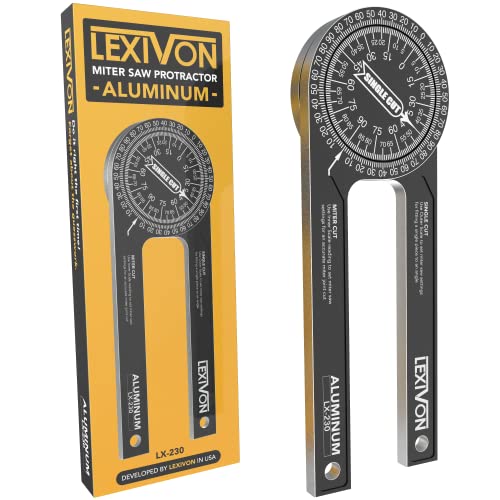
The LEXIVON Aluminum Miter Saw Protractor is made from CNC-machined anodized aluminum alloy steel, offering both durability and rust resistance. Its precision laser-engraved scales enable easy-to-read measurements for accurate angle marking. The internal Teflon O-ring mechanism allows the device to swivel smoothly, helping users to precisely gauge inside and outside corners with minimal effort. This tool eliminates guesswork by featuring two scales that transfer your work angle directly to the saw, helping to perform both miter and single cuts accurately. Its rust-proof design ensures longevity, making it a reliable addition to any woodworking toolkit.
POWERTEC Digital Angle Finder Protractor

The POWERTEC 71828 Digital Angle Finder offers high precision digital readings with an accuracy of ±0.2° and a resolution of 0.05°. Equipped with a strong magnetic base, it can securely attach to any ferrous metal surface, including curved ones, ensuring stable angle measurement. The device provides a measuring range of 4×90 degrees for versatile applications like woodworking, table saws, and miter saws. Housed in a nylon fabric case, the digital angle finder protects against damage from typical workshop drops or knocks. Its digital display offers faster and more precise readings compared to analog angle gauges.
VEVOR Precision Miter Gauge for Table Saws

Designed to fit most standard table saw slots, the VEVOR Precision Miter Gauge comes with an adjustable aluminum alloy head and 15 positive angle stop holes, including commonly used angles such as 15°, 22.5°, 30°, 45°, and 60°. This versatile gauge provides both 3/4″ x 3/8″ T-slots and U-shaped slot compatibility thanks to its detachable disc. Delivered partially assembled, it streamlines setup while maintaining precision. Ideal for advanced angle cuts, this gauge allows users to adjust angles proportionally for intricate woodworking tasks requiring high accuracy and control.
Saker 7-Inch Aluminum Miter Saw Protractor

The Saker Miter Saw Protractor features a precision machined “O” shape design to ensure smooth angle readings for inside and outside corners. Crafted from lightweight aluminum alloy, it offers excellent corrosion resistance and durability. The protractor is equipped with easy-to-read laser-engraved scales, allowing direct angle transfers to the miter saw. Its compact size and light weight make it highly portable and handy for carpentry, plumbing, and general building trades, especially when working with crown molding or trim where precision is critical.
Miotorio Aluminum Protractor Angle Finder

The Miotorio Aluminum Protractor is constructed from CNC precision-machined aluminum alloy with laser-engraved scales for highly accurate angle measurements. Its innovative internal “O”-shaped mechanical rotation allows full 360-degree swivel, enabling effortless adjustment for both internal and external angles. The design ensures no wear or fading on the markings, providing dependable and smooth readings. It features two scales that transfer measurements directly to the saw for precise miter and single cuts, making it ideal for professionals requiring reliable angle detection in carpentry and trim work.
Buying Guide for Miter Saw Angle Gauges
Choosing the best miter saw angle gauge depends on several key factors tailored to your woodworking projects and preferences. This guide explores important considerations to help ensure you get the most suitable tool.
Accuracy and Precision
Look for gauges that offer laser-engraved or digital scales to ensure precise angle measurements. Digital angle finders typically provide higher accuracy (often ±0.1° to ±0.2°), beneficial for fine woodworking. Analog tools with high-quality machining also deliver reliable results and often withstand tough conditions better.
Build Quality and Material
Durability is crucial. CNC-machined aluminum alloys are common and provide a good balance of strength, corrosion resistance, and lightweight portability. Steel components can enhance longevity, especially if you frequently work in rough environments.
Ease of Use and Features
- Swivel Mechanism: Smooth rotational designs like the Teflon O-ring or “O” shape body assist with seamless angle adjustments.
- Magnetic Base: Magnetic digital gauges offer hands-free stability on metal surfaces, making angle setup easier.
- Angle Stops and Scales: Multiple positive stops allow quick access to common angles such as 15°, 22.5°, 45°, and 90°.
- Portability: Lightweight and compact tools are easier to handle on-site or in tight spaces.
Compatibility
For miter gauges integrated with table saws, check compatibility with your saw’s slot dimensions (commonly 3/4″ x 3/8″). Universal designs or adjustable expansions ensure a snug fit and prevent unwanted movement.
Digital vs Analog
While digital gauges provide quick readings and can reduce human error, they require batteries and can be sensitive to impacts. Analog or mechanical gauges are often more rugged and don’t require power but may demand closer attention when reading scales.
Additional Accessories
Consider if the gauge comes with protective cases, extra discs, or calibration tools. These enhance durability, convenience, and longevity of the gauge.