
Choosing the best combination table saw blade is essential for efficient woodworking projects that require both ripping and crosscutting. Combination blades blend tooth configurations to deliver smooth and versatile cuts across various wood types, including plywood, hardwood, and softwood. Below is a comparison of some top-rated 10-inch blades with 50 teeth, designed to fit most standard table saws with a 5/8-inch arbor.
| Product | Brand | Teeth | Kerf | Hook Angle | Features |
|---|---|---|---|---|---|
| CMT 256.050.10 ITK XTreme | CMT | 50 | 0.098″ | 15° | 4 ATB+1 Flat Grind, deep cuts, chip clearance |
| Diablo D1050X Combination Blade | Diablo | 50 | 0.098″ | 15° | TiCo carbide, non-stick coating, laser cut kerf |
| FOXBC 10 Inch Combination Blade | FOXBC | 50 | 0.098″ | 15° | ATB tooth design, large gullet spacing |
| Freud LU84R011 Combination Saw Blade | Freud | 50 | Standard | Standard | Premium TiCo carbide, comb grind, efficient chip removal |
| Freud LU83R010 Thin Kerf Combination Blade | Freud | 50 | Thin kerf | Standard | Thin kerf, TiCo carbide, versatile tooth design |
CMT 256.050.10 ITK XTreme Industrial Combination Blade

This 10-inch, 50-tooth combination blade from CMT is engineered for both rip and crosscuts. The blade features a 4 ATB (Alternate Top Bevel) plus 1 Flat tooth grind, offering smooth finishes on diverse wood types, including melamine, plywood, and chipboard. Its large gullets facilitate effective chip clearance and deep cuts, helping maintain cleaner workpieces and prolong blade life. The blade’s 0.098″ kerf thickness and 15° hook angle optimize cutting power and control. It’s compatible with radial arm saws, miter saws, and table saws.
Diablo Combination Saw Blade – D1050X

The Diablo D1050X features high-performance TiCo carbide teeth that maintain sharpness and durability during extensive use. Its 50 ATB teeth with a 15° hook angle make it well-suited for a combination of rip and crosscuts on wood. The blade is coated with Perma-SHIELD, a non-stick finish that fights heat buildup, gumming, and corrosion for a longer blade lifespan. Additionally, the super-thin laser-cut kerf allows fast, accurate cuts with minimal waste, perfect for remodeling or demolition tasks.
FOXBC 10 Inch 50-Tooth Combination Saw Blade

This 10-inch FOXBC blade comes with 50 precision-ground teeth designed in an ATB pattern for versatile wood cutting. The blade features a 0.098″ kerf and a 15° hook angle, contributing to a smooth finish in both ripping and crosscutting tasks. The plate thickness of 0.071″ ensures stability and reduces vibration. Notably, the blade’s tooth groups are separated by large gullets, improving chip removal and reducing binding.
Freud LU84R011 Premium TiCo Carbide Combination Blade
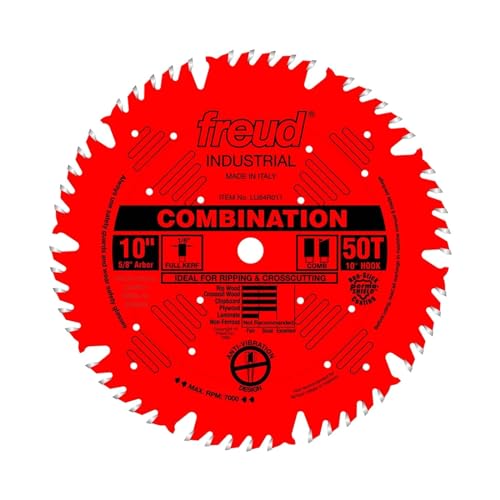
The Freud LU84R011 features an advanced comb grind tooth design with one flat tooth for ripping and four ATB teeth for crosscutting. It incorporates premium TiCo carbide for enhanced cutting performance and edge retention. Large gullets placed before flat-top raker teeth assist with efficient chip removal, making this blade suitable for fast and clean rips as well as smooth crosscuts. Its build quality fits most 10-inch table saws, enhancing durability and cut quality.
Freud LU83R010 Thin Kerf Combination Saw Blade

This Freud blade offers the same robust tooth configuration as the LU84R011 but with the added benefit of a thin kerf. The thinner blade cuts with less material waste and puts less strain on motors, making it ideal for lower-powered table saws. Its high-density TiCo carbide teeth are engineered for maximum durability and clean cutting of hardwoods and plywood. The comb tooth design with large gullets enhances chip clearance, delivering smooth rip and crosscuts efficiently.
Buying Guide: How to Choose the Best Combination Table Saw Blade
Selecting the optimal combination blade involves considering several key factors to match your cutting needs and saw specifications.
Number of Teeth and Tooth Design
Combination blades typically feature 40 to 50 teeth with a mix of Alternate Top Bevel (ATB) and Flat Top Teeth (FTT). More teeth generally offer smoother cuts, especially crosscuts, while fewer teeth generate faster cuts with more aggressive ripping. Look for blades combining one flat-top tooth for ripping and multiple ATB teeth for crosscutting to get versatile performance.
Kerf Width
The kerf is the thickness of the blade’s cut path. Thin kerf blades (.094″ to .098″) demand less power and waste less material, thus ideal for lower-powered saws. Standard kerf blades (.120″ and above) provide more stability and durability but require a more powerful motor.
Hook Angle
The hook angle influences feed speed and cut quality. A moderate hook angle (12° to 15°) is common on combination blades, providing balanced cutting speed without aggressive feeding that can cause tear-out or kickback.
Blade Material and Coatings
Carbide-tipped teeth, especially variants like TiCo (Titanium Cobalt blend), are highly durable and stay sharp longer. Coatings such as Perma-SHIELD help resist heat, gumming, and corrosion, extending blade life and ensuring cleaner cuts.
Compatibility and Arbor Size
Ensure the blade matches your saw’s arbor size — commonly 5/8 inch for many table saws. Confirm blade diameter (usually 10 inches) and that the maximum RPM rating meets or exceeds your saw’s speed. Compatibility across saw types like miter, radial arm, and table saws is beneficial if you intend to use one blade interchangeably.
Cutting Material
Some blades are designed specifically for certain materials like hardwood, softwood, plywood, or laminates. Combination blades are versatile but verify if the blade handles your primary material well for optimal results.