The best countersink bit is the one that matches your screw and lets you control the finished recess. A large assortment will not rescue an incorrect pilot hole, and a depth stop will not make a mismatched screw head sit neatly in the wood.
This shortlist gives you three different starting points: DEWALT DW2535 for a compact set of tapered pilots, Snappy 40030 for five explicitly sized pilot-and-countersink combinations, and Amana Tool 55227 for repeated work that benefits from an adjustable revolving stop. The Amana is one cutter assembly, rather than a set of several screw sizes.
These are conditional recommendations based on manufacturer documentation and exact Amazon product identities. You should not read them as a drill-speed contest, a durability test, or a promise that a particular bit will leave every species perfectly clean.
| Exact model | Documented form | Useful reference | Buying boundary |
|---|---|---|---|
| DW2535 | 3 tapered combinations | #6 / #8 / #10 | Standard drill use |
| 40030 | 5 pilot diameters | 5/64–9/64 in. | Stop collar optional |
| 55227 | 1 stop-equipped assembly | 1/8 in. pilot; #6 reference | One size; angle field unresolved |
Best compact tapered set: DEWALT DW2535
The DW2535 contains three countersink bits identified for #6, #8, and #10 screws. DEWALT describes a four-cutter countersink with a tapered drill bit, designed to combine drilling, countersinking, and counterboring, with replacement tapered bits available.
Choose it when those screw sizes cover most of your planned woodworking and you want a small set to organize. You can keep a short note about the screw used with each setup instead of sorting through many nearly identical accessories.
The tapered pilot matters because a pilot's shape is part of its fit to the screw. Start with your fastener maker's requirements rather than assuming that every modern wood screw wants the same hole as a traditional tapered screw.
DEWALT classifies this product as standard rather than impact. A hex-shaped shank is therefore not permission to hammer away with an impact driver; use the tool and operating method the accessory manufacturer supports.
DEWALT DW2535 — #6, #8, #10 three-piece set
Tapered pilots · three labeled sizes Product photo: Amazon listing for the linked model.View this exact model on Amazon ↗Verify the selected model, package, seller, and current terms.
Best for choosing an explicit pilot diameter: Snappy 40030
Snappy's 40030 supplies five Gold Screw Countersinks with pilot diameters from 5/64 through 9/64 inch. The documented set includes 5/64, 3/32, 7/64, 1/8, and 9/64-inch pilots plus an adjustment hex key.
Choose it when you want to start from a specified pilot diameter and compare that with the fastener instructions. A diameter-based assortment can be easier to reason about than a screw-number label when your screws use different root dimensions or thread designs.
Snappy lists an optional stop collar for depth control; it is not part of the five-countersink contents shown here. Include that extra item in your comparison if repeatable recess depth is the reason you are shopping.
The maker describes an 82-degree countersink angle, but you still need to match the actual head you intend to seat. A pan head, washer head, or specialty fastener does not become a countersunk flat head because a convenient cutter is already in your drill.
Snappy 40030 — five-piece Gold Screw Countersink set
Five specified pilot diameters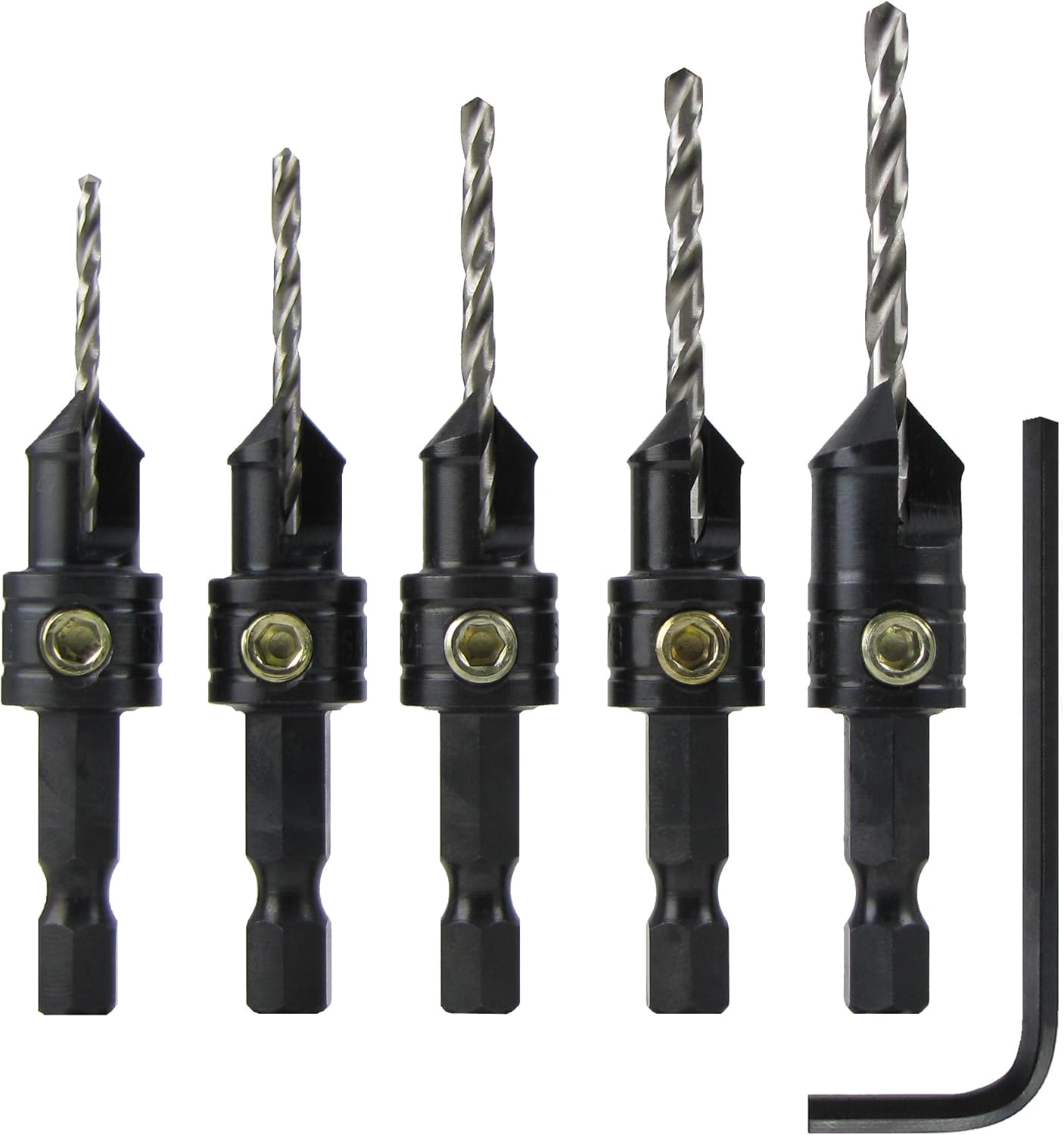 Product photo: Amazon listing for the linked model.View this exact model on Amazon ↗Verify the selected model, package, seller, and current terms.
Best for repeated controlled-depth work: Amana Tool 55227
The 55227 pairs a carbide-tipped countersink with a 1/8-inch drill, a nominal 3/8-inch cutter diameter, and an adjustable revolving stop. Amana's current model page identifies it for #6 wood screws and describes an independent bearing-supported stop arrangement.
Choose it when you have a repeated operation and want that dedicated depth-control feature. You are buying one particular cutter-and-pilot combination, so check its dimensions rather than treating the product title's word “set” as a promise of several interchangeable screw sizes.
The manufacturer's page has inconsistent angle information between its heading and one specification field. This guide does not use that disputed field to certify your screw fit; check the actual fastener and resolve any angle-critical requirement with Amana before buying.
A stop can help you repeat an adjustment, but the wood beneath it still matters. Keep the contact area clean and practice on scrap so you can see whether your chosen depth and handling suit the visible face you want to preserve.
Amana Tool 55227 — single adjustable-stop assembly
1/8-inch drill · #6 wood-screw reference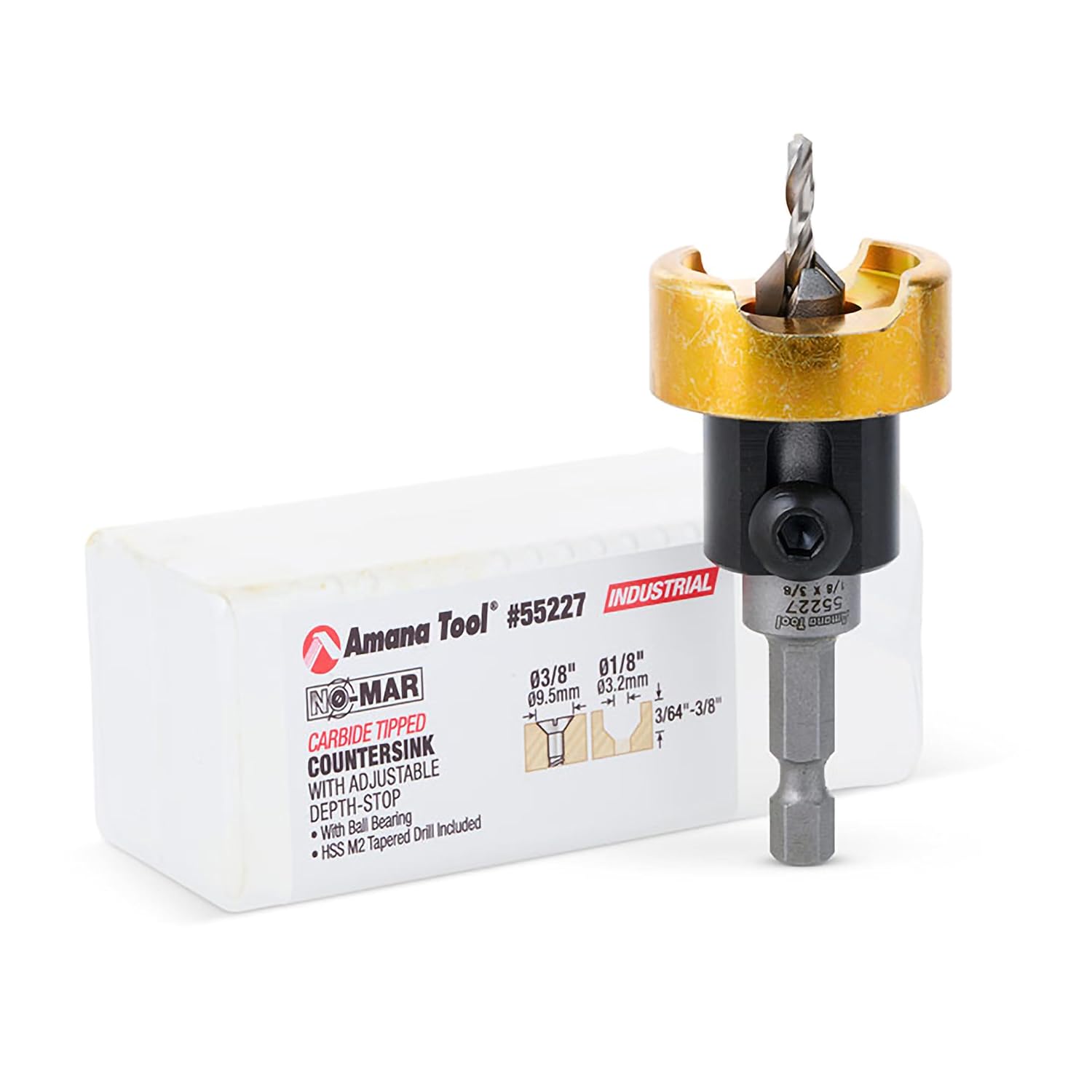 Product photo: Amazon listing for the linked model.View this exact model on Amazon ↗Verify the selected model, package, seller, and current terms.
Separate the pilot, clearance hole, and head recess
Three different shapes can be hiding inside what looks like one screw hole. The pilot guides the threaded portion, a clearance hole lets the upper piece move around the shank where your joint needs it, and the countersink creates a seat for a matching flat head.
Sketch your joint in section before choosing a bit. Draw the actual material thicknesses and screw, then identify which piece should receive threads and which surfaces should come together when you tighten it.
For a simple example, imagine joining a thin apron to a thicker wooden block. Your screw should pull the pieces together; a tight upper hole or an unnecessarily deep head recess can create a different result than the drawing intended.
Use the screw maker's pilot and clearance guidance for the actual wood and fastener. The illustrative drawing here explains the relationships but does not supply a universal hole diameter, screw length, or structural fastening schedule.

Decide what “flush” means before drilling
A screw head can be proud, flush, or recessed, and those are different targets. If you want a visible flat head level with the face, start with that finish goal instead of drilling a deep pocket and hoping the head stops in the right place.
If you intend to cover a screw with a plug, the counterbore and plug need their own matched geometry. Check the cutter and plug-maker instructions, available material thickness, and your project's design before adding depth.
On thin wood, removing more material can be the wrong answer even when the head looks tidy. A decorative scrap and a structural connection carry different requirements, so do not use this buying guide as an engineered connection specification.
Keep one correctly seated practice screw on your bench as a visual reference. It gives you a concrete target for the next adjustment without claiming that one depth setting works across different boards and fasteners.

Build a useful scrap test
Use material from the project and the exact screw you plan to install. A spare piece of soft pine tells you little about how the setup will behave in a dense hardwood face or a thin veneered panel.
Clamp the work securely, provide appropriate backing where needed, and follow your drill's instructions and protective-equipment requirements. Disconnect the supply or remove the battery as directed before adjusting the accessory, and remove the adjustment key before running it.
Make a shallow first recess, stop the tool, and inspect the result before changing depth. Drive the practice screw with appropriate control, then examine whether the head seats as intended and whether the surrounding face remains acceptable.
If the recess looks ragged or the screw will not seat, investigate the fit, setup, cutter condition, and handling. Increasing pressure or sinking the head deeper is not a diagnosis, and it can hide the original cause while removing more material.
Compare the whole purchase
Count the pieces you can actually use rather than the number printed on a package. Three suitable combinations can be a better purchase than a larger set whose pilots do not match your screws or whose replacement parts you cannot identify.
Check whether the quoted offer includes a stop, replacement drills, storage, and the adjustment key. An attractive photograph may show accessories that belong to another package or an optional purchase.
Before ordering, write the selected model, pilot size, screw reference, and intended finish depth together. Keep that record with the tool so a future replacement purchase starts from checked information instead of a resemblance to the old bit.
When none of these belongs in your drill
Choose none of these simply to force a non-countersunk screw head below the surface. Confirm the head design and the joint requirement first, particularly around hardware, hinges, thin faces, or manufacturer-specified fasteners.
Also look elsewhere when you need a different pilot size, a particular head angle that remains unresolved, or an accessory expressly rated for another material or drive method. You do not have to adapt the project to this shortlist.
For a small general kit, start by comparing DW2535's three labeled sizes with your screw drawer. Move to Snappy's explicit diameter choices or Amana's dedicated stop assembly only when that particular feature answers a problem you can name.
Sources behind this guide
Checked October 16, 2026. Manufacturer features are not independent performance testing; prices and offers can change.
- DEWALT DW2535 official model pageThree screw sizes, tapered pilots, four-cutter construction, replacement pilots, Standard rather than Impact classification.
- Snappy 40030 official model pageFive explicit pilot sizes, 82-degree countersink, optional not included depth collar, hex drive.
- Amana Tool 55227 official model pageOne assembly; 1/8-inch pilot, 3/8-inch cutter, #6 reference, revolving depth stop. Conflicting angle field openly retained as unresolved.
- CCOHS powered-hand-tool basic safetySecure work, power isolation for adjustments, key removal, appropriate eye protection; no tool-specific speed schedule.
- Amazon exact listing: DEWALT DW2535 — #6, #8, #10 three-piece setExact complete product/model/package identity only; no price, availability, ratings or shipping claim.
- Amazon exact listing: Snappy 40030 — five-piece Gold Screw Countersink setExact complete product/model/package identity only; no price, availability, ratings or shipping claim.
- Amazon exact listing: Amana Tool 55227 — single adjustable-stop assemblyExact complete product/model/package identity only; no price, availability, ratings or shipping claim.