
The top choice for home buyers is a reliable water pump that delivers steady pressure, handles varying demand, and works with household plumbing. This guide highlights five practical options for common house needs, from whole-house boost to shallow-well setups. Each product is suited for specific buyers: new homeowners needing consistent faucet pressure, families with variable water use, and those upgrading from a basic pump. The table below compares the recommended models at a glance.
| Product | Best For | Key Benefit | Max Head / PSI |
|---|---|---|---|
| ECO-WORTHY 33-Series Industrial Water Pressure Pump | Small to mid-size homes, RVs | On-demand diaphragm pump with smart pressure switch | 131 ft lift / 50 PSI |
| AQUASTRONG Smart 45 | Whole-house systems | Constant pressure with automatic adjustment | 150 ft head / 80 PSI (range 22-80 PSI) |
| ECO-WORTHY 110V Fresh Transfer Diaphragm Pump | Irrigation and garden use, small farms | High efficiency, on-demand 70 PSI | 131 ft lift / 70 PSI |
| FOTING Sump Pump 1HP | Basements, pools, ponds | High flow with debris filtration | 31 ft lift / 76 GPM |
| Aquastrong 1 HP 4500 GPH | Basement and garden drainage | High flow, portable, integrated components | 30 ft lift / 75 GPM |
Below are detailed product sections to help you pick the best fit for your home. Each entry explains who the pump is best for, why it was selected, and a practical caveat.
ECO-WORTHY 33-Series Industrial Water Pressure Pump
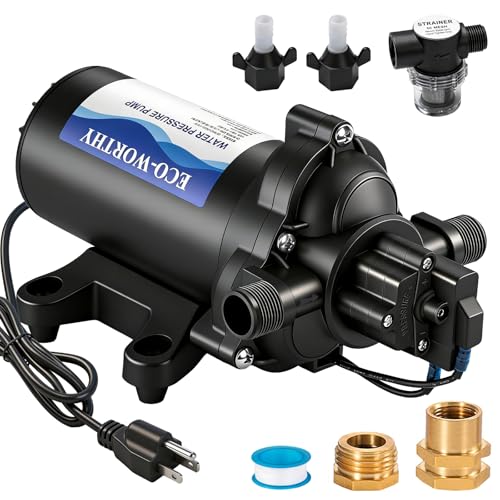
Best For: Small homes, RVs, and light irrigation setups needing on-demand pressure. This 110V AC diaphragm pump activates with water pressure at 50 PSI and includes a smart pressure switch for auto on/off. It’s suitable for applications where carrying a battery is impractical and where quiet operation matters. The pump is self-priming up to 9.8 feet and can lift to 131 feet. A potential limitation is its maximum 50 PSI setting, which may be lower than some high-demand households.
AQUASTRONG Smart 45 Whole House Pump

Best For: Homes seeking consistent, automatic pressure with minimal manual tuning. Smart 45 maintains constant pressure through demand-based adjustments, delivering up to 150 ft of head and 80 PSI. It features a robust stainless steel impeller and eco-friendly materials, making it suitable for long-term residential use. Caution: higher initial cost and a larger system footprint can be a consideration for compact installations.
ECO-WORTHY 110V Fresh Transfer Diaphragm Pump

Best For: Garden irrigation and household transfer duties where reliable on-demand pressure is needed. It pumps at 5.5 GPM with a 70 PSI setting and an on-demand design with temperature protection. It’s quieter and safer due to thermal overload protection. Choose this if you want a compact, versatile transfer pump for water features or irrigation, but be aware that 70 PSI may be insufficient for some high-demand whole-house systems.
Aquastrong 115V Shallow Well Garden Pump

Best For: Garden irrigation and domestic water supply from shallow wells. This shallow well jet pump uses a compact 115V motor and stainless steel housing, with a built-in pressure switch. It supports automatic operation and a typical load up to 1340 GPH at 5 ft. The practical caveat is the need for a compatible well depth and setup; it may not perform as well with deeper wells without a larger system integration.
1/2 HP On Demand Household Water Booster Pump

Best For: Homes needing a straightforward pressure boost with automatic control. The 1/2 HP unit can deliver up to 14 GPM and lift up to 105 feet, with a 3.5 bar maximum outlet pressure. It’s a solid choice for multi-room water delivery and garden irrigation. Limitation: higher headroom or commercial-grade scenarios may require a larger horsepower pump for peak security during peak usage.
Buying Guide: Key Considerations For Choosing A Home Water Pump
What flow rate does my home need? Consider both peak and average flow. Look for units offering a range that covers kitchen, baths, and outdoors without overtaxing the motor.
What is the required pressure? Identify your target PSI and head (height to lift). Pumps with adjustable pressure or built-in pressure switches reduce the need for extra controllers.
Is automatic operation important? If you want hands-off performance, choose a pump with a smart control, auto on/off, and a pressure tank or integrated regulation.
What installation constraints exist? Compact spaces or specific electrical outlets may favor 110V units with smaller footprints or dual-use designs for irrigation and household use.
What about durability and safety features? Look for corrosion-resistant materials, thermal overload protection, and self-priming capability for versatile setups.
What is the intended environment? For basements or outdoor use, select a pump with appropriate sealing, insulation, and power cord length for safe operation.
Frequently Asked Questions
- What is a “diaphragm” water pump and when should I use one? A diaphragm pump uses a flexible membrane to move water. It is reliable for steady, on-demand flow and is common in irrigation and RV setups where battery power is limited.
- Do I need a constant-pressure pump for a home? If your home has variable water use, a constant-pressure system helps maintain even faucet pressure across multiple rooms and appliances.
- What head height should I expect in a typical house? Most homes benefit from 30–60 feet of lift for standard fixtures; higher lifts suit multi-story homes or tall buildings.
- Is a built-in pressure tank necessary? A pressure tank reduces cycling and helps maintain stable pressure, especially with small or medium systems.
- Can these pumps handle hot water? Some models specify compatibility with hot water up to a certain temperature; check each product’s limits before use.
- What maintenance is required? Periodic inspection for leaks, debris, and electrical safety is recommended; some units are designed for easier maintenance with accessible components.