
Answer: This guide highlights five top utility locating tools that help professionals and DIY enthusiasts locate underground power, water, gas, and cable lines with confidence. The selected models balance depth capability, ease of use, and portability for different job sites. The top picks are ideal for contractors, maintenance crews, and utility technicians who need accurate traces, clear interfaces, and reliable signal transmission. Each product section explains who it’s best for, why it was chosen, and a practical caveat to consider before buying. A quick summary table follows the introduction for side-by-side comparison.
| Product | Best For | Key Benefit |
|---|---|---|
| Leica DD130 Underground Locator (Low Frequencies) | Pro teams needing low-frequency tracing | Extended trace range with 512 Hz and 640 Hz |
| Leica DD300 Depth Package | Heavy-duty site work with GNSS and data storage | Turn-key package with Bluetooth, GNSS, and 8 GB storage |
| u-LOCATE Pipe & Cable Locator | Simple, quick finds on small projects | Single frequency with intuitive left/right guidance |
| RIDGID 21898 ST-305 | Versatile tracing with multiple frequencies | Four frequencies and two-tone feedback |
| Schonstedt Rex Multi-Frequency Locator | Multi-frequency flexibility for pipe and cable work | Three active frequencies plus passive LOCates |
Leica DD130 Underground Utility Locator with Low Frequencies

The Leica DD130 is designed for locating underground utilities with a focus on low-frequency tracing. It includes a DD130 Locator, DA175 1 Watt transmitter, and a carry bag, creating a turnkey package for safe tracing of power, water, gas, and cable lines. Best for field teams that require robust low-frequency performance for challenging ground conditions. A limitation is that the depth and trace performance depend on soil conductivity and transmitter setup, so expect variable results in certain soils.
Leica DD300 Depth Package Underground Locator
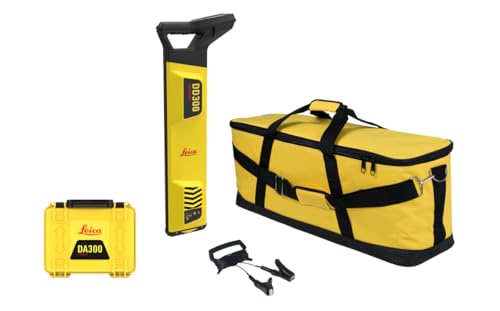
The DD300 Depth Package combines the DD300 locator with a DA300 1 Watt transmitter. It features Bluetooth, internal GNSS, 8 GB data storage, and a color LCD display. This kit suits larger projects or repeated site workers who need precise data collection, mapping, and offline analysis. Choose this if you need a turnkey bundle with data storage and navigation aids. A potential drawback is the heavier setup and higher cost compared to simpler single-frequency units.
u-LOCATE Pipe & Cable Locator

The u-LOCATE locator emphasizes ease of use with a left/right arrow interface to guide users to buried utilities. It’s a single-frequency device suitable for smaller jobs or quick checks where rugged multi-frequency capability is not required. Best for new crew members or simple trace tasks. A limitation is its single-frequency design, which can be less effective in complex underground environments or where noise is high.
RIDGID 21898 ST-305 Line Transmitter

The RIDGID ST-305 provides up to 5 watts and four selectable frequencies for versatile line tracing and underground locating. It supports dual-frequency operation for better accuracy in interference-prone areas. Best for professional users who need robust power and flexible tracing options. A minor caveat is that its more advanced features may require training to optimize use and minimize interference.
Schonstedt Rex Multi-Frequency Locator

The Schonstedt Rex offers multiple frequencies on a compact platform, including three active frequencies (512 Hz, 33 kHz, and 82 kHz) and passive 50/60 Hz. This makes it flexible for a range of pipe and cable tracing tasks and allows compatibility with different utility types. Best for field techs who value multi-frequency capability in a portable form. A limitation is that advanced features may require familiarity with detector behavior to interpret results accurately.
Buying Guide
What to consider when choosing utility locating equipment
Depth capability and frequency range: Higher-frequency devices may locate shallower lines, while lower frequencies penetrate deeper but can be more susceptible to noise. Consider the typical depth and soil conditions at your sites.
Portability vs. turnkey features: Kits with transmitters, GNSS, and data storage suit large crews and mapping tasks. Simpler handheld locators are better for quick checks or small jobs.
Data handling: Models with data storage, Bluetooth, or GNSS integrate with field tablets and mapping software. If you need records for compliance or project management, prioritize data features.
Ease of use: Interface design, visual indicators, and audio cues affect on-site efficiency. Training requirements should be weighed against the benefits of faster tracing.
How to compare these models for different buyers
For contractors handling many sites, the Leica DD300 Depth Package or RIDGID ST-305 offer robust features and data capabilities. For quick checks or entry-level work, the u-LOCATE or Schonstedt Rex provide flexible, portable options. For complex environments with varied utilities, multi-frequency options like the Rex or the DD130’s low-frequency focus can offer better versatility.
Practical usage tips
- Calibrate transmitters and receivers before each job to establish baseline readings.
- Use the lowest effective frequency to minimize interference in noisy soils.
- Document traced routes with a map or data log to support safety programs and future maintenance.
Frequently Asked Questions
- What is the best utility locator for beginners? – A simple, single-frequency model like the u-LOCATE or an entry-level Schonstedt Rex can be suitable for initial tasks and quick checks.
- Which device is best for data collection on large projects? – The Leica DD300 Depth Package stands out with Bluetooth, GNSS, and 8 GB of data storage for field mapping.
- Do low frequencies travel deeper underground? – Yes, lower frequencies typically penetrate deeper than high frequencies, but soil conditions influence performance.
- Can these tools locate non-metallic utilities? – Most underground locators primarily detect metallic lines. For non-metallic utilities, marking and tracer materials or additional methods are often needed.
- Is training required to use multi-frequency locators effectively? – Yes, understanding how different frequencies interact with soil and interference improves accuracy and reduces misreads.
- How should I decide between a turnkey kit and a single locator? – Choose a turnkey kit if you need integrated data capture and a ready-to-work setup; choose a single locator if you primarily perform quick checks and field measurements.