
Choosing a USB-based arbitrary waveform generator (AWG) requires balancing bandwidth, memory, and modulation features against portability and ease of use. The following selections focus on reliability, strong waveform fidelity, and broad modulation support, making them suitable for lab bench testing, electronics development, and educational demonstrations. This article highlights five versatile models and provides a practical buying guide to help you compare options without prices.
| Product | Bandwid th | Channels | Key Features |
|---|---|---|---|
| UNI-T UTG962E Handheld | 60 MHz | 2 | AM/FM/PM/FSK, 200 MSa/s, 24 arbitrary waveforms, USB |
| Rigol DG1022Z | 25 MHz | 2 | SiFi waveform fidelity, 2Mpts, independent channels |
| Siglent SDG810 | 10 MHz | 1 | 125 MSa/s, 46 built-in arbitrary waveforms, multiple modulations |
| Siglent SDG2042X | 40 MHz | 2 | Dual channel, TrueArb / Easy Pulse, touchscreen, 16-bit resolution |
| UNI-T UTG932E | 30 MHz | 2 | 24-bit non-volatile waveform storage, AM/FM/FSK, compact |
UNI-T UTG962E Handheld 60MHz Dual Channel AWG

The UNI-T UTG962E delivers a compact, portable solution with ample bandwidth for field or bench work. It supports two channels at up to 60 MHz with a 200 MSa/s sampling rate and 4K points of memory per channel. Built-in modulation options include AM, FM, PM, and FSK, along with multiple waveforms including sine, square, ramp, and noise. A key strength is its USB connectivity for quick data transfer and control, making it a flexible choice for on-site testing and quick setup in tight spaces. Users can store up to 24 non-volatile arbitrary waveforms for rapid access during experiments.
Rigol DG1022Z Function / Arbitrary Waveform Generator

Rigol’s DG1022Z combines traditional analyzer reliability with modern AWG features. With 25 MHz bandwidth and two independent channels, it provides a practical mix of performance and cost. The device emphasizes waveform fidelity through SiFi (Signal Fidelity) technology for accurate replication of the programmed signals, crucial for testing analog front-ends and mixed-signal circuits. The 2Mpts arbitrary waveform length per channel enables extended, complex waveforms. This model is ideal for engineers who require dependable dual-channel operation for synchronized testing or cross-channel timing studies.
Siglent SDG810 Arbitrary Waveform Generator

The Siglent SDG810 is a compact single-channel AWG designed for straightforward applications requiring reliable standard waveforms. Its 125 MSa/s sampling rate and 14-bit vertical resolution provide robust waveform quality for basic lab tasks. The device ships with five standard waveforms and 46 built-in arbitrary waveforms, offering broad coverage for prototyping, testing, and demonstration work. Its comprehensive modulation options, including AM, FM, PM, FSK, and PWM, enable practical experimentation with signal systems and control schemes.
Siglent SDG2042X Arbitrary Waveform Generator
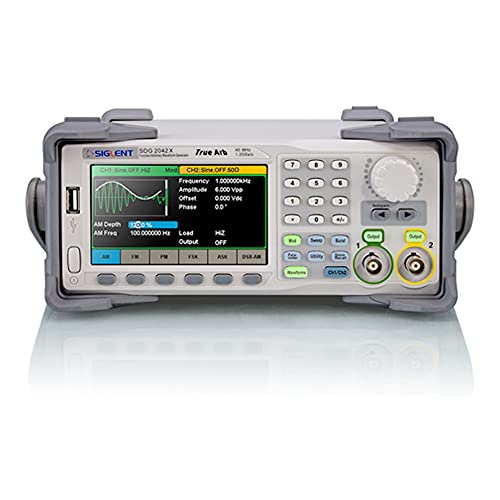
Siglent’s SDG2042X stands out with dual channels, 40 MHz bandwidth, and TrueArb technology, delivering high-fidelity arbitrary waveforms with a modern touch via a touchscreen interface. The 16-bit vertical resolution enhances subtle amplitude details, particularly beneficial for precise DAC testing and detailed modulation studies. The instrument supports a wide range of modulation modes and sweep options, along with pulse capabilities. This model is well-suited for advanced training, electronics development, and research projects that require more complex waveform control and a user-friendly display.
UNI-T UTG962E Kit: 60 MHz Dual-Channel AWG

The UTG962E kit expands on the handheld platform with a dual-channel configuration, offering a similar feature set to the standalone UTG962E but bundled for more extensive development work. It maintains a broad modulation palette, including AM, FM, PM, and FSK, and emphasizes DDS-based waveform generation with 14-bit vertical resolution. The kit format makes it a practical choice for classroom environments, university labs, or teams that prioritize easy expansion and compatibility with additional test equipment.
Buying Guide: Key Purchase Considerations
- Bandwidth and sampling rate: Higher bandwidth (MHz) and faster sampling (MSa/s) enable richer waveform detail and more accurate replication of fast signals. For complex RF or digital testing, prioritize 40–60 MHz ranges with at least 125 MSa/s or higher.
- Number of channels: Dual-channel models enable synchronized testing and cross-channel experiments, which are common in RF and signal processing labs. If single-channel suffices, lighter models can reduce cost and footprint.
- Memory depth and waveform storage: Larger memory (>4K points per channel) and the ability to store many arbitrary waveforms streamline long or repetitive tests. DDS-based generation often provides stable, repeatable results.
- Modulation capabilities: AM, FM, PM, FSK, DSB, PWM, and sweep functions expand testing scenarios. Look for users’ ability to store and recall custom waveforms to match specific test cases.
- Interface and usability: Touchscreen displays, intuitive software interfaces, and clear labeling expedite operation. USB connectivity supports easy data transfer and integration with PC-based test scripts.
- Build quality and portability: Handheld units excel in field work; bench models emphasize robustness for rigorous lab environments. Consider the operating temperature range and power options when choosing.
- Accessories and documentation: Included cables, adapters, and comprehensive guides minimize setup time. Check for support resources and firmware update options to extend device life.
- Price-to-performance balance: While higher-end units offer more channels and features, ensure the selected model matches your actual workload, experiment frequency, and required fidelity.
All five selections provide a blend of practical performance, varied bandwidths, and flexible modulation features suitable for American labs and classrooms. Users should assess their target applications—design verification, microcontroller testing, RF front-end experiments, or signal integrity demonstrations—to choose the best fit.