
If you need to move water quickly from a basement, pool cover, or window well, a submersible sump pump is usually the best choice. This guide highlights five reliable options, describes who they’re best for, and explains key considerations to help you pick the right model for your space. Whether you’re a homeowner, contractor, or DIY enthusiast, these picks balance power, durability, and value for typical sump and water-removal tasks.
| Product | Best For | Key Strength | Limitations |
|---|---|---|---|
| Aquastrong Sump Pump 1 HP | Basements with moderate floods | High flow (4500 GPH) and debris filtration | Requires 1-1/4″ discharge fittings |
| FOTING 1HP Sump Pump | Pools, ponds, hot tubs, and basements | Strong 4600 GPH flow and 10 ft cord | Thermoplastic housing; not for continuous circulation |
| Wayne CDU800 1/2 HP | Dry basements with heavy rainfall | Long-life cast iron and 5100 GPH | Plastic components in some fittings |
| Zoeller M53 Mighty-mate | Quiet, automatic drainage for moderate volumes | Reliable automatic float and non-clog impeller | Lower GPH vs larger units |
| Acquaer 1/3 HP Automatic | Pool covers, hot tubs, and lightweight basements | Automatic on/off with 2160 GPH | Lower flow rate; best for smaller jobs |
Aquastrong Sump Pump 1 HP 4500 GPH

Best for: Basements and window wells with moderate flooding. The Aquastrong model delivers up to 4500 GPH at 5 ft and can lift water up to 30 ft. Its bottom suction helps pull water from the surface while filtering debris down to 1/5 inch. The 1-1/4″ discharge with adapters simplifies installation in typical sump pits. The 10 ft power cord adds convenience for setups without nearby outlets.
Why selected: High flow and solid debris handling make it a practical all-purpose sump pump for typical residential floods.
Caution: The unit uses a thermoplastic housing; avoid extended operation in extreme heat or direct sunlight without shade to reduce wear over time.
FOTING Sump Pump 1HP 4600 GPH
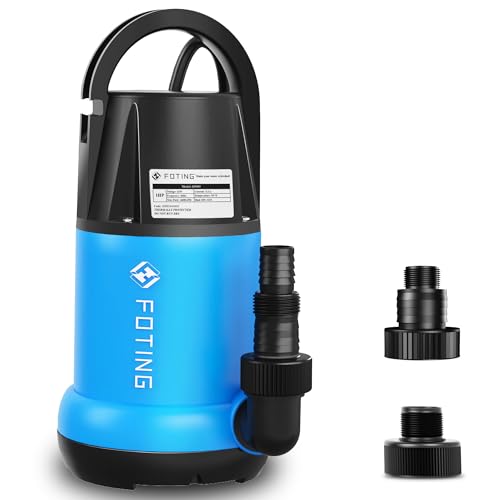
Best for: Pools, ponds, and basements needing robust cleaning and fast water removal. This 1 HP unit delivers up to 4600 GPH at 5 ft with a lift of 31 ft. It handles debris to 1/5 inch and includes a 10 ft cord for flexible placement. The thermoplastic housing is durable and corrosion resistant, with a rounded handle for portability.
Why selected: It combines strong flow with practical features, making it suitable for frequent water transfer tasks around water features and flooded spaces.
Caution: Not designed for continuous pond circulation. Use as a temporary drain pump and flush the impeller after heavy debris to maintain life span.
Wayne CDU800 1/2 HP Sump Pump

Best for: Hefty basement drainage during heavy rain or snowmelt. The CDU800 pumps up to 5100 GPH and uses a cast iron body with stainless steel fasteners for durability in tough sump environments. Its integrated vertical float switch supports automatic operation and minimizes the risk of forgetting to start the pump.
Why selected: High capacity and heavy-duty construction make it suitable for persistent water challenges in busy homes.
Caution: The backup reliability depends on a proper seal around the float switch; ensure the pit is free of dirt that could impede float movement.
Zoeller M53 Mighty-mate
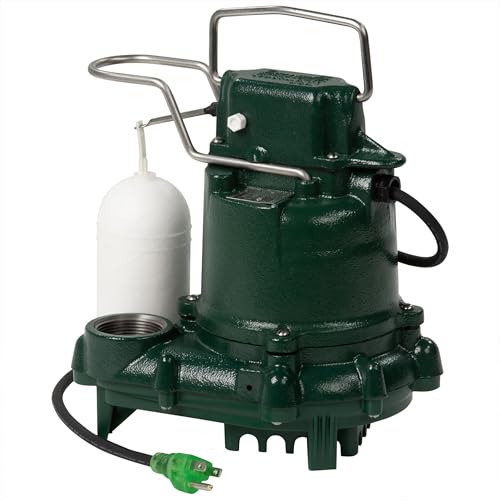
Best for: Automatic basement drainage with reliable, low-maintenance performance. The Zoeller M53 features a float-activated switch, a non-clogging vortex impeller, and a durable housing designed for long life. It’s a compact option for moderate water removal needs where quiet operation matters.
Why selected: Its proven mechanical design supports dependable automatic operation with fewer clogging issues in typical sump pits.
Caution: Flow rate is moderate compared with larger 1 HP units; choose this when space or noise sensitivity is a priority rather than maximum throughput.
Acquaer 1/3 HP Automatic Submersible

Best for: Pool covers, hot tubs, and smaller basement scenarios needing automatic on/off. The Acquaer unit operates automatically when 1-1/2″ of water is detected and shuts off below 1/4″ for energy efficiency. It moves up to 2160 GPH with a bottom suction design that filters debris and maintains stable operation.
Why selected: Automatic control reduces manual intervention, making it convenient for routine pool cover drainage and light basement needs.
Caution: Lower flow rate means it may be less suitable for large-scale floods; ensure the pump fits the expected water volume.
Buying Guide: Key Purchase Considerations
- Flow rate vs. head height: Higher GPH is better for rapid drainage, but consider the vertical lift (head) you need to clear from your pit or area.
- Discharge fittings: Check if the pump includes standard discharge adapters or requires additional fittings (for example, 1-1/4″ NPT with compatible elbows).
- Sump pit debris tolerance: Debris filters and bottom suction help prevent clogs in typical basements or areas with grit.
- Material and durability: Cast iron housings and stainless fasteners offer longevity in tough sump environments; thermoplastic housings are lighter but may be less robust in extreme conditions.
- Automatic vs. manual operation: Float switches enable automatic drainage during rain events or when water collects; manual operation may be preferred for controlled pumping.
- Power cord length: A longer cord (like 10 ft or 25 ft) improves placement flexibility without extension cords, but ensure outlet proximity for safety and efficiency.
- Intended use: Some pumps are designed for continuous drainage, while others are better for occasional use or specific tasks like pool cover drainage.
FAQ
- What is the typical pump capacity I need for a finished basement?
– For average basement floods, look for pumps in the 4000–6000 GPH range with at least 1/2 HP up to 1 HP, depending on water volume and lift height. - Do I need an automatic sump pump?
– Automatic pumps with a float switch reduce manual work by starting when water rises, which is useful during rainstorms or recurring flooding. - Is a cast iron sump pump better than thermoplastic?
– Cast iron offers durability and long life in demanding environments; thermoplastic is lighter and corrosion-resistant but may wear differently under heavy use. - How do I choose based on head height?
– Measure the vertical distance from your pit to the discharge point. Choose a pump whose head rating exceeds that distance for reliable pumping. - Can I use a submersible pump for hot tub drainage?
– Yes, many submersible pumps handle hot tub drainage if they meet the debris and flow requirements, but verify compatibility with your tub’s water temperature and debris level.