
Exploring solar panels for hobby projects opens up affordable, hands-on learning about energy conversion, electronics, and off-grid thinking. The following five panels are compact, beginner-friendly options that work well for DIY experiments, small lighting projects, and educational kits. They are chosen for reliability, simple wiring, and compatibility with low-power devices. This guide highlights key features, practical uses, and how to choose among similar modules for school projects, model making, and home experiments.
| Product | Brand | Power (approx.) | Size | Notes |
|---|---|---|---|---|
| 3Pcs Mini Solar Panel DC 6V | HISUEKIG | 6V 1W per panel | Compact (30cm cable) | Snowproof, windproof; good for weak light and DIY kits |
| AOSHIKE 10Pcs 5V Mini Panels | AOSHIKE | 5V 30mA per panel | 53mm x 30mm each | Sufficient power in full sun; ideal for small projects and lighting |
| Tellegloww 10 Pcs 0.5W 5V Panels | Tellegloww | 5V 100mA per panel | 80mm x 80mm each | High output per panel; easy parallel/series configurations |
| FellDen Micro Solar Panels 5PCS | FellDen | 5V 200mA per panel | 110mm x 60mm each | Good for home lighting and low-power DC devices; includes wires |
| Sunnytech 0.5W 5V Mini Panel | Sunnytech | 5V 100mA | Approximately 80mm x 80mm | Epoxy panel with blocking diode; easy to connect in arrays |
These five options cover a spectrum of hobby-friendly solar cells, from tiny modules designed for educational kits to larger panels suitable for small lighting projects. When selecting panels for a hobby project, consider how much power you need, how you plan to connect multiple panels, and whether the panels perform well in low-light conditions. The following product-by-product sections provide concise use cases, setup tips, and key features to help you decide which modules fit your project goals.
HISUEKIG 3Pcs Mini Solar Panel Kit

The HISUEKIG Mini Solar Panel kit includes three compact 6V panels designed for lightweight DIY projects. Each panel provides approximately 1 watt under favorable conditions, with a 30 cm cable for straightforward integration into small circuits. The polycrystalline design delivers decent efficiency and practical performance in varied weather, making it suitable for educational demos, garden accents, or sensor-powered experiments. The panels are described as snowproof and windproof, which helps during year-round use in outdoor hobby builds. For hobbyists aiming to power small LED arrays, microcontrollers, or standalone sensors, this kit offers a simple, modular entry point.
AOSHIKE 10Pcs Mini Solar Panels
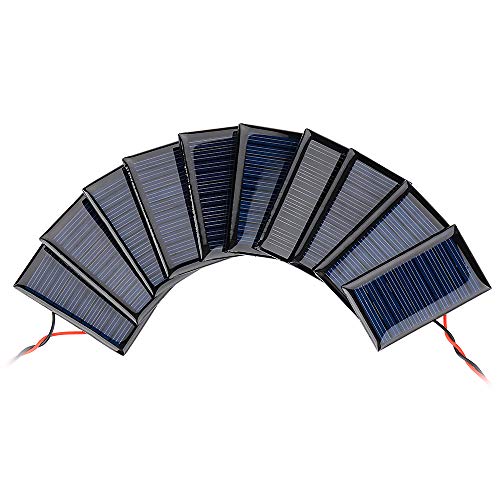
These 10 mini solar panels from AOSHIKE are compact and wired for easy use in small toys, DIY displays, or solar-powered ornaments. Each panel is rated around 5V and 30mA under ideal sun, which supports low-power devices or model projects. The kit is useful for learners building powered models, solar toy projects, or demonstrations showing how sunlight translates to electrical energy. While each panel provides modest current, wired series/parallel configurations can increase overall voltage or current to suit particular project needs. They’re most suitable for light-duty applications and classroom experimentation.
Tellegloww 10 Pcs 0.5W Mini Panels

Tellegloww offers a bulk set of 10 micro solar panels, each rated at 0.5W, 5V, and 100mA. The 80 x 80 mm size balances surface area with portability, making them ideal for compact DIY builds like solar-powered flashlights, pocket notebooks, or small display projects. A standout feature is the two welded wires per panel, which helps ensure reliable connections in projects that require repeated assembly or tinkering. The ability to connect panels in series or parallel provides flexibility to reach higher voltages or currents as your experiment evolves.
FellDen Micro Panels With Wire

FellDen’s kit includes five micro solar panels, each delivering about 5V at 200mA. The panels are designed for compact, low-power applications such as small lighting projects, science demos, or solar-powered water pumps in a miniature setup. Their dimensions (approximately 110mm by 60mm) provide a larger surface area than the tiniest modules, which can translate into better performance in moderate sunlight. Wires are included, simplifying integration into DIY systems and educational kits where hands-on wiring practice is part of the learning objective.
Sunnytech 0.5W Mini Solar Panel Module

Sunnytech’s 0.5W mini panel is built for straightforward DIY projects and classroom demonstrations. It features a blocking diode already installed to prevent overcharging and backflow, which can be helpful for beginners learning how to connect multiple panels in series or parallel. The epoxy resin construction provides durability in wind and light rain conditions, and color-coded wires with alligator clips make experimentation and prototyping easy. This panel is well-suited for powering small sensors, model displays, or educational kits that require a dependable, low-power source.
Buying Guide: Key Considerations for Hobby Solar Panels
Choosing the right solar panels for hobby projects involves balancing power needs, project scale, and ease of use. Here are practical perspectives to consider:
- Power requirements: Evaluate the total voltage and current your project will demand. Small LEDs, sensors, and microcontrollers typically need low current, so many hobby panels are adequate in parallel or with modest boosting strategies.
- Wiring and connectivity: Panels that come with wires pre-attached or welded tabs simplify assembly. Look for two-wire connections for easy series or parallel configurations and reliable mounting options for prototype builds.
- Size and portability: Larger panels harvest more energy but may be less convenient for compact projects. Consider panel dimensions in relation to your device or enclosure.
- Durability under conditions: Weather resistance matters for outdoor experiments. Panels described as snowproof or windproof tend to be more robust for year-round use in hobby environments.
- Low-light performance: Some panels maintain usable output in weaker sunlight, which is helpful for indoor demonstrations or shaded outdoor setups. Check specifications for operation under partial sun.
- Cost and simplicity: For beginners, kits with integrated cables and clear documentation reduce setup time. For advanced builders, modular panels allow more complex array configurations.
- Future expandability: If you plan to scale your project, choose panels that can be easily connected in series or parallel to achieve higher voltages or currents without replacing hardware.
In sum, the recommended five panels provide a range of sizes, outputs, and wiring options suitable for hobbyists exploring solar-powered lights, educational demos, sensor networks, and small DIY devices. When planning your project, map your power budget, confirm available sunlight, and consider the ease of integration with your existing components to maximize learning and results.