
Choosing the right solar panel system for an enclosed trailer involves balancing space, efficiency, durability, and compatibility with storage and use cases. This guide reviews five top options that fit enclosed trailers, RVs, and other mobile setups, highlighting what to look for in panels, controllers, and mounting hardware. Each option includes key specs, what you get, and how it suits compact, travel-ready power needs.
Summary of selected products:
- ECI Power 100W 12V Solar Power Kit with LiFePO4 Battery
- ECO-WORTHY 200W 12V/24V Solar Panel Kit with 30A PWM Controller
- Renogy 200W Monocrystalline RV Solar Kit with Adventurer PWM Controller
- Rvpozwer 200W 18BB N-Type Solar Panel
- Renogy 200W ShadowFlux N-Type Solar Panel
ECI Power 100W 12V Solar Power Kit

The ECI Power kit includes a 100W mono panel, a 12V 20Ah LiFePO4 battery, and a 10A PWM charge controller, along with MC4 cables and mounting brackets. The LiFePO4 battery is rated for high cycle life and robust performance, aiming to handle frequent charging and discharging with stability. This bundle is positioned as an economical option for off-grid trailers and small campers, with a focus on safe lithium power at a consumer-friendly price point. Its components are designed to work together out of the box for straightforward installation.
Key considerations: This setup suits compact trailers where space is at a premium and a balanced light-load solar solution is desired. The 100W panel provides steady daytime charge, while the LiFePO4 chemistry offers deeper discharge capacity and longer overall life compared to some lead-acid options. The included mounting hardware helps simplify installation, but buyers should verify mounting space and weight distribution on their specific trailer model.
ECO-WORTHY 200 Watts 12V/24V Kit

This kit pairs a high-efficiency 200W monocrystalline panel with a 30A PWM controller, designed for RVs, trailers, campers, and other off-grid applications. It emphasizes broad compatibility with 12V and 24V systems and robust performance in varied sun conditions. The panel’s corrosion-resistant frame and weatherized construction are highlighted as long-term durability features, with a recommended daily output in favorable sun conditions. It’s positioned as a solid, mid-to-high power option for trailers needing more daily energy without a complex system.
Key considerations: This package is best for users who expect higher daily energy needs, such as larger batteries or additional devices. The PWM controller is simple and reliable, though not as efficient as MPPT in all conditions. Ensure your trailer roof can accommodate a 200W panel and that the mounting hardware can handle wind loads and mounting surface constraints.
Renogy 200W Adventurer Kit
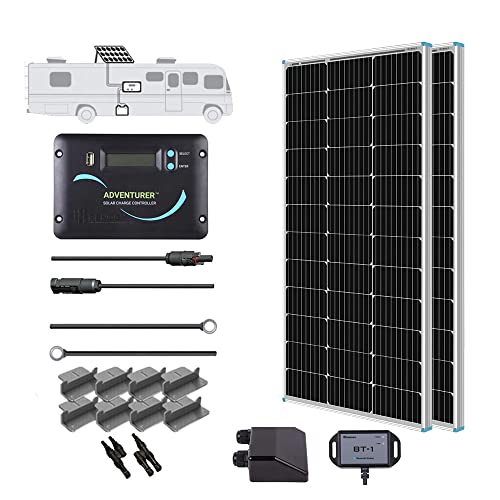
Renogy’s Adventurer 200W kit combines a 200W mono panel with a PWM controller designed for RVs and campers and includes mounting brackets for wall or roof installation. The kit is designed for those wanting a compact, space-conscious setup with a proven brand, offering decent efficiency and a straightforward install process. Rated to withstand outdoor conditions, it can support RV and trailer power needs with a smaller system footprint compared to larger arrays.
Key considerations: The 200W rating is a solid middle ground for mobile applications where roof space is limited. The PWM controller is user-friendly but may be outperformed by MPPT in suboptimal sunlight. For enclosed trailers, ensure enough internal space for the controller and battery, and plan cable routing to minimize energy loss.
Rvpozwer 200W 18BB N-Type Panel

The Rvpozwer 200W panel uses 18BB N-Type technology for enhanced efficiency and durability, delivering up to an estimated 1000 Wh per day under typical conditions. Its N-Type cells offer improved performance with higher resistance to light-induced degradation. The product highlights easy installation through pre-drilled holes for brackets, making it a versatile option for trailers, RVs, and other off-grid applications requiring reliable power in a compact footprint.
Key considerations: This panel is ideal where high efficiency and robust construction are essential. The N-Type technology adds cost but can deliver better performance in partial shade and lower-light days. Plan for compatible charge controllers and mounting hardware, and verify roof space for a single 200W kit along with a battery and necessary cabling.
Renogy 200W ShadowFlux N-Type Panel

Renogy’s ShadowFlux anti-shading technology aims to deliver consistent power even when portions of the panel are shaded by nearby objects. It uses N-Type cells and a compact design to reduce weight and footprint while maintaining high efficiency. This 200W panel is suited for enclosed trailers where shading from equipment, vents, or partial roof obstruction can occur. The anti-shading feature helps optimize output across a range of mounting angles and sun conditions.
Key considerations: Anti-shading tech is beneficial in less-than-ideal sun conditions, but ensure the trailer’s roof layout allows for optimal panel placement to minimize shading. The panel’s efficiency and compact form factor suit smaller trailers or setups where space is at a premium. As with all high-efficiency panels, ensure appropriate cable management and a compatible charge controller to maximize performance.
Buying Guide: Key Purchase Considerations For Enclosed Trailers
- System goals and energy needs: Assess daily energy use, battery capacity, and whether you need to support essential systems (refrigeration, lighting, sensors) or higher power loads.
- Panel power vs. space: Larger panels deliver more power but require roof space and mounting considerations. For enclosed trailers, 100–200W is a common starting point; more for higher consumption or longer off-grid periods.
- Battery chemistry and compatibility: LiFePO4 offers longer lifecycle and stability; ensure the controller is compatible with your chosen battery type and that discharge depth aligns with your use case.
- Charge controller type: PWM is simple and cost-effective; MPPT provides higher efficiency in varied conditions, especially with shading or mixed sun. Choose based on budget and expected conditions.
- Mounting and durability: Look for corrosion-resistant frames, weather sealing, and pre-drilled mounting points for easy installation on trailer roofs or walls. Weight distribution matters for trailer handling.
- Wiring and protection: Plan cable routing to minimize losses. Include fuses, proper gauge conductors, and consider weatherproof enclosures for controllers and connections.
- Expandability: If future power needs grow, choose panels and controllers that can be paralleled or upgraded without replacing the entire system.
- Brand support and warranty: Reliable brands with good customer support and warranties help protect your investment in mobile solar setups.
Overall, the right solar panel system for an enclosed trailer balances available roof space, desired daily energy, and the reliability of components. Selecting a kit with a compatible controller, a robust mounting kit, and durable panels helps ensure steady performance on the road and at camp.