
Car camping thrives when you can rely on clean, quiet power anywhere your adventures take you. This guide highlights five top-performing solar panels that balance lightweight design, high efficiency, and off-grid versatility. Whether you’re topping up a compact power station, charging devices, or running small appliances at a campsite, these options help you stay powered without heavy equipment or noisy generators.
| Product | Brand | Key Strength | Ideal For |
|---|---|---|---|
| Renogy 200W Portable Solar Panel | Renogy | High efficiency, foldable | Off-grid power stations, RVs, SUVs |
| Jackery Explorer 2000 v2 | Jackery | Massive capacity, fast charging | Home backup, extended camping trips |
| Renogy 200W Flexible Solar Panel | Renogy | Flexible, curved surface compatibility | Marine, RVs, cabins on curved roofs |
| Renogy 100W Flexible Solar Panel | Renogy | Lightweight, 25% efficiency | Compact camping setups, vehicle rooftops |
| Ecosonique 200W Portable Solar Panel | Ecosonique Technology | Kickstand design, USB-C PD3.0 | Camping, RVs, power stations |
Car campers benefit from panels that are easy to deploy, rugged enough for outdoor environments, and capable of charging multiple devices or power stations simultaneously. The selections below cover a range of uses—from high-output generators for longer trips to compact, curved-surface panels for irregular vehicle roofs—while emphasizing portability and reliability in outdoor settings.
Renogy 200W Portable Solar Panel

Renogy’s 200W foldable solar panel uses advanced 16BB N-Type cells to achieve up to 25% efficiency, delivering more power from limited space and under cloudy conditions. The panel weighs 13.89 lbs and folds to roughly backpack size, with a magnetic closure that simplifies setup and storage in tight camper spaces. A versatile output kit includes 1 USB-C PD port (45W max) and 2 USB-A ports (18W & 15W), plus MC4 output for charging power stations or 12V systems. This makes it suitable for charging smartphones, tablets, laptops, cameras, and deep-cycle batteries while on the road.
Jackery Explorer 2000 v2 Portable Power Station

The Jackery Explorer 2000 v2 provides a robust energy solution with 2042Wh capacity and up to 2200W of inverter power across three AC outlets. A USB-C PD 100W port enables fast device charging, minimizing downtime at campsites or remote locations. The unit’s Cell-to-Body (CTB) construction yields a compact, stable frame that is easier to transport than many 2kWh competitors. When solar charging is available, users can top up the battery and run essential devices, bringing a balance of portability and endurance to longer outdoor stays.
Renogy 200W Flexible Solar Panel

This 200W flexible panel is designed for curved surfaces, such as marine hulls or RV roofs that aren’t flat. It uses half-cut PERC cell technology for improved light capture and efficiency, with an ultra-lightweight profile that makes transportation and installation easier for campers who value stealth and flexibility. Its flexibility extends installation options on boats, vans, and other non-traditional surfaces where rigid panels won’t fit. The panel’s low-profile form helps reduce wind resistance when mounted on trailers or roof racks.
Renogy 100W Flexible Solar Panel
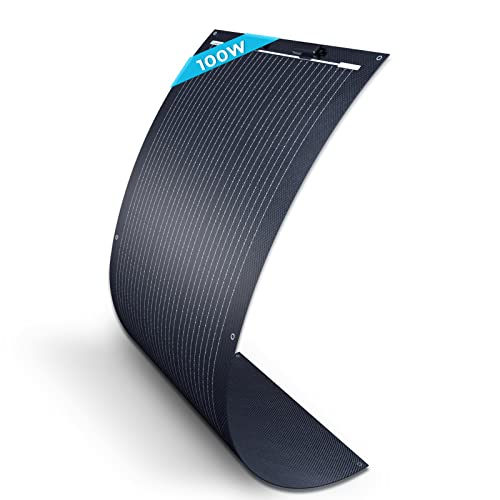
The 100W flexible panel from Renogy brings a compact, lightweight option with 25% efficiency thanks to 16BB N-Type cell technology. It folds easily into portable configurations, making it suitable for smaller camping setups, vans, and RVs with limited space. Its magnetic closure and 240-degree bend tolerance enable versatile mounting, while its USB-A and USB-C output options support charging phones and small devices directly. It’s ideal for campers who want dependable solar input without adding substantial weight to their vehicle setup.
Ecosonique 200W Portable Solar Panel

The Ecosonique 200W panel emphasizes portability with a lightweight 10.6 lb design and a foldable 18″ x 16.3″ footprint. It includes a robust kickstand system and 23.5% efficiency, plus 20V MC4 direct output and multiple cable adapters to suit EcoFlow, Jackery, Bluetti, and other power stations. It also supports USB-C PD3.0 (45W) and USB-A QC3.0 for direct device charging. This configuration is well-suited for campers who need reliable solar charging for laptops, phones, and small tools while keeping setup straightforward and compact.
Buying Guide: Key Purchase Considerations
- Power needs and system compatibility: Match panel wattage to your power station capacity and typical daily energy use. Ensure MC4, USB-C PD, or USB-A outputs align with your devices.
- Portability and weight: For car camping, lighter panels with compact folding designs reduce setup time and vehicle space usage.
- Flexibility and mounting options: Flexible panels excel on curved surfaces; rigid panels with kickstands are easier to set on flat ground or roof racks.
- Durability and weather resistance: Look for IP ratings, tempered glass or protective layers, and robust frames to withstand exposure to sun, rain, and wind.
- Efficiency and area: Higher efficiency panels generate more energy in shaded or partially cloudy conditions, a critical factor when space is limited.
- Charging speed and multi-device support: USB-C PD and multiple USB outputs reduce the need for multiple adapters and allow simultaneous charging of several devices.
- Portability vs. output trade-offs: Larger wattage panels improve energy generation but add weight and bulk—balance needs with vehicle capacity and parking space.
- Maintenance and warranty: Check for product warranties and customer service quality to ensure long-term reliability in varying climates.
These options collectively address common car-camping scenarios: short weekend trips with modest device charging, longer expeditions requiring substantial power for a portable inverter or mini-fridge, and setups with nontraditional vehicle surfaces. Each product emphasizes portability, durability, and practical charging capabilities to fit American outdoor lifestyles.