
Harness reliable, portable solar energy with top-tier solar battery power stations. This guide highlights five leading models, emphasizing capacity, charging speed, expandable options, and overall versatility for camping, emergencies, RVing, and off-grid living. Each option offers LiFePO4 battery chemistry, durable construction, and robust output to power essentials anywhere. Compare features side-by-side and discover which unit best fits your power needs and outdoor lifestyle.
| Product | Brand | Battery | Output | Notes |
|---|---|---|---|---|
| Jackery Explorer 1000 v2 | Jackery | 1070Wh LiFePO4 | 1500W AC / 100W USB-C | 1-hour fast charge |
| Jackery Solar Generator 1000 v2 | Jackery | 1070Wh LiFePO4 | 1500W AC / 100W USB-C | 1-hour fast charge; 10-year lifespan |
| EF ECOFLOW Delta 2 | EF ECOFLOW | 1024Wh LiFePO4 | 1800W AC / 100W USB-C | Expandable to 3kWh |
| Anker SOLIX C1000 | Anker | 1056Wh LiFePO4 | 1800W peak / 2400W surge | UltraFast charging |
| OUPES Mega 1 | OUPES | 1024Wh LiFePO4 | 2000W AC | Expandable to 5kWh |
Jackery Solar Generator 1000 V2 With 200W Panel

The Jackery Solar Generator 1000 V2 combines a 1,500W continuous AC output with a 3,000W surge, enabling safe operation of refrigerators, air conditioners, and high-widelity appliances. Its 1,070Wh LiFePO4 battery offers enhanced longevity and stability, while a compact design at 23.8 lbs simplifies transport for camping, road trips, or emergency readiness. A foldable handle adds portability, and the unit supports fast charging, reaching full charge quickly via the Jackery App’s emergency mode. This model emphasizes safety and endurance with a durable battery designed to retain capacity through thousands of cycles, making it a reliable outdoor power companion.
Jackery Explorer 1000 v2 Portable Power Station

The Explorer 1000 v2 mirrors the performance of its sibling with a 1,070Wh LiFePO4 battery and 1,500W continuous output, supporting 3,000W surge for demanding devices. It features a rapid 1-hour charging option and a refined ChargeShield 2.0 protection system to optimize safety during fast charging. The unit’s sturdiness helps it endure frequent outdoor use, while the long lifespan of the LiFePO4 pack ensures capacity retention after thousands of cycles. This model suits off-grid homes, RV adventures, and extended outdoor stays requiring dependable power availability.
Jackery Solar Generator 1000 v2 With 2x100W Panels

Powered by a next-gen, 1,500W AC output and a robust 1,070Wh LiFePO4 battery, this configuration enhances charging speed and energy throughput, offering faster replenishment and better life cycle management (4,000 cycles, maintaining about 70% capacity). Its 1-hour fast charge is supported by ChargeShield 2.0, delivering safer and smarter energy transfer. The design emphasizes durability, safety certifications, and strong output, making it ideal for mid-size households, campers, and emergency kits requiring reliable energy from a portable source.
EF ECOFLOW Delta 2 Portable Power Station

The Delta 2 delivers 1,024Wh LiFePO4 capacity with 1,800W continuous AC output and 2,000W surge, enabling operation of multiple appliances simultaneously. Its 7x faster charging targets 0-80% in about 50 minutes and 0-100% in roughly 80 minutes when using AC input. Expandable capacity from 1kWh to 3kWh via additional batteries broadens its scope for home backup or extended camping trips. Its modularity and generous port array support diverse devices, from power tools to electronics, with a focus on reliable, scalable power for off-grid use.
Anker SOLIX C1000 Portable Power Station

The Anker SOLIX C1000 focuses on rapid replenishment with UltraFast charging, reaching 80% in about 43 minutes and full charge in under an hour via AC input. Its LiFePO4 chemistry supports up to 3,000 battery cycles over roughly a decade, delivering long-term reliability. A powerhouse with a 2,400W surge capacity supports a wide range of appliances, aided by 11 ports that accommodate diverse devices. This model balances speed, endurance, and versatility for home backup, RV trips, and outdoor excursions requiring quick, dependable power.
OUPES Mega 1 Portable Power Station
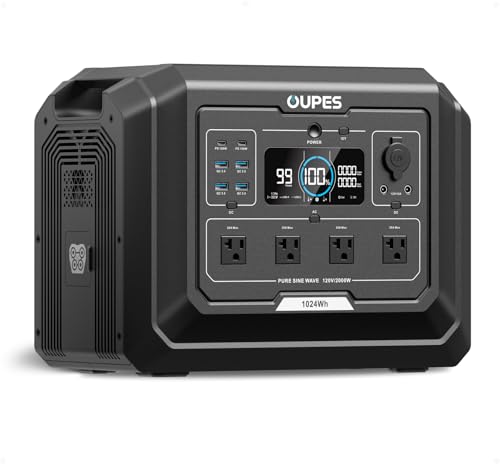
The OUPES Mega 1 packs 1,024Wh LiFePO4 capacity with 2,000W continuous output and a peak of 4,500W, enabling operation of heavy appliances while maintaining a compact footprint. It offers expandability up to 5kWh with additional batteries, addressing larger energy demands for longer off-grid stays or backup power. Two charging speeds include fast options to rapidly top up energy stores, complemented by an UPS mode to protect critical electronics. The Mega 1 emphasizes scalable power for comprehensive home backup and mobile adventures alike.
Buying Guide: Key Purchase Considerations
- Battery chemistry and life: LiFePO4 balances safety, longevity, and weight. Look for units rated for thousands of cycles and minimal capacity loss over time.
- Capacity and output: Choose an energy reserve (Wh) that matches your essential loads. Higher continuous power (W) supports refrigeration, tools, and medical devices, while surge rating matters for startup spikes.
- Charging speed and sources: Fast charging reduces downtime. Consider solar input compatibility, AC charging, and optional expansion packs for larger off-grid needs.
- Portability vs. expandability: Weigh weight and form factor against the ability to add batteries or solar panels for scalable power.
- Safety and certifications: Look for protective features (short-circuit, thermal, overcharge) and certifications that indicate reliable design and safety compliance.
- Use case compatibility: For RVs or off-grid homes, prioritize systems with multiple ports and robust surge capacity. For camping, portability and battery longevity may take precedence.
In summary, each model offers distinct strengths—from rapid charging and high surge support to expandable capacity and rugged endurance. Your choice should align with your typical load profile, travel frequency, and how quickly you want to replenish energy after use. Consider pairing a solar panel kit with your preferred station to maximize independence from grid power and ensure continuous operation during extended trips or emergencies.