
Answering your search for reliable 2-in-1 smoke and carbon monoxide detectors, these picks are chosen for easy use, strong protection, and longevity. They suit homeowners wanting simple, battery-powered alarms, renters needing portable options, and families seeking long-life devices. The table below summarizes the selected models and why they stand out.
| Product | Best For | Why It Stands Out |
|---|---|---|
| First Alert Combination Smoke & CO Alarm, 1-Pack | Budget-conscious single-unit setup | Precision Detection, reliable 2-in-1 protection, end-of-life warning |
| First Alert Combination Smoke & CO Alarm, 3-Pack | Multi-room coverage | Same tech as 1-pack, great value for multiple rooms |
| First Alert SMCO210, 10-Year Sealed Battery | Long-term, low-maintenance protection | 10-year sealed battery, no replacements, easy install |
| Kidde 30CUDR, 4 Pack | Larger homes or multi-room setups | Fast detection, clear visual alerts, built-in warranty |
| X-Sense SC07, 1-Pack (10-Year Battery) | Standalone, long-life display | 2-in-1 protection with a large LCD display, 10-year power |
First Alert 1-Pack Smoke & CO Alarm

The First Alert SMICO100 1-Pack combines smoke and carbon monoxide detection in a compact, battery-operated unit. It uses Precision Detection to reduce nuisance alarms from cooking while providing early warning in a home fire emergency. Best for: individuals or small apartments needing quick, reliable 2-in-1 protection without hardwiring. Limitation: being battery-powered, it requires periodic battery checks and eventual replacement after end-of-life warning.
First Alert 3-Pack Smoke & CO Alarm
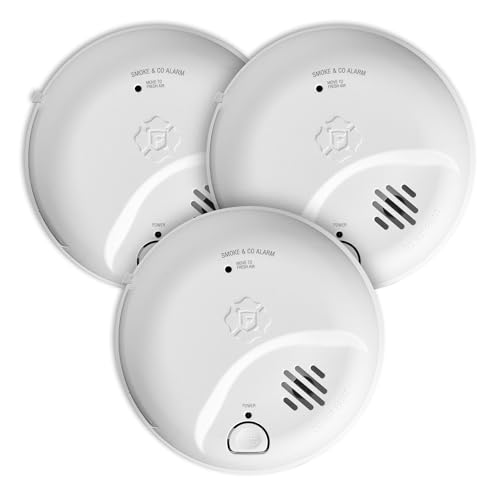
The 3-pack version extends the same Precision Detection and 2-in-1 protection across multiple rooms. Best for: larger spaces or households needing broader coverage with consistent performance. Limitation: still battery-powered; plan for occasional battery checks and eventual replacement after the device’s end-of-life warning.
First Alert SMCO210 10-Year Model

This 10-year sealed-battery model eliminates the need for battery replacements while maintaining 2-in-1 protection. Best for: homes where minimizing maintenance matters and a long, uninterrupted power source is preferred. Limitation: fixed 10-year life means replacement is required at the end of the battery life, regardless of device condition.
Kidde 4-Pack 30CUDR AA Battery Detector

The Kidde 30CUDR 4-pack offers 2-in-1 detection with fast response and 85 dB alarm, plus a red LED light for clear warnings. Best for: larger homes or rental properties needing reliable, multi-room coverage with consistent performance. Limitation: relies on AA batteries; requires periodic battery checks and replacements to keep the alarm functional.
X-Sense SC07 10-Year Battery Alarm

The X-Sense SC07 combines a photoelectric smoke sensor and an electrochemical CO sensor with a 10-year sealed battery and a large LCD display. Best for: households wanting a standalone unit with a clear daily readout of status and long-term power. Limitation: not interconnectable with other alarms; for multi-room interconnection, require models with wireless interconnection such as SC07-W.
X-Sense SC06 5-Pack (Not Interconnected)

The SC06 5-pack provides a basic, standalone 2-in-1 solution with a 10-year battery. Best for: budget-conscious homes needing broad coverage without interconnectivity. Limitation: does not support wireless interconnection or base station links; consider SC06-W for interconnectivity if needed.
Kidde 1-Pack 30CUDR AA Detector

The 1-pack version mirrors the 4-pack model’s 2-in-1 detection and 85 dB alarm with an AA battery. Best for: single-room installation or small apartments needing reliable protection with straightforward maintenance. Limitation: single-unit coverage versus multi-pack configurations.
Buying Guide
Key questions to help you pick the right smoke and CO detector:
- What power option fits my home? Consider 10-year sealed batteries for low maintenance or replaceable AA/AAA batteries for flexibility and lower upfront cost.
- Is 2-in-1 detection preferred? Combining smoke and CO detection reduces the number of devices needed, but standalone smoke or CO detectors may be suitable in specific rooms or for simplicity.
- Do I need interconnection? Interconnected alarms can improve safety by sounding all units when one detects danger. If interconnection is necessary, choose models or families that support wireless linking.
- What is the expected lifespan? Ten-year battery models reduce upkeep but require replacement at end-of-life; replaceable-battery models need periodic battery changes.
- Where should I place detectors? Place bedrooms, living areas, kitchens (to reduce nuisance alarms), and hallways for optimal coverage per local guidelines.
- What about false alarms? Look for models with advanced sensing that minimize cooking or steam-triggered alarms while staying responsive to real threats.
FAQ
- Q: Do these detectors require professional installation? A: Most battery-operated units are designed for DIY installation with minimal tools; always follow the manufacturer’s instructions.
- Q: How long do 10-year batteries last in practice? A: They are designed to last a decade under normal use, but events like frequent alarms may affect battery life.
- Q: Can I interconnect different brands? A: Interconnection usually works within the same brand family or with compatible standards; check product specifications.
- Q: What should I do after a false alarm? A: Confirm the environment (steam, cooking, or smoke), silence if appropriate, and assess placement to minimize nuisance alarms.
- Q: Do these detectors require maintenance? A: Yes, test monthly and replace batteries as required by the model. Ten-year sealed-battery units still require occasional checks of the unit’s status.
- Q: Which detector is best for a large home? A: Models with multi-pack options (like 3-pack or 4-pack sets) and interconnection capability generally provide better coverage for larger spaces.