
Answer: For tight spaces and light to medium-duty tasks, small circular saws offer portable power, precise cuts, and flexible blade options. The top picks below are best suited for DIYers, furniture makers, and hobbyists who need accurate straight cuts in limited spaces without the bulk of full-size models.
The following table highlights five compact circular saws chosen for versatile performance, ease of use, and material variety. Use this as a quick reference to compare who each model best serves.
| Product | Best For | Key Benefit |
|---|---|---|
| Seesii Mini Circular Saw with Laser Guide | DIYers, home renovations | Laser guide, 4 blades for multi-material cuts |
| Skil 5080-01 13-Amp 7-1/4″ Circular Saw | Projects needing power and long cuts | High power, bevel stops for versatile cuts |
| DOVAMAN Circular Saw | Multi-material projects | Six blades included for wood, metal, tile, plastic |
| DEWALT ATOMIC 20V MAX Circular Saw | Cordless convenience | Brushless motor, lightweight, control features |
| GALAX PRO 4Amp Circular Saw with Laser | Compact, budget-friendly cuts | Laser guide, bevel capability, dust adapter |
Seesii Mini Circular Saw With Laser Guide
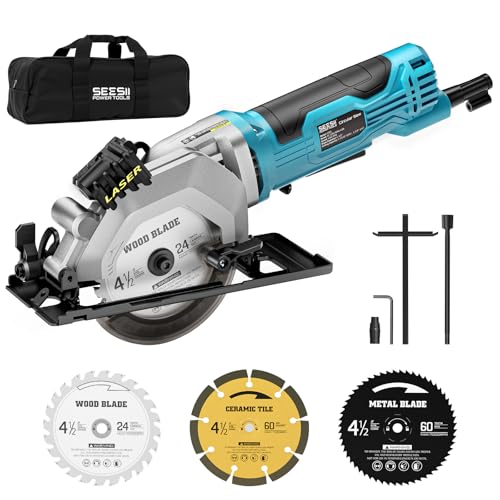
Best for compact setups and beginners who value precision. This 4.8A corded saw delivers up to 4000 RPM and includes a laser guide and multiple blades (TCT, HSS, diamond) for wood, soft metal, tile, and plastic. The integrated dust hose adapter helps maintain visibility, and the rip guide supports straight cuts. This model suits DIYers tackling furniture projects or renovations in tight spaces where a full-size saw would be cumbersome.
Best-use note: The included blades cover a broad range of materials, but users should verify blade compatibility for specific projects and consider additional blades if cutting sensitive materials. Caution: The laser guide requires alignment accuracy for best results, and wear safety eyewear during operation.
Skil 5080-01 13-Amp Circular Saw

Best for power-heavy tasks and longer cuts. The 13-amp motor provides ample cutting power and the saw weighs less than earlier SKIL models, reducing fatigue. A 51-degree bevel with positive stops expands cut capacity for framing and decking. This model is a solid pick for projects requiring more horsepower while maintaining a manageable footprint.
Limitation: It’s not a cordless tool, so you’ll need a nearby power source. Choose this if you prioritize raw power and longer cut performance over portability or battery convenience.
DOVAMAN Circular Saw

Best for multi-material projects and value-conscious buyers. This saw includes six blades (wood, soft metal, tile, plastic), a built-in laser guide, and an edge guide for precise, straight cuts. The metal auxiliary handle and large base improve stability during operation. It’s suitable for dedicated DIYers who switch materials often, such as hobbyists building furniture or installing trim.
Important note: Blade changes are required to switch materials, so plan your workflow to minimize downtime. Best for users who don’t mind swapping blades for different tasks.
DEWALT ATOMIC 20V MAX Circular Saw

Best for cordless convenience and light to medium-duty work. The brushless motor enhances efficiency and runtime, and the tool is designed for one-handed control with a removable auxiliary handle and a hang hook for storage. Ideal for projects where access to power is limited or where mobility matters, such as trim work or paneling on site.
Limitation: Battery power is essential; performance depends on the available charge and battery model. Choose this if you value freedom from cords and plan for battery management and charging time.
GALAX PRO 4Amp Circular Saw With Laser

Best for beginner to intermediate users who want a budget-friendly option with accuracy aids. Equipped with a laser guide, a 4-1/2″ blade, and a vacuum adapter, this compact saw supports precise cuts in wood, PVC, drywall, and similar materials. The included rip guide helps maintain straight lines during long cuts, and the 3/8″ arbor matches common small blades.
Consideration: While affordable, performance may lag on tougher materials. Use this model for lighter tasks or as a starter tool for new DIYers looking to learn layout and accuracy without bandwidth constraints.
Buying Guide
Key questions to guide your choice:
- What will I cut most often? Wood-only tasks favor blades optimized for wood, while mixed-material projects require versatile blade kits.
- Corded or cordless? Corded models deliver consistent power; cordless options offer mobility but depend on battery life and availability.
- Depth of cut and bevel range? A depth capacity of around 1-11/16″ at 90° and bevels up to 45° cover common framing and trim tasks.
- Precision aids? Laser guides, edge/rip guides, and parallel rulers help achieve straight, repeatable cuts in tight spaces.
- Dust management? Dust extraction or vacuum adapters improve visibility and workspace cleanliness.
- Blade compatibility and changes? Check blade size (commonly 4-1/2″ or 4-1/2″ with 3/8″ arbor) and how easy it is to swap blades between materials.
Materials and Use Cases
Woodworking projects often benefit from sharp HSS or carbide blades and stable bases. When cutting tile or plastic, ensure blades are rated for non-wood materials and use protective gear to manage silica dust and debris. For tight spaces, compact models with laser alignment help maintain accuracy without sacrificing maneuverability.
Safety and Setup
Always wear eye and hearing protection. Secure the workpiece and verify the saw’s base sits flush on the cut line. Maintain a clean workspace and ensure dust extraction connections are secure before cutting.
FAQ
- Which small circular saw is best for beginners? The Seesii or GALAX PRO models are good starting points due to built-in guides and lower weight, aiding beginners in learning straight cuts.
- Are laser guides essential? Not strictly essential, but they improve alignment for precise cuts, especially in long or repetitive work.
- Should I choose a corded or cordless mini saw? Choose corded for constant power and steady performance; choose cordless for portability and on-site tasks without a power outlet.
- Can these mini saws cut metal or tile? Some models include blades for soft metal and tile. Always verify blade compatibility and follow safety guidelines for each material.
- What is the typical bevel range? Bevels commonly range from 0° to 45°; some models offer fixed bevel stops for common angles to speed up setup.
- Do they require dust collection? Many compact saws support vacuum adapters to reduce dust and improve cut visibility.