
For homeowners evaluating single-phase solar inverters, reliability, efficiency, and expandability matter. The following picks highlight top performers with built-in MPPT controllers, parallel-connection options, and robust protection features. Each product supports 120V/240V operation and is suitable for off-grid, on-grid, or hybrid setups. The list emphasizes models with strong charging capabilities, solar priority modes, and user-friendly monitoring via apps or WiFi.
| Product | Brand | Key Features |
|---|---|---|
| SUNGOLDPOWER 10000W 48V Solar Inverter (SGPWATT) | SGPWATT | 2 MPPTs, 10000W output, 200A charging, WiFi, 120/240V, parallel capable |
| Aninerel 12000W Hybrid Solar Inverter | Aninerel | 2 MPPTs, 12000W, 48V DC input, 120/240V output, up to 6 units parallel |
| SUNGOLDPOWER 10000W 48V UL1741 (SGPWOSAY) | SGPWOSAY | UL1741, 200A charging, 2 MPPTs, 120/240V, parallel up to 6 |
| POWLAND 12000W Grid-Tied Hybrid Inverter | POWLAND | Grid-tied with anti-backflow, 200A MPPT, 90-500VDC input, up to 72 kW with 6 units |
| LiTime 5000W Solar Hybrid Inverter Charger | LiTime | 100A MPPT, 5000W, UPS-style, 6 units parallel, 120V output |
These selections focus on systems that blend solar harvesting with reliable grid or battery backup capabilities. All units can operate in single-phase or split-phase configurations, feature built-in MPPT controllers, and provide multiple charging modes to optimize energy use. When evaluating solar inverters, consider how many units you might parallel, your battery chemistry, and whether you need grid-tied, off-grid, or hybrid operation.
SUNGOLDPOWER 10000W 48V Inverter (SGPWATT)

The SUNGOLDPOWER 10000W 48V Pure Sine Wave Inverter combines a full 10 kW continuous output with up to 20 kW surge and built-in MPPT solar regulation. It supports 120V/240V split-phase or 120V single-phase output. A WiFi module enables remote monitoring of performance and settings via a smartphone app. Safety features include PV input over-voltage/current protection, AC input protection, battery over-voltage protection, and overload protection. The inverter supports four charging modes: Hybrid Charging, Utility Priority, Solar Priority, and Only Solar, offering flexibility for diverse energy scenarios.
Designed for larger homes or workshops, this model’s parallel capability allows multiple units to combine up to 60 kW or more, providing substantial scalability. It is suitable for off-grid cabins, backup power systems, or on-grid hybrids where solar power must be prioritized without sacrificing appliances’ performance. Consider pairing with a compatible battery bank and solar array that can deliver consistent 500V DC input for best results.
Aninerel 12000W Hybrid Solar Inverter

The Aninerel 12,000W Hybrid Solar Inverter converts 48V DC to 120V/240V AC, delivering 12 kW continuous power and up to 24 kW peak. It features two MPPT solar charging controllers with up to 220A battery charging capacity and supports up to 500V PV arrays. The unit supports parallel connections with up to six inverters, allowing a combined output up to 72 kW. It is designed for reliable on/off-grid operation in residential, RV, cabin, and workshop settings, and supports 220A PV charging for rapid solar energy capture during bright conditions.
Key advantages include fast charging and strong expansion potential for large-scale solar deployments. The parallel capability enables stacking multiple inverters to meet higher load demands or to compensate for panel variations. This model is well-suited for homeowners seeking high power with robust MPPT control and future scalability.
SUNGOLDPOWER 10000W 48V UL1741 (SGPWOSAY)
This SUNGOLDPOWER model mirrors the 10 kW performance with UL1741 certification, ensuring compliance with safety standards. It features built-in 2 MPPT controllers, a maximum 200A battery charging capability, and 120V/240V configurable output. The inverter includes WiFi monitoring and four output modes: Hybrid Charging, Utility Priority Charging, Solar Priority Charging, and Only Solar Charging. It supports parallel operation for higher system power and surge capacity, making it a practical choice for larger solar installations or backup power networks.
With robust protections for PV input, AC input, battery voltage, and overload, this unit helps ensure stable operation even during grid fluctuations. The possibility to mix grid support with solar generation enables more economical energy management for homes with variable sun exposure.
SUNGOLDPOWER 10000W 48V Pure Sine Wave Inverter (SGPWATT) Again
This variant reiterates SUNGOLDPOWER’s 10 kW inverter with built-in MPPT controllers and dual-mode output. It emphasizes four charging/output modes, a broad 500V DC open-circuit voltage, and WiFi connectivity for remote parameter checks. The device is designed to handle heavy domestic loads, with protection features designed to prevent damage from over-voltage, over-current, and over-load situations. Parallel operation remains a core feature for scalable power, making it suitable for larger homes or multi-building properties where uninterrupted power is critical.
POWLAND 12000W Grid-Tied Solar Hybrid Inverter

The POWLAND 12,000W grid-tied hybrid inverter is designed to work with 48V DC input and outputs 120V/240V AC. It features built-in 200A MPPT charge control, and a wide PV input voltage range of 90-500VDC, enabling direct PV-to-AC conversion. A standout feature is the anti-backflow mode, which prioritizes powering loads while exporting excess energy to the grid when available. This model is ideal for larger homes or RV setups where grid-tied backup is essential, while helping to minimize battery use by maximizing solar energy harvest and grid support.
With high efficiency claims and the ability to stack with multiple units, this inverter targets users seeking to reduce battery reliance and improve solar utilization during peak sun hours. Practical considerations include ensuring compatible grid-tied policies and proper wiring for multi-inverter synchronization.
LiTime 5000W Solar Hybrid Inverter Charger
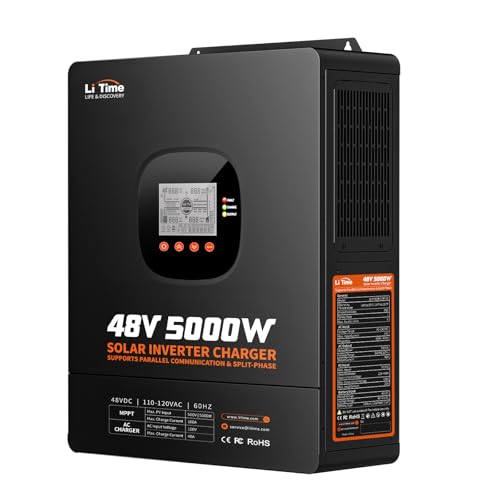
The LiTime 5 kW inverter integrates 100A MPPT, a 5 kW inverter, and a 40A battery charger in a compact form factor. It supports parallel operation with up to 6 units, delivering up to 30 kW in a multi-inverter array. The unit offers a UPS-like experience, switching seamlessly between PV power, battery, and mains as needed. It is compatible with 48V lithium or lead-acid batteries and provides multiple output modes, including Inverter Priority, PV Priority, Utility Priority, and a Mixed Load workflow.
Designed for home backup, off-grid, or farm use, LiTime emphasizes energy management and reliability. The combination of UPS functionality with robust parallel support makes it suitable for households seeking dependable power during outages, while still leveraging solar energy when available.
Buying Guide: Key Considerations For Choosing A Single-Phase Solar Inverter
When selecting a single-phase solar inverter, consider these essential factors to ensure the system meets your needs and remains reliable over time.
- Power rating and surge capacity: Match the continuous output (kW) to your loads, and verify surge capability for motors and compressors.
- MPPT count and PV voltage range: Multiple MPPTs improve harvesting under partial shading; ensure PV input voltage supports your array’s voltage.
- Output configuration: Decide between single-phase 120V, split-phase 120/240V, or 208V three-phase outputs based on home wiring and appliance needs.
- Grid-tied vs hybrid vs off-grid: Hybrid models with battery charging offer backup power, while grid-tied units typically prioritize feeding energy back to the grid.
- Battery charging capability: Look at maximum charging current (A) and supported battery chemistries; higher charging can reduce charging time in sunny conditions.
- Parallel expansion: If you expect growth, ensure the inverter supports multi-unit paralleling with proper phase synchronization.
- Monitoring and connectivity: WiFi apps and remote monitoring help track performance and diagnose issues quickly.
- Protections and certifications: Check for over-voltage, under-voltage, short-circuit, over-current, and UL1741 or equivalent certifications for safety and compliance.
- Physical considerations: Size, heat dissipation, and installation space can influence performance and longevity.
- Warranty and support: A longer warranty and accessible support can reduce ownership risk given the complexity of solar systems.
In summary, the best single-phase solar inverters balance high power output with robust protection, flexible charging modes, and scalable configurations. For larger homes or installations with future expansion, models that support multiple units in parallel offer the most value. For backup power reliability, prioritize units with UPS-like features and smart monitoring to keep critical loads running during outages.