
Direct answer: A high-quality whetstone or honing rod is essential for maintaining the edge on Damascus steel. For beginners, choose a two-sided stone (e.g., 1000/6000 grit) with a stable base and clear angle guides. For professionals, consider ultra-flat CBN or premium high-carbon steel rods for precise edge realignment. This guide highlights five top options to suit different needs and skill levels, helping you keep your Damascus blades razor-sharp.
| Product | Type | Best For | Limitation |
|---|---|---|---|
| Sharp Pebble Premium Whetstone Kit | Whetstone (1000/6000) | Beginner to mid-level users sharpening Damascus and carbon knives | Requires water-based maintenance; base quality varies by model |
| Sharp Pebble Complete Whetstone Kit | Whetstone (1000/6000) with built-in guides | Beginners seeking guided angle control for Damascus blades | Angle guides are fixed; may feel limited for advanced edge work |
| CBN Sharpening Stone (8 inch) | Double-sided CBN (80/180) | Professionals needing ultra-flat surface and fast material removal | Higher price; best used with proper technique |
| SENKEN Tsunami Sharpening Rod | Sharpening rod (emery) with wood handle | Damascus and hard steel touch-ups between sharpening rounds | Not a stone; edge maintenance may require stoning for burrs |
| Monbalcon Honing Rod (10 inch) | Honing rod, high-carbon steel | Everyday realignment of Damascus and kitchen knives | Does not remove metal; limited to honing rather than reshaping edge |
Sharp Pebble Premium Whetstone Knife Sharpening System

- Premium Construction: Aluminum Oxide blend for sharp, consistent cuts.
- Includes double-sided whetstone (#1000 / #6000), bamboo base, angle guide, manual, and ebook.
- Non-slip base reduces movement for safe sharpening.
- Best for beginners and hobbyists sharpening Damascus or carbon steel knives.
Best for: Novices who want a complete, guided kit with minimal setup. Why selected: comprehensive bundle helps maintain Damascus blades with a reliable base and angle control. Caution: Needs proper water lubrication; avoid drying out the stone.
Sharp Pebble Complete Whetstone Knife Sharpening System

- Built-in angle guides with settings (15°, 17°, 20°, 22°) for consistent Damascus sharpening.
- Dense, even 1000/6000 grit stones are forgiving for beginners and precise for experts.
- Stable, non-slip base and water-only use for cleanup and safety.
- Best for: Beginner to mid-level users who want guided sharpening; avoid if you need rapid heavy material removal.
Why selected: The integrated guides reduce guesswork, which is ideal for Damascus knives requiring careful edge restoration. Limitation: Some users may outgrow the fixed guide range as skills advance.
CBN Sharpening Stone – 8 Inch (80/180 Grit)

- Ultra-flat surface (≤0.01mm) suitable for long-edge knives and precise grinding.
- Dual-sided 80/180 grit for coarse shaping and fine refinement of Damascus blades.
- CBN abrasive chosen for stability at high temperatures and long life.
- Best for: Professionals and workshops needing reliable, flat sharpening surfaces.
Why selected: Flatness and dual grit make this ideal for true edge restoration on Damascus steel. Caution: May require learning curves for proper angle control and cooling.
SENKEN Tsunami Professional Sharpening Rod
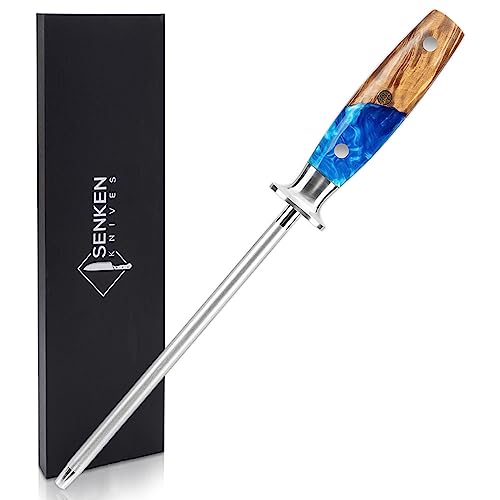
- Incredibly tough emery rod, designed for Damascus and hard steels up to HRC 63.
- Sturdy construction with blue resin and natural wood handle for grip.
- Easy-to-use for quick touch-ups between thorough sharpening sessions.
- Best for: Damascus blades needing precise burr removal and edge realignment. Caution: Not a stone; use alongside a whetstone for best results.
Why selected: A tough emery rod is a practical complement to stone sharpening, providing quick retreats of edge irregularities on Damascus steel. Limitation: Not a replacement for full sharpening or honing with a stone.
Monbalcon Honing Rod (10 Inch)

- German high-carbon steel for precise realignment of Damascus knife edges.
- 10-inch length with ergonomic stainless steel handle and safety guard.
- Realigns edges without removing metal, maintaining blade integrity over time.
- Best for: Regular maintenance between stone sharpening; avoid relying solely on honing for major edge reformations.
Why selected: A professional honing rod supports edge maintenance on Damascus steel, extending stone sharpening intervals. Caution: Does not sharpen by removing metal; use it after initial sharpening on a stone.
HENCKELS Sharpening Steel, 9-Inch

- Maintains knife edges between professional sharpenings.
- Designed for regular use with a comfortable grip for kitchen and BBQ tools.
- Safe, simple honing that supports Damascus blades when used correctly.
- Best for: Everyday kitchen use and quick maintenance of Damascus steel knives.
Why selected: A trusted brand makes routine maintenance straightforward, helping Damascus blades stay ready for cooking tasks. Caution: For heavy edge restoration, combine with proper whetstone sharpening.
Buying Guide: Sharpening Tools for Damascus Steel
What kind of sharpener do I need?
Damascus steel blades benefit from both sharpening stones and honing rods. Stones remove material and reshape edges; rods realign and refine. A two-sided whetstone with an appropriate grit (e.g., 1000/6000) is a versatile starting point, while a flat, durable surface like a CBN stone can support professional edge work.
What grit should I start with?
Begin with a medium grit (around 1000) for Damascus blades with minor dulling. Move to a fine grit (6000) for polishing and burr-free edges. For damaged or deeply dulled blades, start with a coarser grit and gradually progress to finer grits.
Is a base or angle guide important?
Yes. A stable base prevents slippage, and an angle guide helps maintain consistent edge geometry—crucial for Damascus blades with intricate patterns that demand precise sharpening angles.
What about honing rods vs. sharpening stones?
Honing rods are excellent for quick edge realignment and maintenance between full sharpening sessions. Whetstones are essential for restoring a dull edge and reshaping a blade. Use both for best results, especially with high-carbon Damascus steel.
Maintenance tips
- Keep stones damp during use; avoid letting them dry out.
- Clean stones after use and store in a dry place.
- Protect your Damascus blade by developing a regular sharpening schedule based on use.
Quick comparison at a glance
- Best for beginners: Two-sided whetstones with guides for steady progress.
- Best for precise edge work: Flat CBN stone with dual grit.
- Best for quick touch-ups: Honing rods with ergonomic handles.
- Best all-around: Complete sharpening kits combining stones, guides, and bases.
Frequently asked questions
How often should I sharpen Damascus steel knives?
Regular maintenance with honing rods can extend intervals between full sharpenings. Re-sharpen with a whetstone when the edge becomes dull or chipped.
Can I use oil on whetstones?
Water is typically sufficient for the listed stones. Oils may be used on some stone types, but follow manufacturer guidance.
Are Damascus knives compatible with all sharpeners?
Damascus blades vary in steel composition. Use stones and guides designed for high-carbon steel and follow the blade’s care instructions.
What is the advantage of a built-in angle guide?
It helps maintain consistent edge angles, reducing the risk of under- or over-sharpening and protecting the blade’s complex geometry.
Do I need expensive tools to sharpen Damascus blades?
Not necessarily. Start with a reliable two-sided whetstone and a honing rod; upgrade to advanced options if you need higher precision or flatter surfaces.
How do I know I’ve achieved a sharp edge?
Finish with a light pass on the finest grit, test by slicing a sheet of paper with minimal effort and observing a smooth, burr-free edge.