
Find the right sander for beginners with tools that are easy to control, lightweight, and budget-friendly. This guide highlights beginner-friendly sanders that balance power and simplicity, helping new woodworkers achieve smooth finishes without complexity. Each pick is described for the type of user it best serves, from casual hobbyists to aspiring DIY remodelers. The products below are organized to compare grip comfort, dust management, and ease of use, so you can choose confidently.
Summary of chosen products (quick glance):
- SKIL 5” Random Orbital Sander with Cyclonic Dust Box & 3pc Sanding Sheet – SR211601
- SKIL Corded Multi-Function Detail Sander with Micro-Filter Dust Box – SR232301
- WEN 6301 Electric Detailing Palm Sander
- HYCHIKA Detail Sander, 14,000 OPM
- DEKOPRO 5″ Random Orbital Sander with Dust Box
SKIL 5” Random Orbital Sander SR211601 — Best For Versatile Projects

The SKIL SR211601 delivers a 2.8-amp motor with 13,000 orbits per minute for smooth finishes on wood, metal, and coated surfaces. It includes a cyclonic dust box that is easy to empty, helping beginners maintain a cleaner work area. Variable speed control allows adapting power to different materials, making it a flexible option for new hobbyists tackling varied tasks. Best for: beginners seeking a reliable, all-purpose sander with straightforward dust management. Caution: dust bin visibility may require frequent emptying on intensive projects.
SKIL SR232301 Corded Detail Sander — Best For Detail Work
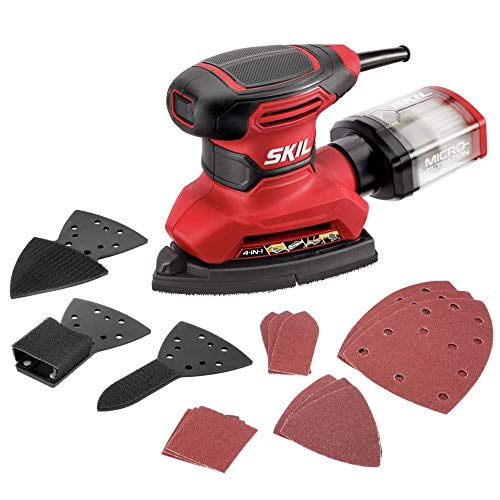
This 4-in-1 detail sander offers a powerful 1.2-amp motor and 13,500 OPM, ideal for tight corners and delicate contours. It includes three extra detail attachments for precision work on edges and curved surfaces. A micro-filtration dust system with a 1-1/4″ dust port helps keep the workspace cleaner when paired with a vacuum. Best for: beginners focusing on trim, cabinetry edges, and small finish work. Caution: tool attachments require occasional alignment to ensure flush contact with surfaces.
WEN 6301 Detailing Palm Sander — Best For Precision

The WEN 6301 features a compact 3.75 x 5.5 inch pad with an angled tip for precise work. A powerful 1-amp motor delivers 13,500 OPM, while its lightweight design (about two pounds) makes it comfortable for extended use. Best for: beginners who need a precise sander for small projects and tight spaces. Caution: smaller pad size may require more passes on larger flat surfaces.
HYCHIKA Detail Sander — Best For Tight Corners

HYCHIKA’s detail sander runs at 14,000 OPM with a 1.6-amp motor, making it suitable for small corners, rust removal, and paint stripping on metal and wood. It ships with 12 sanding sheets (P80, P120, P240) and uses a hook-and-loop system for quick disc changes. Efficient dust collection helps maintain a cleaner workspace. Best for: beginners needing a compact tool for detailed finish work. Caution: performance may be limited on very thick coatings without multiple passes.
DEKOPRO 5″ Orbital Sander — Best For Budget Smoothness

DEKOPRO offers a 2.5A motor with speeds up to 14,000 RPM and six variable speeds plus 16 discs, covering a broad range of light to mid-duty sanding tasks. Its detachable dust bag and improved dust collection help reduce cleanup time. Best for: beginners seeking a budget-friendly option with multiple speed settings. Caution: heavier use can heat the tool; allow cooling between extended sessions.
Buying Guide
What should a beginner look for in a first sander?
- Grip and weight: Lighter tools reduce fatigue and improve control for first-time users.
- Dust management: A built-in dust collection system or bag keeps the work area cleaner and improves visibility.
- Orbital vs detail style: Orbital sanders are versatile for flat surfaces; detail sanders excel in corners and edges.
- Power and speed: A modest motor with adjustable speeds helps adapt to different materials and coatings.
- Disc size and pad shape: 5-inch pads are standard; smaller pads offer precision for tight spaces.
- Ease of disc changes: Hook-and-loop discs speed up swap-outs for beginners.
What type of projects suit beginner sanders?
Flat-surface refinishing on small furniture, cabinet touch-ups, and craft projects are ideal for entry-level sanders. For trim and ornate work, detail sanders offer better precision and control. If you expect frequent dust exposure, prioritize models with effective dust collection and a clear, easy-to-empty bin.
How to choose between corded and cordless options?
Corded sanders provide continuous power suitable for longer sessions, while cordless models offer mobility for projects away from outlets. For beginners, a corded option can reduce battery management distractions and deliver consistent performance across tasks.
Which features matter most for beginners?
- Variable speed control to adapt to materials
- Comfortable handle design and weight balance
- Effective dust collection to keep the workspace clean
- Easy disc change with hook-and-loop or quick-change systems
Quick comparison table
| Product | Best For | Key Benefit | Potential Limitation |
|---|---|---|---|
| SKIL SR211601 | All-around projects | Cyclonic dust box and variable speed | Dust bin fullness may require frequent emptying |
| SKIL SR232301 | Detail work | Three attachments for contours | Smaller surface area requires careful alignment |
| WEN 6301 | Precision in tight spaces | Angled tip pad for accuracy | Pad size limits coverage on large areas |
| HYCHIKA Detail Sander | Tight corners | Multiple sandpaper types included | May perform best with lighter coatings |
| DEKOPRO 5″ Orbital | Budget general use | Six speeds and 16 discs | May overheat with heavy, prolonged use |
FAQ
- Do beginner sanders require a lot of maintenance? Basic maintenance includes keeping the dust port clear and replacing worn sanding discs as needed.
- Is a dust bag as effective as a vacuum attachment? A vacuum-attached dust port can improve dust collection, but a good dust bag is usually sufficient for light projects.
- Which brand offers the best beginner value? Several brands provide solid beginner options; look for models with comfortable grips, easy disc changes, and reliable dust management.
- Can I use any sanding sheet with these sanders? Most listed models use standard hook-and-loop discs sized for 5 inches; verify disc size before purchase.
- Are cordless sanders better for beginners? Cordless offers mobility but may limit run-time; for beginners, a corded model often provides steadier power.
- How important is speed control for beginners? Variable speed helps tailor aggressiveness to materials, reducing the risk of gouging or burn marks.