
Answering the common buyer question: which professional orbital sanders deliver reliable performance across wood, metal, and composite surfaces? This guide highlights five solid options, each suited to different workstyles—from pros needing corded power to builders favoring cordless convenience or pneumatic efficiency. The top picks balance power, dust control, and user comfort, with notes on ideal applications and potential limitations. Use the quick reference table to compare core specs at a glance.
| Product | Type | Best For | Key Benefit |
|---|---|---|---|
| SKIL SR211601 | Corded, 5” | General carpentry and finishing | Cyclonic dust box and variable speed |
| DEWALT DWE6423 | Corded, 5” | Precision sanding with vibration control | Counterweight design reduces vibration |
| BOSCH ROS20VSC | Corded, 5” | Dust collection and easy disc changes | Vacuum-assisted dust collector |
| DEWALT DWE6421K | Corded, 5” | Heavy-duty woodworking and shaping | 12,000 OPM and compact profile |
| DEWALT DCW210B | Cordless, 5” | Remote or ladder work and overhead sanding | Brushless motor with variable speed |
SKIL 5” Random Orbital Sander with Cyclonic Dust Box

Features include a 2.8-amp motor delivering up to 13,000 orbits per minute, helping achieve smooth finishes across various wood and composite surfaces. The integrated cyclonic dust box keeps work areas cleaner and the transparent container allows quick checking of dust capacity. Variable speed control provides the right amount of power for different materials.
Best for: General carpentry and finishing tasks where a budget-friendly, reliable corded sander is preferred. This model suits beginners to mid-level users who want straightforward dust management and speed control. Caution: The dust container is transparent but users should regularly empty to maintain suction efficiency.
DEWALT DWE6423 5-Inch Random Orbit Sander

Powered by a 3-amp motor delivering 8,000–12,000 OPM and a separate counterweight design, this sander emphasizes reduced vibration for improved comfort during extended use. A dust-sealed switch helps protect internal components from dust ingress, extending tool life when used in dusty environments.
Best for: Professionals who need lower vibration for long sanding sessions and a robust dust-preserving design. Choose this if you frequently work on larger panels and require steadier control. Limitation: Slightly heavier compared to ultra-compact palm sanders.
BOSCH ROS20VSC Palm Sander with Vacuum Dust Collector

Equipped with a variable speed dial and a vacuum-assisted dust collection system, this sander is designed for efficient dust management and versatile finishing. The hook-and-loop disc attachment makes disc changes quick, and the system helps keep the workpiece clean for a smoother finish.
Best for: Pros needing a solid dust-collection solution combined with easy disc changes for frequent material switching. Limitation: Vacuum compatibility is dependent on the chosen vacuum system, which may require an additional attachment in some setups.
DEWALT DWE6421K 5-Inch Orbital Sander Kit
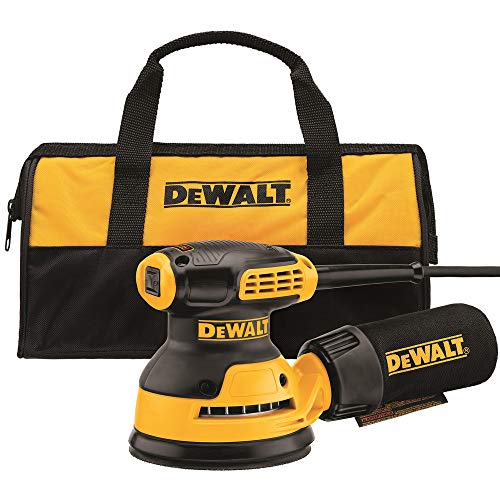
This kit features a 3.0-amp motor capable of up to 12,000 OPM and a shorter height to help users reach tight spaces. The separate counterweight design reduces vibration for comfortable operation over longer sessions, making it suitable for precise shaping and detailing work.
Best for: Woodworkers who need close-to-workpiece access and a compact profile for edging and trim work. Caution: Higher OPM might demand more careful material handling to avoid gouging on softwoods.
DEWALT DCW210B 20V MAX Orbital Sander (Tool Only)

A cordless option with a brushless motor delivers efficient runtime and performance. Variable speed control ranges from 8,000 to 12,000 OPM to adapt to different applications. A low-profile height helps users keep the pad close to the work surface for precise sanding, especially in tighter spaces or overhead tasks.
Best for: Teams or job sites needing mobility and overhead access without a power cord. Limitation: Battery life and charging considerations may affect sustained heavy use on larger projects.
Buying Guide: Key Considerations for Choosing a Professional Orbital Sander
- Power vs. weight: Corded models typically offer consistent power without battery constraints; cordless options trade duration for mobility. Pick according to project length and mobility needs.
- Orbital action and speed range: Higher OPM provides faster material removal but may impact finish quality on soft woods. Variable speeds help tailor performance to material type.
- Dust management: Dust collection is critical for visibility and air quality. Decide between built-in cyclone boxes, vacuum-assisted collectors, or bagless options.
- Vibration control: Counterweight designs and low-vibration handles reduce fatigue in long tasks. Consider ergonomic features if you sand all day.
- Disc attachment: Hook-and-loop (Velcro) discs enable quick changes. Ensure compatibility with standard 5-inch discs and dust collection integration.
- Applications and finishing quality: For fine finishes, look for models with stable sanders, even orbit patterns, and low swirl potential.
FAQ
- What is the advantage of a variable-speed orbital sander? – It lets you match sanding aggressiveness to the material, reducing the risk of gouging and producing smoother finishes.
- What should I consider for dust management? – Look for a system that suits your shop layout, whether built-in dust boxes or vacuum-assisted collectors for cleaner work surfaces.
- Is a cordless sander suitable for heavy-duty work? – Cordless options offer mobility but may require battery swaps for long sessions. For continuous use, corded models are often more reliable.
- Which sander is best for beginners? – A model with a comfortable grip, low vibration, and straightforward dust collection is ideal for new users learning control and finish quality.
- How important is disc attachment type? – Hook-and-loop discs enable fast disc changes, reducing downtime during multi-step projects.
- Can I use a sander for metal surfaces? – Some sanders are designed for metal or composites; always verify the tool’s suitability for non-wood materials in the product specs.